If you want to build stronger glutes without relying entirely on heavy weights, glute drive bands can be a surprisingly versatile training tool. They add resistance to movements such as hip thrusts, glute bridges, squats, lateral walks, and kickbacks while making it easier to train at home or while traveling.
The key is using them correctly. A resistance band won’t automatically make an exercise effective. Band placement, resistance level, range of motion, tempo, and technique all determine how much work your glutes actually perform.
This guide explains what glute drive bands are, how they work, which exercises pair well with them, how to choose the right resistance, and how to build a practical glute-focused workout.
Suggest Reads: Compact Hip Thrust Benches vs. Glute Drive Bands
Table of Contents
What Are Glute Drive Bands?
Glute drive bands are resistance bands designed to increase tension during lower-body exercises that target the glute muscles. They are commonly used around the thighs, above the knees, or around the ankles to create outward or lateral resistance.
Unlike traditional free weights, bands create resistance through elastic tension. The farther a band stretches, the more tension it generally produces.
The term “glute drive” can also refer to training focused on producing force through the hips. When bands are incorporated into exercises such as hip thrusts or bridges, they can encourage you to actively push the knees outward and maintain tension throughout the movement.
Why do bands work the glutes?
Your glutes are involved in several important hip movements, including:
- Hip extension
- Hip abduction
- External rotation
- Stabilization of the pelvis and hip
A resistance band can make these movements more challenging by adding tension that your muscles must control.
For example, placing a loop band above your knees during a hip thrust creates outward resistance. Instead of simply extending your hips upward, you also have to resist the band pulling your knees inward.
That combination can make a familiar exercise feel considerably different.
Glute Drive Bands vs. Traditional Resistance Bands
Not every resistance band is equally convenient for glute training.
| Band type | Best use | Main advantage |
|---|---|---|
| Mini loop band | Glute activation, squats, bridges | Compact and easy to position |
| Fabric loop band | Hip thrusts, lateral walks | Comfortable and less likely to roll |
| Long resistance band | Kickbacks, assisted movements | Greater exercise variety |
| Tube band with handles | Standing exercises | Easy grip for upper and lower body |
| Heavy loop band | Advanced lower-body training | High resistance potential |
For most glute-focused workouts, mini loop or fabric loop bands are the easiest starting point.
What Muscles Do Glute Drive Bands Target?
Glute-focused resistance band exercises primarily train the three gluteal muscles.
Gluteus maximus
The gluteus maximus is the largest glute muscle and plays a major role in hip extension.
It contributes strongly during:
- Hip thrusts
- Glute bridges
- Squats
- Lunges
- Step-ups
Gluteus medius
The gluteus medius sits on the outer portion of the hip. It helps move the leg away from the body and contributes to hip and pelvic stability.
Band exercises such as lateral walks and standing abductions can emphasize this function.
Gluteus minimus
The gluteus minimus is a smaller muscle located underneath the gluteus medius. It also contributes to hip abduction and stabilization.
Supporting muscles
Depending on the exercise, resistance bands can also challenge your:
- Quadriceps
- Hamstrings
- Hip flexors
- Calves
- Core
- Hip stabilizers
That makes glute bands useful for more than simply “burning” the glutes.
Best Glute Drive Band Exercises
You don’t need dozens of exercises to create an effective workout. A small selection of movements can cover hip extension, abduction, and single-leg stability.
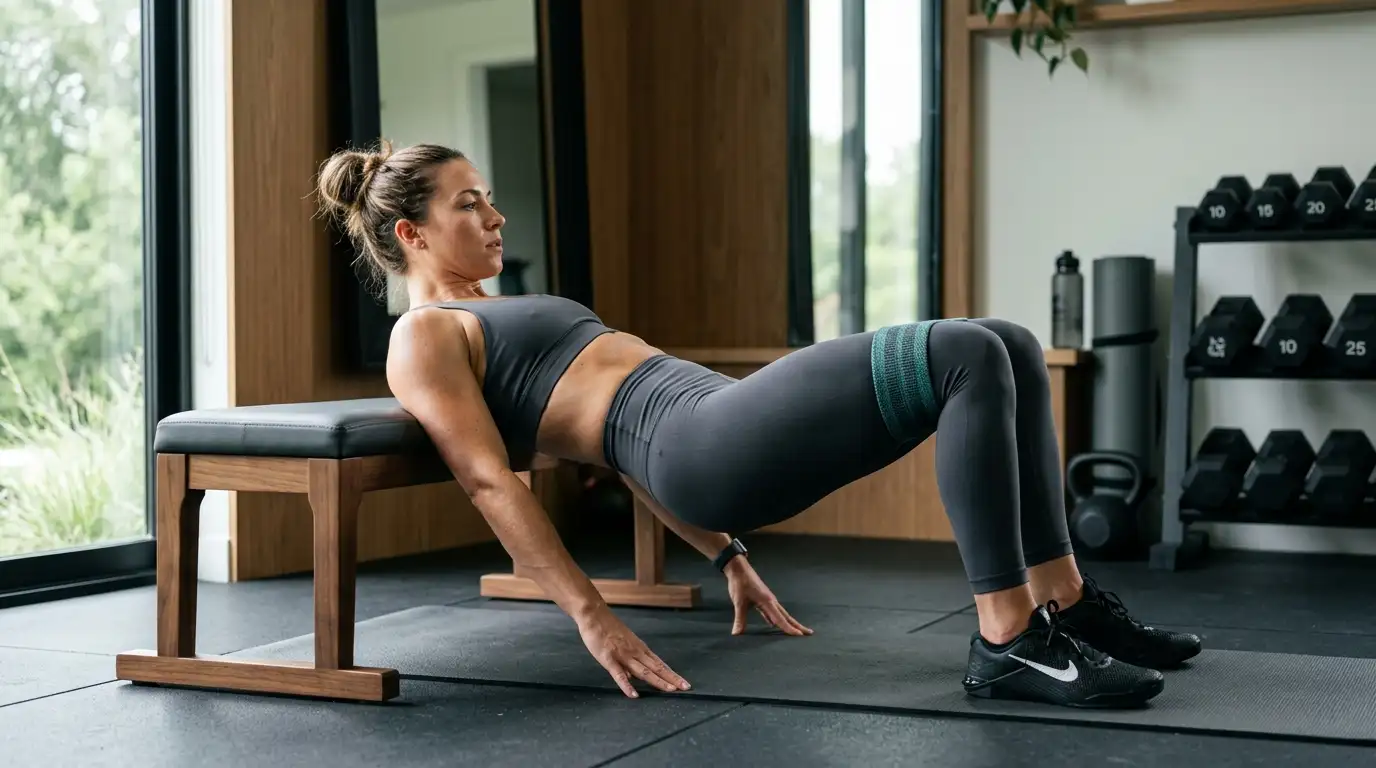
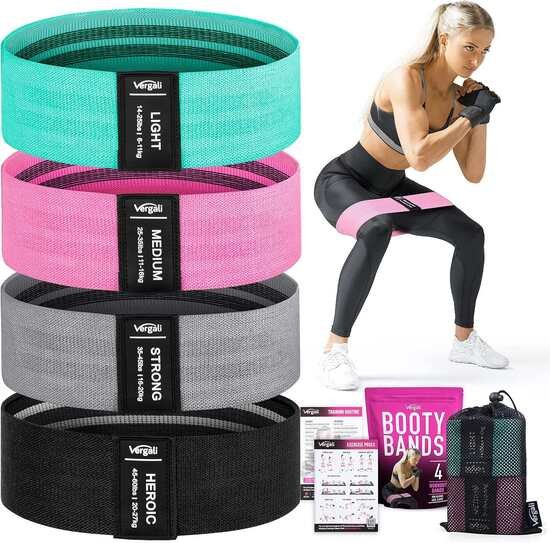
1. Banded Hip Thrust
The hip thrust is one of the most useful exercises for training hip extension.
How to do it:
- Place a loop band above your knees.
- Sit with your upper back supported against a stable bench or couch.
- Position your feet approximately hip-width apart.
- Drive through your feet and lift your hips.
- Keep your knees tracking outward against the band’s resistance.
- Squeeze your glutes at the top.
- Lower under control.
Don’t hyperextend your lower back to get higher. The goal is controlled hip extension rather than simply lifting the hips as far as possible.
Pro tip: Start with a lighter band if the resistance causes your knees to collapse inward or changes your technique.
2. Banded Glute Bridge
The glute bridge is a simpler alternative that works well for beginners and home workouts.
Lie on your back with your knees bent and feet flat on the floor. Place the band above your knees.
Push through your feet, lift your hips, and maintain outward pressure against the band.
Pause briefly at the top before lowering.
3. Banded Squat
Place the band above your knees and perform a controlled squat.
The band encourages you to maintain tension through the hips while you descend and stand.
However, don’t exaggerate the movement by forcing your knees excessively outward. Your knees should remain aligned with your feet.
4. Lateral Band Walk
This is one of the classic glute band exercises.
Technique:
- Place the band around your thighs or ankles.
- Bend slightly at your hips and knees.
- Take controlled steps sideways.
- Keep tension on the band throughout the movement.
- Avoid letting your feet snap together between steps.
The goal isn’t to take huge steps. Small, controlled movements often make it easier to maintain consistent tension.
5. Banded Kickback
Attach or position a suitable resistance band around your legs and extend one leg backward while keeping your torso stable.
Think about moving from the hip rather than swinging the entire leg.
Avoid arching your lower back to create extra range of motion.
6. Standing Hip Abduction
Stand tall and move one leg sideways against the band’s resistance.
This exercise emphasizes hip abduction and can be useful as part of a warm-up or accessory workout.
7. Banded Romanian Deadlift
Long resistance bands can be used for a banded hinge movement.
Stand on the band, hold the other end, push your hips backward, and return to standing by driving the hips forward.
This variation can train the posterior chain, including the glutes and hamstrings.
A Simple Glute Drive Band Workout
You can combine several exercises into a short lower-body session.
| Exercise | Sets | Reps |
|---|---|---|
| Banded hip thrust | 3 | 10–15 |
| Banded squat | 3 | 10–15 |
| Lateral band walk | 3 | 10–15 steps each direction |
| Banded kickback | 2–3 | 12–15 each side |
| Glute bridge | 2–3 | 12–20 |
Rest as needed between sets.
The correct resistance should make the final repetitions challenging while allowing you to maintain good technique.
How to Choose the Right Glute Band Resistance
Choosing a band based only on its color isn’t reliable because manufacturers use different color systems and resistance ratings.
Instead, judge the band by how it feels during the exercise.
Beginners
Start with light or moderate resistance.
You should be able to perform the movement smoothly without compensating with your lower back, hips, or shoulders.
Intermediate users
A medium or heavier band may be appropriate when lighter resistance no longer provides enough challenge.
Advanced users
You can use heavier bands or combine bands with weights.
For example:
Hip thrust + resistance band + dumbbell
can provide both external load and lateral resistance.
The important principle is progressive overload. If an exercise becomes consistently easy, you need some form of progression.
How to Progress With Glute Drive Bands
You don’t necessarily need a heavier band every week.
You can progress by:
- Increasing repetitions.
- Increasing resistance.
- Adding sets.
- Slowing the eccentric phase.
- Adding a pause at peak contraction.
- Increasing range of motion when appropriate.
- Moving from bilateral to unilateral exercises.
- Combining bands with free weights.
A useful progression might look like this:
Week 1: 2 sets × 12 reps
Week 2: 3 sets × 12 reps
Week 3: 3 sets × 15 reps
Week 4: Increase resistance and return to 10–12 reps
This isn’t a mandatory formula, but it illustrates how you can make band training progressively harder.
Can Glute Drive Bands Build Muscle?
Yes, resistance bands can contribute to muscle growth when the training provides sufficient resistance and is performed consistently.
The important factor isn’t whether the resistance comes from a band or a dumbbell. Your muscles need an appropriate training stimulus, adequate recovery, and sufficient nutrition.
However, bands have limitations.
As you become stronger, certain band-only exercises may eventually become difficult to progress. At that point, combining bands with dumbbells, barbells, machines, or other forms of resistance can give you more loading options.
The bigger lesson
Don’t judge a glute workout by how much it burns.
A strong “burn” can indicate that a muscle is working, but it isn’t by itself proof that you’re getting an optimal muscle-building stimulus.
Focus instead on:
- Increasing training difficulty
- Maintaining good technique
- Getting enough recovery
- Progressing over time
- Training consistently
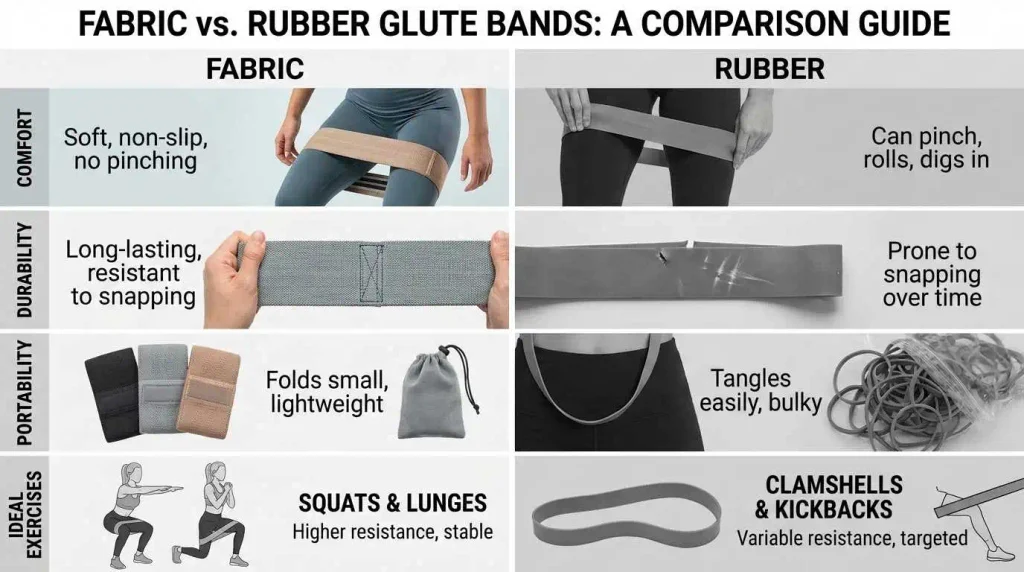
Fabric vs. Rubber Glute Bands
One of the most practical decisions is choosing between fabric and rubber.
Fabric bands
Fabric bands are often comfortable against the skin and can feel secure during movements such as lateral walks and hip thrusts.
They may also feel less prone to rolling than some thin rubber bands.
Rubber bands
Rubber or latex bands are highly flexible and available in many resistance levels.
They’re often versatile and easy to pack.
The downside is that some users find thinner rubber bands uncomfortable or prone to rolling during certain exercises.
Which should you choose?
If comfort and stability are your priorities, a fabric glute band may be appealing.
If you want maximum versatility and easy storage, a rubber loop band can be an excellent option.
Neither material automatically produces better results. The best choice is the band you’ll use consistently and correctly.
Common Glute Band Mistakes
Using too much resistance
A band that’s too heavy can cause your technique to deteriorate.
If your knees collapse inward, your torso shifts excessively, or you’re using momentum, reduce the resistance.
Placing the band incorrectly
Above the knees is a common position, but the ideal placement depends on the exercise and the band’s design.
Always follow the manufacturer’s instructions when available.
Taking oversized steps
During lateral walks, giant steps can make it difficult to maintain tension and control.
Smaller steps are often more effective.
Chasing the burn
A burning sensation isn’t the goal.
Good technique and progressive training matter more than making an exercise feel uncomfortable.
Never progressing
Doing the exact same band workout indefinitely can limit your results.
Your training should become gradually more challenging as your strength improves.
Are Glute Drive Bands Good for Home Workouts?
They’re particularly useful for home training because they’re:
- Lightweight
- Portable
- Easy to store
- Relatively inexpensive
- Suitable for small spaces
- Compatible with many exercises
You can keep a band in a drawer or travel bag and perform a meaningful lower-body session without a large home gym.
For people with limited space, a few bands can provide considerably more exercise variety than their size suggests.
Glute Bands for Warm-Ups vs. Strength Training
One common mistake is treating every band session as an activation routine.
Light resistance bands can work well before a workout, especially for practicing movement patterns and warming up the hips.
But bands can also be used as genuine resistance-training tools.
The difference is largely intensity and programming.
A light band used for 15 easy repetitions is not equivalent to a challenging set performed close to muscular fatigue.
A practical approach
Use lighter resistance for warm-ups and movement preparation.
Use appropriately challenging resistance for your main training sets.
That distinction makes your workout much more purposeful.
How Often Should You Train Your Glutes With Bands?
Your ideal frequency depends on your overall training program, intensity, recovery, and experience.
For many people, two to three lower-body sessions per week can provide a practical framework, provided there is appropriate recovery between challenging sessions.
You don’t need to train your glutes hard every day.
If your glutes remain significantly fatigued or sore, give them more recovery before another demanding session.
Glute Drive Bands: Quick Decision Guide
| Your goal | Best approach |
|---|---|
| Beginner home workout | Light-to-medium loop band |
| Glute activation | Light band + controlled reps |
| Muscle building | Challenging band + progressive overload |
| Travel workouts | Compact fabric or rubber loop |
| Advanced strength | Heavy band combined with weights |
| Hip stability | Lateral walks and abduction work |
| Posterior-chain training | Band hinges, bridges and hip thrusts |
Key Takeaways
- Glute drive bands are versatile tools for lower-body resistance training.
- Loop bands work particularly well for hip thrusts, bridges, squats, and lateral walks.
- The gluteus maximus, medius, and minimus can all be trained with appropriate exercises.
- More resistance isn’t always better; technique should remain controlled.
- Progress by increasing resistance, repetitions, sets, tempo, or exercise difficulty.
- Fabric and rubber bands both have useful advantages.
- A burning sensation isn’t the same thing as an effective workout.
- Bands can support muscle growth when training is sufficiently challenging.
- Combining bands with free weights can provide more progression for stronger lifters.
- Consistency, progressive overload, and recovery matter more than the equipment itself.
Frequently Asked Questions
Are glute drive bands effective?
Yes. Resistance bands can make exercises such as hip thrusts, bridges, squats, and lateral walks more challenging. Their effectiveness depends on appropriate resistance, technique, progressive overload, and consistent training.
Can I build bigger glutes with resistance bands?
You can build and strengthen your glutes with resistance bands, particularly when the exercises provide sufficient challenge and become progressively harder. As you become stronger, adding weights can provide additional loading options.
Should I put a glute band above or below my knees?
For many exercises, placing a loop band above the knees is a practical starting position. The ideal position depends on the movement and band design, so follow the manufacturer’s guidance when applicable.
Are fabric glute bands better than latex bands?
Not necessarily. Fabric bands can be comfortable and stable, while latex bands offer flexibility and a wide range of resistance levels. Choose based on comfort, exercise selection, durability, and personal preference.
How long should a glute band workout be?
A focused workout can take around 20–40 minutes, depending on the number of exercises, sets, rest periods, and whether you’re combining bands with other equipment.
Can I use glute bands every day?
You can use light band movements frequently, but challenging resistance training requires recovery. If you’re training the glutes hard, avoid assuming that daily training will automatically produce better results.
Do glute bands help with squats?
Yes. A properly positioned band can add resistance around the hips and encourage controlled knee alignment. It should complement good squat technique rather than force the knees excessively outward.