
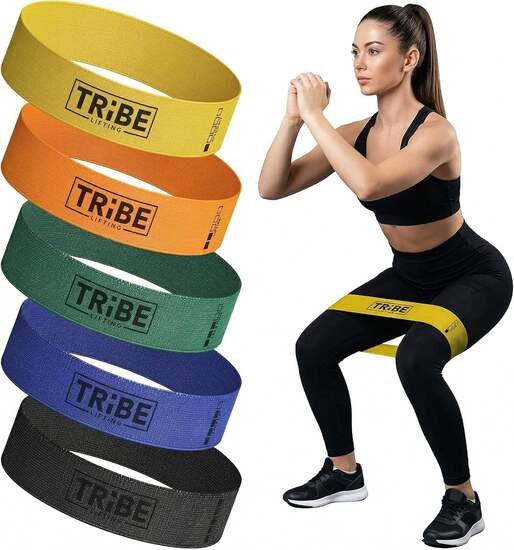
Fabric booty bands, also called glute bands, have become a popular tool for lower-body workouts because they add resistance without requiring a full home gym. Unlike traditional latex resistance loops, fabric bands are typically made from woven elastic material with a wider surface that sits around the thighs, calves, or ankles.
The best fabric booty bands can make exercises such as squats, hip thrusts, glute bridges, lateral walks, and kickbacks more challenging while remaining compact enough to keep in a gym bag or drawer.
But not every glute band feels the same. Band width, resistance level, elasticity, grip, construction, and sizing all affect how useful—and comfortable—a band will be during training.
This guide explains how fabric booty bands work, which exercises they are best for, how to choose the right resistance, common mistakes to avoid, and how to build an effective glute workout around them.
Table of Contents
What Are Fabric Booty Bands?
Fabric booty bands are short, closed-loop resistance bands designed primarily for lower-body exercises. They are usually made from elastic fabric, often with reinforced stitching, and provide external resistance as you move your legs apart or extend your hips.
The band creates tension when stretched. Your muscles must then work against that tension to control the movement.
In simple terms: a fabric booty band is a loop of elastic resistance material that adds progressive tension to exercises such as squats, bridges, hip thrusts, and lateral walks.
Unlike long resistance bands, booty bands are specifically designed to stay around the legs rather than being held in the hands or anchored to furniture.
Fabric vs. Latex Glute Bands
The biggest difference is the material.
| Feature | Fabric Booty Bands | Latex/Rubber Bands |
|---|---|---|
| Feel | Soft and textile-like | Stretchy and rubbery |
| Skin comfort | Usually comfortable | Can pinch or pull body hair |
| Rolling | Generally less likely | May roll during movement |
| Grip | Often strong due to woven texture | Can become slippery with sweat |
| Portability | Excellent | Excellent |
| Durability | Often highly durable | Can deteriorate with age or heat |
| Resistance feel | Usually firm and controlled | Often provides a different stretch profile |
| Best use | Lower-body resistance training | Versatile resistance training |
Neither material is automatically better for everyone. The ideal choice depends on your exercises, comfort preferences, and desired resistance.
What Do Fabric Glute Bands Do?
Fabric glute bands increase resistance during lower-body movements.
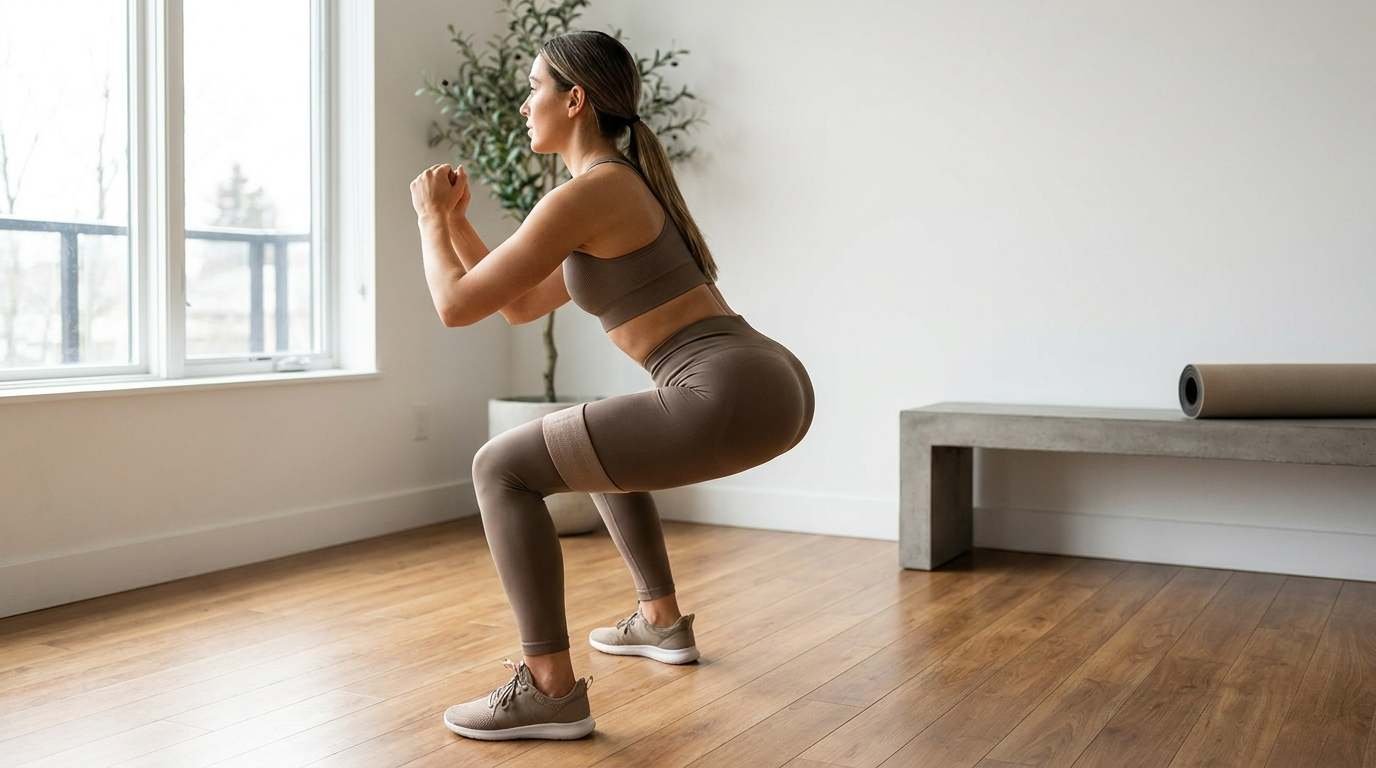
When you place a band above your knees during a squat, for example, the band encourages your legs to move inward. You must actively push against that tension to maintain your desired position.
This can make relatively simple bodyweight exercises more demanding.
Fabric bands are particularly useful for:
- Glute activation exercises
- Hip-strengthening movements
- Lower-body workouts
- Warm-ups
- Home workouts
- Travel workouts
- Strength-training accessories
- Exercise progressions
- Adding resistance to bodyweight exercises
One important distinction: a glute band doesn’t magically isolate your glutes. Your results depend on exercise selection, technique, resistance, training volume, recovery, and overall programming.
Benefits of Fabric Booty Bands
1. They Add Resistance Without Heavy Equipment
A fabric band can increase exercise difficulty without requiring dumbbells, barbells, or machines.
That makes it useful for people training at home, traveling, or building a minimalist workout setup.
A single band can turn a basic glute bridge into a more challenging movement without taking up much space.
2. They Are Easy to Carry
Fabric glute bands are small enough to fit inside most gym bags and luggage.
For travelers, this is particularly useful because a band can provide resistance training when access to a gym is limited.
3. They Work Well for Lower-Body Exercises
The loop design is particularly convenient for movements involving the hips and legs.
Common exercises include:
- Banded squats
- Glute bridges
- Hip thrusts
- Lateral band walks
- Monster walks
- Standing abductions
- Kickbacks
- Clamshells
- Romanian deadlift variations
- Banded lunges
4. They Can Improve Exercise Awareness
A band provides immediate physical feedback.
During a lateral walk, for example, you can feel when the band loses tension. That feedback can encourage more deliberate movement instead of simply moving through repetitions.
5. They Offer Convenient Workout Progressions
You can progress an exercise by:
- Increasing band resistance
- Increasing repetitions
- Increasing sets
- Slowing the eccentric phase
- Adding pauses
- Increasing range of motion
- Combining the band with weights
This makes fabric bands useful even after basic bodyweight exercises become easier.
Are Fabric Booty Bands Good for Building Glutes?
Yes, fabric booty bands can contribute to glute development, but they should be viewed as resistance-training equipment rather than a shortcut to bigger glutes.
Muscle growth requires sufficient training stimulus and recovery. A band can provide that stimulus when the resistance is challenging enough and the exercises are performed with appropriate volume and technique.
For someone new to resistance training, a band may provide plenty of challenge. For an experienced lifter, however, a fabric band may work best as a supplement to heavier movements such as squats, hip thrusts, deadlifts, split squats, and other loaded exercises.
A useful strategy is to combine bands with conventional resistance.
For example:
- Use a fabric band for warm-up and activation.
- Perform your primary strength exercise with an appropriate load.
- Finish with higher-repetition band exercises.
This approach gives you both substantial resistance and convenient accessory work.
Best Fabric Booty Band Exercises
1. Banded Glute Bridge
Place the band above your knees and lie on your back with your feet planted.
Drive your hips upward while maintaining outward pressure against the band.
Focus on: controlled hip extension rather than simply lifting your hips as quickly as possible.
2. Banded Hip Thrust
A fabric band can be placed above the knees during a hip thrust.
The band adds an outward-resistance component while the hip thrust provides the primary hip-extension movement.
This combination can make the exercise more demanding than a bodyweight hip thrust alone.
3. Banded Squat
Place the band above your knees and perform a controlled squat.
Maintain enough tension to keep the band engaged without forcing your knees excessively outward.
Pro tip: Don’t use a heavier band simply because it feels more difficult. The goal is controlled movement, not maximum tension at the expense of technique.
4. Lateral Band Walk
Place the band around your thighs or lower legs depending on the band’s design and your desired resistance.
Bend slightly through the knees and hips, then take controlled sideways steps.
Keep tension in the band throughout the movement.
5. Monster Walk
Start in a partial squat and walk diagonally forward while maintaining band tension.
Reverse the movement to return to your starting position.
Monster walks can be useful as part of a lower-body warm-up or accessory circuit.
6. Banded Clamshell
Lie on your side with your knees bent and the band positioned above your knees.
Keep your feet together while raising the top knee.
Avoid rotating your entire torso backward to create additional movement.
7. Standing Hip Abduction
Place the band around your thighs or ankles if the band design permits it.
Move one leg outward while keeping your torso stable.
The smaller, controlled movement is usually more useful than swinging the leg aggressively.
8. Banded Kickback
Anchor your body securely and extend one leg backward against the band’s resistance.
Focus on moving from the hip while minimizing unnecessary movement through your lower back.
How to Choose the Right Fabric Booty Band
Choosing the right band is more important than buying the heaviest resistance available.
Consider Band Resistance
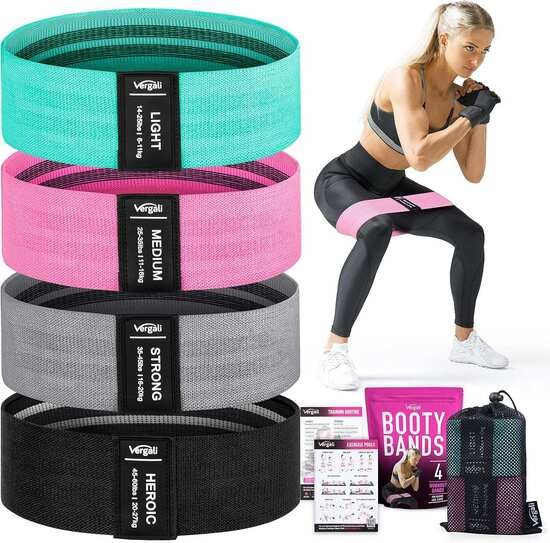
Many sets offer several resistance levels, commonly ranging from light to heavy.
A practical setup might include:
- Light: warm-ups, activation, rehabilitation-style movements, beginners
- Medium: general lower-body training
- Heavy: stronger trainees and demanding compound movements
- Extra-heavy: advanced accessory work where appropriate
Resistance labels aren’t standardized across every manufacturer, so don’t assume that a “heavy” band from one brand will feel identical to another.
Consider Band Width
A wider band generally provides more surface area against the skin and may feel more stable around the legs.
For many people, wider fabric bands are comfortable for squats, bridges, and hip thrusts.
Check the Inner Grip
Some fabric bands include silicone or textured grip strips designed to reduce slipping.
This can be especially helpful during exercises involving repeated leg movement.
However, grip isn’t the only factor. Proper sizing matters too.
Choose the Right Size
A band that is too loose may provide little resistance.
A band that is excessively tight may make exercises uncomfortable and restrict movement.
Ideally, the band should provide meaningful resistance while still allowing you to perform the intended range of motion with good technique.
Should You Buy One Band or a Set?
For most people, a set of fabric booty bands is more versatile than a single band.
A set allows you to adjust resistance depending on the exercise.
For example, you might use a lighter band for clamshells and a heavier band for squats.
A set is particularly useful if more than one person will use the bands or if you expect your strength to improve over time.
If you’re a beginner who isn’t sure whether you’ll use them consistently, starting with one moderate-resistance band can also be reasonable.
Fabric Booty Band Workout for Beginners
You don’t need a complicated routine to get started.
Try this simple circuit:
| Exercise | Reps |
| Banded Glute Bridge | 12–15 |
| Banded Squat | 10–15 |
| Lateral Band Walk | 8–12 steps each direction |
| Banded Clamshell | 10–15 per side |
| Banded Kickback | 10–15 per side |
Complete 2–3 rounds, resting as needed between exercises.
The correct resistance is one that makes the final repetitions challenging while allowing you to maintain controlled technique.
How to Progress With Glute Bands
Doing the same number of repetitions forever isn’t necessary.
Use a simple progression framework:
Technique → Repetitions → Resistance → Volume
Start by mastering the movement.
Once your technique is consistent, gradually increase repetitions. When the current resistance becomes too easy, move to a stronger band.
You can also increase the number of sets.
Another useful progression is tempo. Instead of rushing through a banded squat, lower yourself slowly and pause briefly before standing.
The “Last Few Reps” Test
A practical way to judge resistance is to ask:
Could I easily perform several more repetitions with perfect form?
If the answer is yes, the band may be too light for that particular exercise.
If you can’t complete the movement without losing control, the band may be too heavy.
The sweet spot is resistance that makes the final repetitions challenging while keeping technique consistent.
Common Fabric Booty Band Mistakes
Using Too Much Resistance
A heavier band isn’t automatically better.
Excessive resistance can cause you to compensate with other muscles or change the movement pattern.
Letting the Band Go Slack
If the band repeatedly becomes loose during an exercise designed to maintain tension, you may be reducing the resistance stimulus.
Moving Too Quickly
Fast repetitions can turn controlled resistance training into momentum-driven movement.
Slow down and control both directions of the exercise.
Placing the Band Incorrectly
The correct placement depends on the exercise and manufacturer’s instructions.
A band designed for use around the thighs shouldn’t automatically be placed around the ankles.
Ignoring Technique
A band should enhance an exercise—not replace good form.
Keep your torso controlled, move through a comfortable range, and avoid forcing positions that cause pain.
Treating “Activation” as the Entire Workout
Glute activation exercises can be useful, but they aren’t necessarily a complete strength program.
If your goal is long-term strength or muscle development, consider progressively challenging resistance exercises as part of your broader training plan.
Fabric Bands vs. Long Resistance Bands
Fabric booty bands are specialized tools.
Long resistance bands are more versatile and can be used for movements involving the upper and lower body.
| Goal | Better Option |
| Glute activation | Fabric booty band |
| Lateral walks | Fabric booty band |
| Hip abduction | Fabric booty band |
| Full-body workouts | Long resistance band |
| Assisted pull-ups | Long resistance band |
| Upper-body training | Long resistance band |
| Travel-friendly lower-body training | Fabric booty band |
| Maximum exercise versatility | Long resistance band |
If your priority is specifically lower-body training, fabric bands are convenient. If you want one resistance tool for an entire workout program, longer bands may provide greater versatility.
How Often Should You Use Fabric Glute Bands?
The ideal frequency depends on your overall training program and recovery.
You might use them:
- During warm-ups
- As accessory exercises
- During dedicated lower-body workouts
- In short home workouts
- During travel
- As part of mobility or movement routines
If you’re already performing demanding lower-body strength sessions, you don’t necessarily need to perform extensive band work every day.
More training isn’t automatically better. The quality of your training and your ability to recover matter too.
How to Keep Fabric Booty Bands in Good Condition
Proper care can help extend the useful life of a fabric resistance band.
After Training
Allow the band to dry if it becomes sweaty.
Avoid storing it while damp in a closed gym bag.
Keep It Away From Excessive Heat
Don’t leave resistance bands in a hot car for prolonged periods.
Inspect the Stitching
Check for:
- Frayed fabric
- Damaged stitching
- Cracks or deterioration
- Unusual stretching
- Loss of elasticity
Replace a damaged band rather than continuing to use it.
Follow the Manufacturer’s Cleaning Instructions
Fabric construction varies, so cleaning recommendations can differ. Follow the instructions supplied with your particular band rather than assuming every fabric band should be washed the same way.
Are Fabric Booty Bands Better Than Rubber Bands?
There is no universal winner.
Fabric bands are often preferred because they feel comfortable, stay in place well, and work particularly well for lower-body movements.
Rubber or latex bands may offer different resistance characteristics and can be more versatile depending on their design.
The better option is the one that provides the appropriate resistance, stays securely positioned, and allows you to train consistently.
A Simple Buying Checklist
Before purchasing fabric booty bands, check these factors:
- Resistance: Does the set provide levels appropriate for your current strength?
- Width: Is the band wide enough to feel comfortable?
- Grip: Does it stay in position during movement?
- Construction: Are the seams and stitching reinforced?
- Sizing: Does the loop fit comfortably around your intended body position?
- Versatility: Can it be used for the exercises you actually plan to perform?
- Storage: Does it come with a convenient storage bag or case?
- Care: Are the cleaning and maintenance instructions clear?
A band that looks impressive but doesn’t fit correctly is less useful than a simple band that you can comfortably use several times a week.
Expert Tips for Better Results
Use the band to improve control, not just difficulty. The most useful resistance is resistance you can manage deliberately.
Keep tension where appropriate. For exercises such as lateral walks, avoid taking steps so large that the band becomes loose.
Pair bands with compound exercises. Fabric bands can complement squats, hip thrusts, split squats, and other strength movements.
Don’t chase the heaviest band. Choose resistance according to the exercise and your ability to maintain good technique.
Progress gradually. Increasing resistance, repetitions, sets, or movement control can all make an exercise more challenging.
Train the whole lower body. A strong lower-body program doesn’t need to revolve around one muscle or one type of exercise.
Key Takeaways
- Fabric booty bands are compact loop resistance bands designed primarily for lower-body training.
- They can add resistance to squats, hip thrusts, glute bridges, lateral walks, kickbacks, and other exercises.
- Fabric construction can provide a comfortable, stable alternative to latex bands.
- The correct resistance is more important than choosing the heaviest band.
- A set with multiple resistance levels can provide greater versatility.
- Bands can support glute development when combined with progressive resistance training.
- They work well as warm-up tools, accessories, or standalone equipment for convenient workouts.
- Good technique should always take priority over resistance level.
- Inspect bands regularly for damage and replace worn or compromised equipment.
- For the best long-term results, combine band training with a balanced lower-body strength program.
Conclusion
Fabric booty bands are one of the simplest ways to add resistance to a lower-body workout. Their compact design makes them especially useful for home training, travel, warm-ups, and accessory work.
The key isn’t finding the band with the highest resistance. It’s finding one that fits comfortably, stays in place, provides an appropriate challenge, and allows you to perform controlled repetitions.
For beginners, a light-to-moderate band can provide plenty of room to learn and progress. More experienced trainees can use heavier bands alongside squats, hip thrusts, split squats, and other resistance exercises.
Used consistently and intelligently, fabric glute bands can be a practical part of a well-rounded lower-body training program—not a gimmick, but a simple resistance tool that makes effective training easier to do almost anywhere.
Frequently Asked Questions
Are fabric booty bands good for beginners?
Yes. Fabric booty bands can be useful for beginners because they are simple, portable, and easy to incorporate into basic lower-body movements. Start with manageable resistance and focus on learning the movement before progressing.
Can fabric booty bands grow your glutes?
They can contribute to glute growth by providing resistance during exercises. However, muscle development depends on the overall training stimulus, progressive overload, nutrition, recovery, and consistency rather than the band alone.
Should a fabric booty band go above or below the knees?
Placement depends on the exercise and the specific band. For many squat, bridge, and hip-thrust variations, placing the band above the knees is common. Always follow the manufacturer’s instructions and choose a position that allows controlled movement.
How tight should a fabric glute band be?
It should provide noticeable resistance without preventing you from performing the exercise with good technique. If it constantly slips, it may be too loose or incorrectly positioned. If it severely restricts movement, it may be too tight.
Are fabric bands better than latex bands?
Not necessarily. Fabric bands are often comfortable and stable for lower-body exercises, while latex bands can offer greater versatility depending on their design. Your training goals and personal preference should determine the choice.
Can you use fabric booty bands every day?
You can use light band movements frequently, but whether daily training is appropriate depends on the intensity and your overall workout schedule. Muscles also need adequate recovery after demanding resistance sessions.
What resistance should beginners use?
A light or moderate band is usually a practical starting point. The correct level should make the final repetitions challenging without causing you to lose control or change the intended movement pattern.
Can you use fabric booty bands without weights?
Yes. Fabric bands can be used for complete lower-body workouts without traditional weights. As your strength increases, however, combining bands with other forms of resistance can provide additional progression options