
Choosing the right cardio machine for an apartment or home office involves more than comparing calorie burn or workout intensity. Noise, available floor space, workout comfort, and everyday convenience all influence whether a machine becomes part of a sustainable fitness routine or ends up collecting dust in a corner.
For people who work from home, live in shared buildings, or exercise early in the morning, quiet operation can be just as important as cardiovascular performance. A rowing machine offers a full-body workout, an elliptical provides low-impact exercise with a steady rhythm, and an under-desk walking pad makes it possible to stay active while working at a computer.
However, these machines serve different purposes. The best choice depends on how we plan to exercise, how much space we have, and whether we need a dedicated workout session or movement throughout the working day.
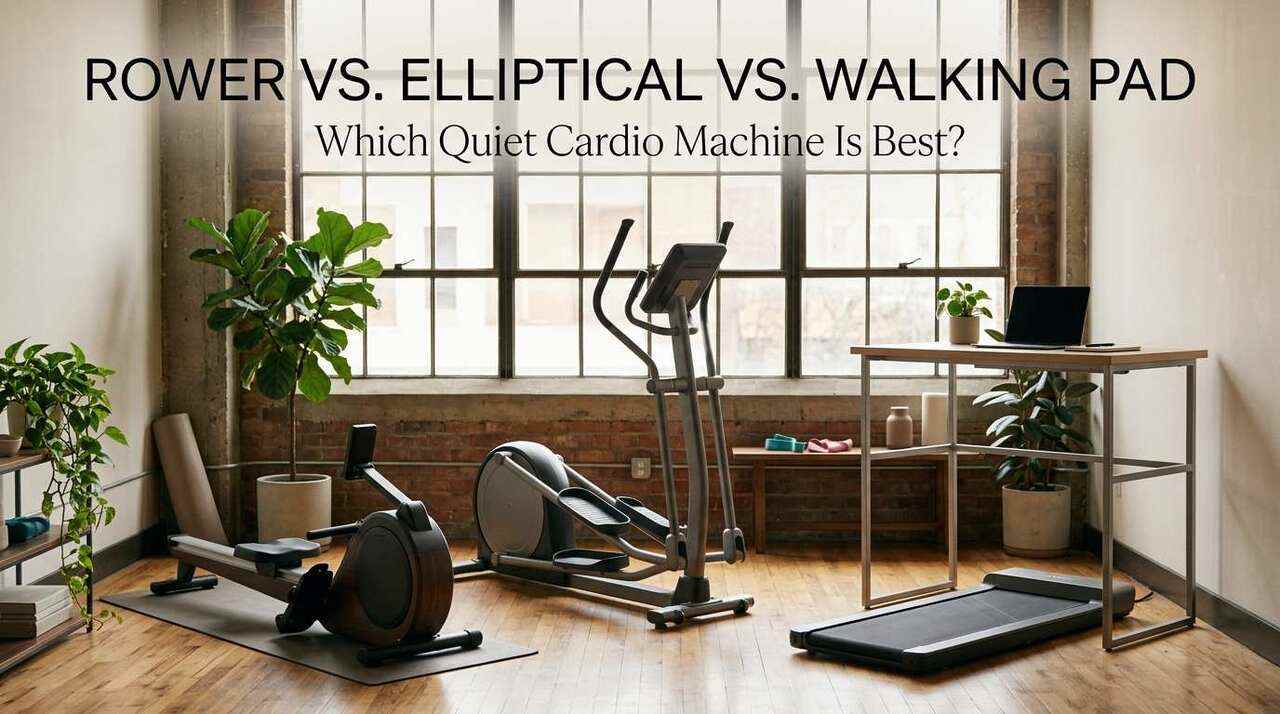
In this guide, we compare a rower vs. elliptical vs. under-desk walking pad across noise levels, space requirements, workout intensity, joint impact, convenience, and overall suitability for apartment living.
Table of Contents
Rower vs. Elliptical vs. Walking Pad: Quick Comparison
Each cardio machine offers a different balance of convenience, exercise intensity, and noise control. Understanding these differences helps us narrow down the options before investing in home fitness equipment.
| Feature | Rowing Machine | Elliptical Trainer | Under-Desk Walking Pad |
|---|---|---|---|
| Primary purpose | Full-body cardio and muscular endurance | Low-impact cardiovascular exercise | Light movement while working |
| Workout intensity | Moderate to vigorous | Light to vigorous | Usually light to moderate |
| Muscles involved | Legs, glutes, back, arms, and core | Legs, glutes, and optionally upper body | Primarily legs and glutes |
| Noise sources | Flywheel, seat, chain or belt, and water resistance | Flywheel, pedals, and moving components | Motor, belt, and footsteps |
| Joint impact | Low when technique is correct | Low | Low, depending on walking speed and individual needs |
| Multitasking | Difficult during vigorous sessions | Limited | Excellent for walking while working |
| Storage | Some models fold or stand vertically | Compact models exist, but many are bulky | Many models slide under furniture |
| Best use | Dedicated cardio sessions | Dedicated low-impact workouts | Movement during desk work |
| Learning curve | Moderate | Low | Very low |
Noise levels vary considerably between models. A magnetic rower may be quieter than an air rower, while a well-designed walking pad can produce less mechanical noise than a poorly maintained elliptical.
The quietest machine is not necessarily the best machine for every household. We should consider how the equipment will be used, when workouts will take place, and whether noise travels through the floor to neighboring apartments.
1. Rowing Machine: Best for Full-Body Cardio in a Compact Space
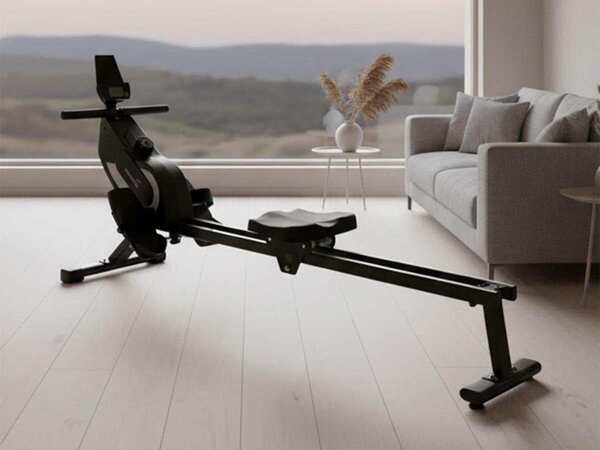
Suggested Rowing Machine: YOSUDA Rowing Machine for Home, Magnetic Rower with 16-Level Resistance
A rowing machine combines cardiovascular conditioning with repeated muscular effort. Unlike walking pads, which primarily involve the lower body, rowing engages the legs, glutes, back, arms, and core in a coordinated movement.
This makes rowing an attractive choice for people who want a more comprehensive workout without buying several pieces of equipment.
How Quiet Is a Rowing Machine?
The sound produced by a rowing machine depends heavily on its resistance mechanism.
Magnetic rowing machines are generally among the quietest options because resistance is created magnetically rather than through a fan or moving water. Their main sounds typically come from the sliding seat, rail, drive mechanism, and the user’s movement.
Water rowers produce a distinctive swishing sound as water moves through the tank. Many users find this sound pleasant, but it can be noticeable in a quiet apartment, particularly during vigorous sessions.
Air rowers create resistance through a fan. As rowing speed increases, the fan becomes louder, making these models less suitable for households that prioritize minimal noise.
For apartment workouts, a magnetic rower is often the strongest starting point. We should still check independent reviews for seat-rail noise, resistance adjustments, and drive-system sounds rather than relying exclusively on a manufacturer’s noise claims.
Workout Benefits and Intensity
Rowing requires coordinated leg drive, trunk stabilization, and upper-body movement. When performed with appropriate technique, it can deliver an effective cardiovascular workout while challenging several major muscle groups.
The legs generate much of the initial power, the torso transfers that force, and the arms finish the movement. The return phase reverses the sequence.
This combination makes rowing particularly useful when we want to improve aerobic fitness and muscular endurance within a limited amount of time.
Intensity can be adjusted through stroke rate, effort, and resistance settings where available. Beginners can start with short, controlled sessions and gradually increase duration as their conditioning improves.
However, technique matters. Excessive rounding of the back, pulling too early with the arms, or using uncontrolled movements can make rowing uncomfortable and less efficient.
Space Requirements and Storage
Many rowing machines occupy a relatively long footprint during use. However, certain models fold in half or stand vertically when not in use.
Before purchasing, we should measure both the machine’s operating dimensions and its storage dimensions. Vertical storage is useful only if the ceiling height, stability, and manufacturer’s storage instructions allow it.
A rower may be a good option for a small apartment when there is a dedicated corner for workouts, but it is not necessarily the most convenient machine for a narrow home office.
Who Should Choose a Rower?
A rowing machine is particularly suitable for people who:
- Want a full-body cardiovascular workout.
- Prefer structured exercise sessions over multitasking.
- Need adjustable workout intensity.
- Have enough floor space to accommodate a long machine.
- Want quieter operation without the fan noise of an air rower.
For a more focused equipment comparison, see our guide to compact rowing machines.
2. Elliptical Trainer: Best for Low-Impact, Dedicated Cardio
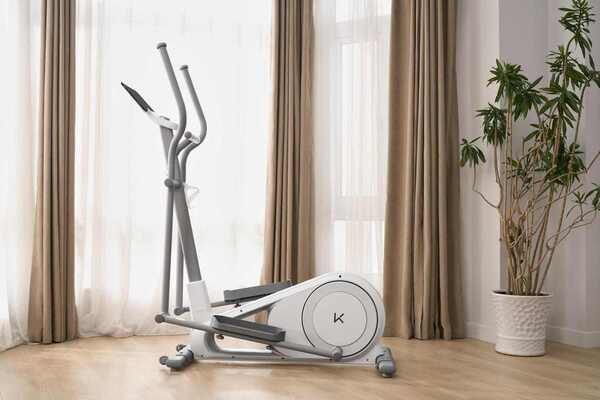
Suggested Elliptical Trainer: Niceday Elliptical Exercise Machine with 15.5/18/19IN Long Stride
An elliptical trainer creates a smooth, gliding movement that resembles walking or running without the same repeated foot strikes against the floor.
It is a practical option for people who want a dedicated cardiovascular workout while limiting impact. Depending on the model, moving handlebars can also engage the upper body.
Unlike a walking pad, an elliptical generally requires us to stop other activities and concentrate on exercise. In return, it offers more opportunities to adjust workout intensity and resistance.
Are Elliptical Machines Quiet Enough for Apartments?
Many modern ellipticals use magnetic resistance and belt-driven mechanisms to reduce mechanical noise. However, the machine’s overall sound depends on its construction, maintenance, and how forcefully we exercise.
Common noise sources include:
- Flywheel and resistance components: Poorly maintained or lower-quality mechanisms may create humming or grinding sounds.
- Pedal movement: Loose connections can cause clicking or squeaking.
- Moving joints: Dry pivot points and worn bushings may create repetitive noises.
- Footsteps and frame movement: Vigorous exercise can transfer vibration through the floor.
- User contact: Shoes striking the pedals and handlebars moving under pressure can add sound.
A quiet elliptical should move smoothly without repeated knocking, squeaking, or excessive frame movement.
A dense exercise mat can help reduce some vibration and protect flooring. It cannot eliminate all structure-borne noise, especially in buildings with lightweight floors.
We should also distinguish between mechanical noise and vibration. A machine may sound relatively quiet in the room while still transmitting movement to the apartment below.
Workout Benefits and Muscle Engagement
Elliptical trainers provide continuous lower-body movement while allowing us to regulate resistance and stride speed.
Depending on the design, the workout can involve the quadriceps, hamstrings, glutes, and calf muscles. Models with moving handlebars add upper-body movement, although this does not make every elliptical equivalent to a full-body rowing workout.
Incline settings, resistance adjustments, and programmed intervals can make sessions more demanding.
For beginners, steady sessions at a comfortable pace can provide a manageable introduction to cardiovascular exercise. More experienced users can alternate between higher- and lower-intensity intervals.
The elliptical’s stable, guided movement can also appeal to people who dislike the impact associated with running. Nevertheless, comfort varies by individual, and users with joint problems should choose equipment and intensity appropriate to their needs.
Space and Everyday Convenience
Ellipticals generally occupy more vertical space than walking pads and can have a substantial footprint. Some compact designs are suitable for smaller rooms, but many models are difficult to move or store.
The machine’s stride length and pedal spacing also affect comfort. A compact elliptical may fit into a small room but feel restrictive for taller users.
Before purchasing, we should check the assembled dimensions, recommended clearance, maximum user weight, and whether the machine can be moved easily for cleaning.
Who Should Choose an Elliptical?
An elliptical is a strong option for people who:
- Prefer dedicated cardio sessions.
- Want low-impact movement with adjustable resistance.
- Like a steady, guided exercise pattern.
- Need more workout intensity than casual walking typically provides.
- Have enough space for a permanent or semi-permanent machine.
If noise is a priority, explore our guide to quiet ellipticals for apartments.
3. Under-Desk Walking Pad: Best for Quiet Movement While Working
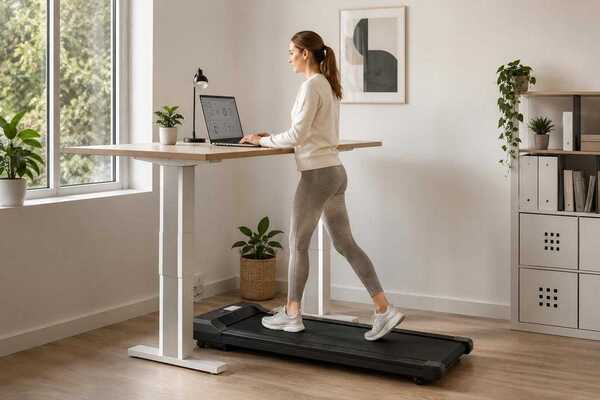
An under-desk walking pad takes a different approach to home fitness. Instead of replacing a dedicated workout, it allows us to incorporate walking into the working day.
This can be particularly appealing to remote workers, freelancers, students, and anyone who spends several hours sitting at a desk.
A walking pad typically has a compact deck, a motorized belt, and a relatively low profile. Many models are designed to slide beneath furniture when not in use.
Its main advantage is convenience: we can accumulate movement during activities that do not require intensive concentration or precise hand movements.
How Quiet Is an Under-Desk Walking Pad?
Walking pads are often marketed as quiet, but their actual sound depends on several factors.
The motor generates mechanical noise, while the belt and rollers create additional sound during operation. Footsteps can become the most noticeable noise, particularly at higher speeds.
A quiet motor does not automatically make a walking pad apartment-friendly. Vibrations can travel through the floor, especially when the equipment is placed directly on a hard surface.
To reduce unwanted noise:
- Choose a model with a well-reviewed motor and smooth belt operation.
- Place it on a suitable, dense exercise mat that is compatible with the machine.
- Keep the walking surface clean and follow the manufacturer’s lubrication instructions.
- Maintain proper belt alignment and tension.
- Begin at a low speed and increase gradually.
- Wear comfortable walking shoes that do not strike the deck excessively.
We should also consider the type of work being performed. Slow walking may be compatible with reading emails, attending some meetings, or reviewing documents. Typing accuracy and concentration can become more difficult as speed increases.
Can We Walk While Working at a Desk?
Yes, although the experience depends on walking speed, desk height, and task complexity.
For simple administrative work, many people find slow walking manageable. More demanding activities, such as writing detailed reports, editing intricate designs, or performing tasks that require precise mouse control, may be easier while seated or standing still.
An adjustable standing desk is especially useful because it allows us to switch between sitting, standing, and walking.
We should begin with short walking periods rather than trying to walk continuously throughout the entire workday. Gradually increasing the duration makes it easier to evaluate comfort, concentration, and fatigue.
A walking pad should complement normal breaks and dedicated exercise rather than replace every form of physical activity.
Workout Intensity and Fitness Benefits
Walking pads generally provide less resistance and fewer opportunities for intense full-body exercise than rowers or ellipticals.
Nevertheless, walking contributes to daily physical activity, and regular movement can help reduce prolonged sedentary time.
The intensity depends on speed, incline if supported, walking duration, and individual fitness. Some models offer adjustable incline, but many under-desk designs are intended primarily for level walking.
For people who struggle to find time for exercise, accumulating short periods of movement during the day can be more practical than relying entirely on a separate workout session.
However, a walking pad does not train the upper body in the same way as a rowing machine, nor does it necessarily provide the same range of cardiovascular intensity as an elliptical.
Storage and Small-Apartment Suitability
Walking pads usually have a smaller footprint than full-size ellipticals. Some models feature transport wheels and can be stored beneath a bed, sofa, or desk, provided the available clearance is sufficient.
We should verify the machine’s actual dimensions, weight, folded configuration, and lifting requirements before assuming it can be stored easily.
A lightweight walking pad may be convenient to move, but it still needs a stable operating surface and sufficient clearance around the belt.
Another important consideration is the desk itself. The walking surface should allow natural posture, adequate arm movement, and a comfortable screen height.
Who Should Choose a Walking Pad?
A walking pad is particularly useful for people who:
- Work from home for several hours a day.
- Want to move more without interrupting every task.
- Have limited space for fitness equipment.
- Prefer walking to structured cardio workouts.
- Need an accessible way to break up long periods of sitting.
For a detailed buying guide, see our recommendations for the best under-desk treadmills.
4. Which Cardio Machine Is the Quietest?
There is no universal winner because noise depends on machine design, maintenance, flooring, and workout intensity. However, we can identify common patterns that help narrow the choices.
| Machine Type | Typical Noise Characteristics | Main Noise Concern |
|---|---|---|
| Magnetic rower | Often very quiet mechanically | Seat movement and drive mechanism |
| Water rower | Moderate, distinctive water sound | Water movement and sliding seat |
| Air rower | Usually becomes louder as effort increases | Fan noise |
| Magnetic elliptical | Often quiet when well maintained | Pedal joints, flywheel, and vibration |
| Motorized walking pad | Low to moderate mechanical noise, with footsteps | Motor, belt, and floor vibration |
For households where someone is sleeping in the next room, a magnetic rower or a well-maintained magnetic elliptical may be preferable to an air rower.
For people who want to exercise while participating in work calls, a slow walking pad may be more practical, provided its motor and footstep noise remain unobtrusive.
The best approach is to evaluate noise under realistic conditions. A machine should be tested at the intended workout speed, on the intended floor, and with the mat that will be used at home.
When possible, read reviews that describe actual apartment use rather than relying only on decibel claims. Noise measurements can be misleading when the distance from the microphone, room acoustics, and operating conditions differ.
5. Floor Vibration: The Overlooked Apartment Cardio Problem
Mechanical noise is only one part of the equation. In an apartment building, vibration transmitted through the floor can disturb neighbors even when the machine sounds relatively quiet in the room.
A treadmill belt creates repeated foot impacts, while rowing and elliptical machines can transmit vibration through their frames and contact points.
The severity depends on the building’s construction, flooring, equipment weight, workout intensity, and the location of the machine.
How to Reduce Floor Noise
First, place the equipment on a stable, level surface. An uneven floor can make frames rock and joints knock, creating additional noise.
Second, consider a dense, purpose-built equipment mat. It can help protect the floor and reduce some vibration, although results vary according to the mat’s material and thickness.
Third, check that all fasteners are properly tightened and moving components are maintained according to the manufacturer’s instructions.
Finally, consider workout timing. Even a relatively quiet machine may be noticeable during late-night or early-morning exercise when the surrounding environment is silent.
For especially noise-sensitive apartments, test the machine at low intensity before committing to regular sessions. If vibration remains noticeable in adjacent rooms, changing the location or equipment may be more effective than adding more padding.
6. Which Machine Offers the Best Workout?
The best workout depends on what we want to achieve. Comparing machines solely by calorie burn or workout intensity overlooks the practical differences that determine how consistently we use them.
For Full-Body Conditioning: Rowing Machine
Rowing combines repeated leg drive, trunk stabilization, and upper-body pulling. It is a compelling choice when we want a structured session that challenges several muscle groups.
Its effectiveness depends on proper technique and consistent effort. Beginners should prioritize movement quality before increasing intensity.
For Adjustable, Low-Impact Cardio: Elliptical
The elliptical provides a smooth movement pattern with adjustable resistance and, on some models, incline.
It works well for steady-state sessions and intervals without requiring the coordination of rowing. Its larger footprint, however, can make it less practical for very small rooms.
For Daily Movement and Sedentary Work: Walking Pad
The walking pad’s strongest advantage is that it integrates activity into an existing routine.
Rather than setting aside a separate workout period, we can walk during suitable work tasks. Its value comes from convenience and consistency, not from matching every benefit of more demanding cardio equipment.
What About Weight Management?
All three machines can contribute to a weight-management routine by increasing physical activity and energy expenditure.
However, the amount of energy used depends on workout duration, intensity, body size, and individual factors. No machine guarantees weight loss on its own.
A walking pad may make it easier to accumulate movement throughout the day, while a rower or elliptical may support more vigorous sessions. The most useful choice is the one that fits our routine and can be used consistently alongside appropriate nutrition, recovery, and other physical activity.
7. Best Cardio Machine for a Small Apartment
Apartment suitability depends on more than the machine’s listed footprint. We also need to consider where it will be used, how it will be stored, and whether it can be operated without disrupting other household members.
| Apartment Situation | Best Starting Choice | Reason |
|---|---|---|
| Small home office | Under-desk walking pad | Designed for use beneath or near a desk |
| Shared apartment with noise concerns | Magnetic rower or quiet magnetic elliptical | Often avoids the louder fan noise of an air rower |
| Limited storage space | Compact walking pad | Many models have a low profile and transport wheels |
| Dedicated home workout corner | Rower or elliptical | Better suited to focused exercise sessions |
| Long workdays spent sitting | Walking pad | Makes regular movement easier to integrate |
| Preference for full-body cardio | Rowing machine | Engages upper and lower body |
| Preference for steady, guided movement | Elliptical | Simple movement pattern with adjustable resistance |
These recommendations are starting points rather than guarantees. A compact machine may still be awkward to store, and a quiet model may transmit vibration through a particular floor.
Before buying, measure the available space and verify the machine’s weight, storage configuration, operating clearance, and maintenance requirements.
8. What to Check Before Buying Quiet Cardio Equipment
A machine that looks suitable online may be inconvenient in everyday use. We should assess several practical features before choosing between a rower, elliptical, and walking pad.
Resistance and Drive Mechanism
For rowers, magnetic resistance is a sensible starting point when low mechanical noise is important.
For ellipticals, look for smooth resistance transitions, stable pedals, and well-reviewed moving joints.
For walking pads, pay attention to motor quality, belt construction, speed settings, and reports of vibration.
Dimensions and Storage
Check the full operating footprint, not just the product’s headline dimensions.
Measure the surrounding clearance, including the space required to mount or dismount safely. If the equipment needs to be stored after every session, verify the exact storage position and whether it can be moved without assistance.
User Weight and Ergonomics
Always check the manufacturer’s stated weight capacity and suitability for the intended user.
For rowers, evaluate seat comfort, rail length, and footrest adjustment. For ellipticals, check stride length and pedal spacing. For walking pads, consider belt width, walking-surface length, and the ease of maintaining a natural gait.
Maintenance and Warranty
Loose components, worn belts, and poorly maintained moving parts can increase noise over time.
Review the manufacturer’s maintenance schedule, replacement-part availability, warranty coverage, and customer support before purchasing.
Realistic Noise Reviews
Look for reviews from people who use the machine in apartments or shared homes.
Pay particular attention to recurring complaints about squeaking, rattling, motor noise, belt alignment, and floor vibration. A single favorable comment is less useful than a consistent pattern across multiple reviews.
9. How to Build a Quiet Cardio Routine at Home
Once we have selected the right equipment, the next step is creating a routine that fits our space and schedule.
For a dedicated cardio session, we can begin with a few minutes of easy movement, progress to a comfortable working pace, and finish with a gradual reduction in intensity.
A rowing routine should emphasize controlled technique and smooth transitions. An elliptical session can begin with low resistance before progressing according to comfort and fitness. A walking pad routine can start with short bouts of easy walking distributed throughout the day.
The goal is not to maximize intensity during every session. It is to build a routine that we can maintain without excessive fatigue or disruption.
Example Weekly Approach
| Day | Suggested Activity | Main Purpose |
|---|---|---|
| Monday | Moderate rowing or elliptical session | Dedicated cardio |
| Tuesday | Short walking-pad periods during work | Break up sitting |
| Wednesday | Easy cardio at a comfortable pace | Consistency and recovery |
| Thursday | Walking-pad breaks throughout the day | Daily movement |
| Friday | Rowing or elliptical intervals, if appropriate | Vary exercise intensity |
| Saturday | Outdoor walking or another preferred activity | Broader physical activity |
| Sunday | Rest or gentle movement | Recovery |
This is an illustrative schedule rather than a universal prescription. We should adjust duration and intensity to our fitness level, health needs, and recovery.
People returning to exercise after a long break should start gradually. Anyone with a medical condition or specific exercise restrictions should seek appropriate professional guidance before adopting a demanding routine.
10. Rower vs. Elliptical vs. Walking Pad: Final Verdict
The rowing machine, elliptical, and under-desk walking pad can all support a more active lifestyle, but they solve different problems.
Choose a rowing machine if full-body cardio is the priority. A magnetic model is often a strong choice for apartment workouts because it avoids the prominent fan noise associated with air resistance.
Choose an elliptical if you want dedicated, low-impact cardiovascular exercise. It provides adjustable resistance and a guided movement pattern, although its size may be a limitation in smaller homes.
Choose an under-desk walking pad if you want to move more while working. Its compact design and convenient use make it especially appealing to remote workers and people who spend much of the day sitting.
For many apartment dwellers, the most practical choice is not the machine with the highest theoretical workout intensity. It is the machine that fits the room, respects household noise constraints, and supports a routine we can maintain.
When noise and convenience are equally important, a quiet magnetic rower is worth considering for dedicated workouts, while a well-reviewed walking pad is often the more practical choice for everyday movement during desk work.
The right purchase ultimately depends on how we intend to use it. By matching the machine to our available space, preferred exercise style, and daily schedule, we can create a home cardio setup that is practical, comfortable, and easier to use consistently.