
A slant board is a simple piece of fitness equipment designed to place your feet on an incline during stretching, mobility work, and lower-body exercises. By changing the position of your feet and heels, a slant board can be useful for calf stretching, ankle-mobility work, and elevated-heel squat variations.
But not every slant board is the same. Angle, stability, surface grip, size, adjustability, and construction can all affect how useful a board is in your home gym.
If you’re considering buying one, this guide explains what a slant board does, how to use it, which exercises you can perform, and what features are worth looking for.
Table of Contents
What Is a Slant Board?
A slant board is an angled platform that allows your feet to rest at an incline rather than flat on the floor. Some models have a fixed angle, while adjustable versions let you choose between several incline positions.
Slant boards are commonly used for:
- Calf stretching
- Ankle-mobility exercises
- Slant board squats
- Lower-body mobility work
- Warm-ups
- Stretching routines
- Bodyweight exercises
- Strength-training variations
The basic idea is straightforward: the inclined surface changes your foot position and can make certain movements or stretches easier to perform.
For home-gym users, a slant board can also be a compact alternative to larger mobility equipment.
What Is a Slant Board Used For?
The most common uses fall into two categories: mobility and exercise.
For mobility work, a slant board can provide a consistent foot position during calf and ankle stretches. For strength exercises, it can be used to create elevated-heel variations of movements such as squats.
Slant Board for Calf Stretching
One of the simplest applications is the slant board calf stretch.
Standing with your feet positioned on the angled surface changes the relationship between your feet, ankles, and lower legs. This makes the board particularly useful when you want a dedicated surface for calf stretching.
A slant board can also make it easier to maintain a consistent position from one session to another.
Slant Board for Squats
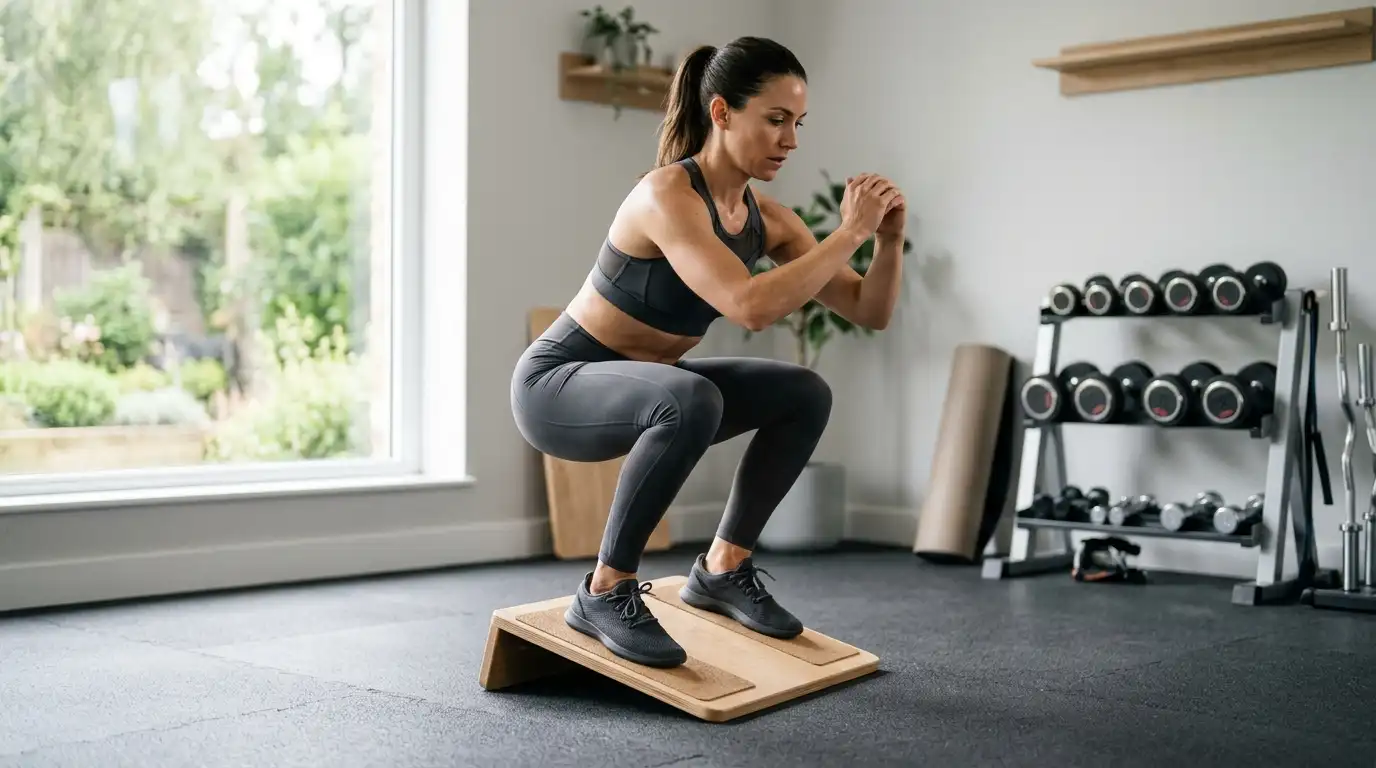
A slant board for squats places the heels on an elevated surface while the forefoot remains lower.
This setup changes the mechanics of the squat and can make the movement feel different from a conventional flat-foot squat. Some people use heel elevation when working on squat positioning or when performing certain lower-body training variations.
However, a slant board isn’t a requirement for learning how to squat. Think of it as a training tool rather than a replacement for normal squat practice.
Slant Board for Mobility
A slant board can also become part of a broader lower-body mobility routine.
You can use it alongside movements targeting:
- Ankles
- Calves
- Lower legs
- Squat positioning
- Lower-body flexibility
Its main advantage is consistency: instead of improvising a foot position with household objects, you have a purpose-built inclined platform.
Slant Board Benefits
A slant board doesn’t need to be complicated to be useful. Its value comes from giving you a stable, repeatable incline for specific movements.
1. Dedicated Calf Stretching Surface
A slant board gives you a defined surface for calf stretching instead of relying on improvised equipment.
This can be especially convenient if stretching is already part of your home workout routine.
2. Supports Ankle-Mobility Work
Ankle mobility is important for many lower-body movements. A slant board can be incorporated into exercises designed to work through controlled ankle movement.
It isn’t a magic solution for limited mobility, but it can be a practical tool for structured mobility sessions.
3. Useful for Elevated-Heel Squats
A slant board can provide a consistent heel-elevated position for squat variations.
This makes it useful for people who want to experiment with different squat setups without permanently modifying their footwear or using unstable objects under their heels.
4. Compact Home-Gym Equipment
Compared with larger strength and mobility equipment, most slant boards take up very little floor space.
That makes them particularly appealing for apartment gyms, small workout rooms, and minimalist home setups.
5. Easy to Store
A compact slant board can generally be moved out of the way after training.
If storage space is limited, look for a model with a manageable footprint and a design that can be stored vertically or under other equipment.
Slant Board Exercises
A slant board can be used for more than one stretch. Depending on the design and your training goals, you can incorporate it into several lower-body exercises.
1. Slant Board Squats
Stand with both feet securely positioned on the board and perform a controlled squat.
Focus on maintaining stable foot contact and controlled movement rather than simply trying to achieve maximum depth.
Tip: Start with bodyweight before adding resistance. This lets you understand how the incline changes the movement.
2. Slant Board Calf Stretch
Place your feet on the board and gradually settle into a comfortable stretching position.
Avoid bouncing or forcing the range of motion. The goal is controlled stretching rather than trying to reach an extreme position.
3. Calf Raises
A slant board can also be incorporated into calf-raise variations when the platform provides enough stability and space for the movement.
Perform the exercise slowly and keep your feet positioned securely on the surface.
4. Tibialis Raises
Depending on the board’s design and your setup, it may be incorporated into controlled lower-leg exercises such as tibialis raises.
Make sure the board is stable before attempting any movement that changes your center of gravity.
5. Split Squat Variations
Some users may incorporate an inclined surface into split-squat variations. However, this requires more attention to stability and positioning than simple stretching.
If you’re new to the equipment, start with basic movements before experimenting with more complex variations.
6. Mobility Drills
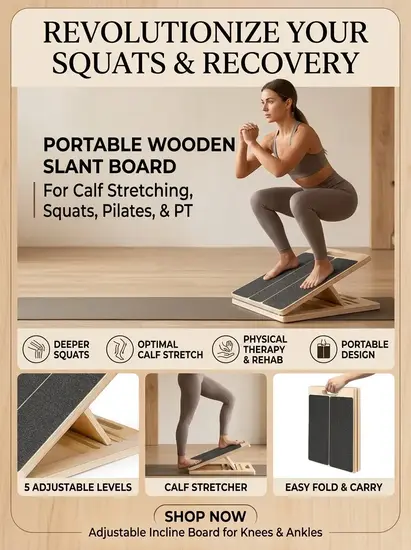
A slant board can be added to a short mobility routine involving controlled ankle and lower-leg movements.
The board works best as one tool within a broader routine rather than as a replacement for every mobility exercise.
Slant Board Squats: How to Do Them
Slant board squats are one of the most useful applications to understand if you’re considering buying this type of equipment.
Here’s a simple starting approach:
- Place the slant board on a stable, non-slip surface.
- Step onto the board with both feet positioned evenly.
- Keep your feet securely connected to the surface.
- Brace your midsection and maintain an upright, controlled posture.
- Lower into a comfortable squat.
- Keep the movement controlled as you return to standing.
- Start with bodyweight before adding resistance.
Common Slant Board Squat Mistakes
Avoid turning the exercise into a race for maximum depth.
Common mistakes include:
- Using an unstable board
- Choosing an aggressive angle immediately
- Allowing the feet to shift
- Adding weight too quickly
- Losing control during the descent
- Treating heel elevation as necessary for every squat
The right setup should make the movement feel controlled rather than unstable.
Slant Board for Squats: Is It Worth It?
A slant board can be worthwhile if you specifically want a dedicated tool for heel-elevated squat variations, calf stretching, and mobility work.
The biggest advantage is convenience. You can create a repeatable elevated-foot position without balancing your heels on improvised objects.
However, you don’t necessarily need one to perform effective squats.
If your main goal is general strength training, a normal squat performed with appropriate technique may be enough. If you regularly work on mobility or enjoy experimenting with different lower-body exercise variations, a slant board can offer more versatility.
Bottom line: a slant board is best viewed as a specialized training accessory, not an essential piece of equipment for everyone.
How to Do a Slant Board Calf Stretch
The slant board calf stretch is one of the easiest ways to use this equipment.
Step 1: Set Up the Board
Place the board on a stable surface where it won’t slide during the stretch.
Step 2: Position Your Feet
Place your feet evenly on the angled surface.
Step 3: Find a Comfortable Position
Stand tall and allow your lower legs to move into a controlled stretch.
Step 4: Hold the Stretch
Maintain a comfortable position without bouncing or forcing the movement.
Step 5: Exit Slowly
Step off the board carefully rather than jumping or rushing out of the stretch.
If a particular position causes sharp pain or discomfort, stop rather than forcing the stretch.
How to Choose the Best Slant Board
If you’re shopping for a slant board, don’t choose based on appearance or price alone.
The following features matter more.
Angle
The angle determines how your feet are positioned and affects how the board feels during stretching and exercises.
A fixed-angle board can be perfectly adequate if you know what position you prefer. An adjustable model offers more flexibility.
Adjustability
An adjustable slant board lets you change the incline.
This can be useful if multiple people will use the board or if you want different positions for stretching and exercise.
Surface Grip
A non-slip surface is one of the most important practical features.
Your feet should remain secure during use, particularly when performing movements rather than simply standing on the board.
Stability
A board that shifts or rocks can quickly become frustrating.
Look for a design with a stable base and sufficient contact with the floor.
Weight Capacity
Check the manufacturer’s stated weight capacity before buying.
A board should be appropriate for your body weight and the type of exercises you intend to perform.
Size
Consider the actual surface area available for your feet.
A compact board is easier to store, but a larger platform may provide more room for different foot positions.
Construction
Common materials include wood, plastic, and metal components.
The best choice depends on how frequently you plan to use the equipment, how much portability matters, and your preferred balance between weight and durability.
Portability
If you train in different rooms or travel with your equipment, look for a lightweight design with a manageable footprint.
For a permanent home gym, portability may matter much less than stability.
Fixed vs. Adjustable Slant Boards
Choosing between a fixed and adjustable model largely comes down to versatility.
| Feature | Fixed Slant Board | Adjustable Slant Board |
|---|---|---|
| Angle | One primary angle | Multiple angles |
| Simplicity | Very simple | More adjustment |
| Versatility | Moderate | High |
| Storage | Usually simple | May be more complex |
| Best for | Specific use | Multiple exercises |
| Price | Often lower | Often higher |
Who Should Choose a Fixed Board?
A fixed board can make sense if you primarily want it for one purpose, such as calf stretching or a particular squat variation.
Who Should Choose an Adjustable Board?
An adjustable model may be better if you want to experiment with different angles or use the board for several types of exercises.
For most buyers, the decision should come down to how many different positions they will actually use, not simply how many settings a product advertises.
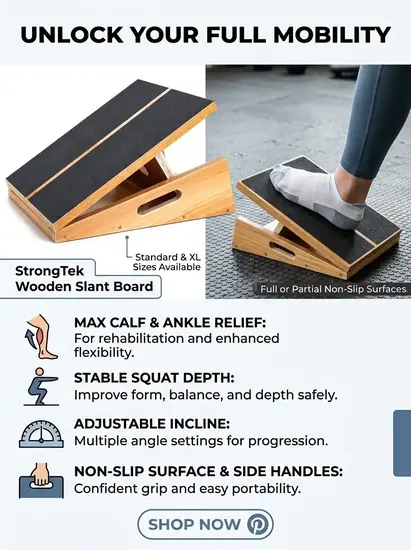
StrongTek Slant Board: What to Look For
The StrongTek slant board is one product option worth researching if you’re shopping in this category.
When evaluating a StrongTek model—or any competing slant board—look beyond the brand name and check the actual specifications.
Pay particular attention to:
- Board angle
- Weight capacity
- Platform dimensions
- Surface traction
- Construction
- Portability
- Storage
- Adjustability
- Warranty
- Current price
A product can be a good choice for one buyer and unnecessary for another. If your main goal is calf stretching, you may not need the same features as someone looking for an adjustable board for multiple squat variations.
Slant Board vs. Squat Wedge
The terms are sometimes used interchangeably, but products can differ considerably.
A squat wedge is generally focused on elevating the heels during strength exercises, while a slant board may be designed more broadly for stretching, mobility, and lower-body training.
When comparing products, look at the actual design rather than relying only on the product name.
Ask:
- Is the angle fixed?
- Can the angle be adjusted?
- Is the surface large enough for stretching?
- Is it stable during squats?
- Does it have sufficient grip?
- Is it easy to store?
- Is it designed for your intended exercises?
The best option is the one that matches your primary use.
Common Slant Board Mistakes
Choosing Based Only on Price
The cheapest board isn’t necessarily the best value.
A slightly more expensive model may offer better stability, grip, construction, or adjustability.
Using Too Much Incline
More incline isn’t automatically better.
Start with a manageable position and adjust according to your exercise and comfort.
Ignoring Surface Stability
A board that slides can undermine the entire purpose of the equipment.
Always use it on an appropriate surface and follow the manufacturer’s instructions.
Using an Improvised Alternative
Household objects aren’t necessarily designed to support body weight during exercise.
A purpose-built board offers a predictable surface and design.
Adding Weight Too Quickly
If you’re using a slant board for squats, first learn how the elevated position changes the movement with bodyweight.
Only then consider adding resistance.
Is a Slant Board Worth Buying?
For the right user, yes.
A slant board can be a useful addition to a home gym if you want a dedicated tool for calf stretching, ankle-mobility work, heel-elevated squats, or other lower-body exercises.
It’s particularly attractive if you want equipment that is:
- Compact
- Easy to store
- Simple to use
- Versatile
- Suitable for home workouts
But it isn’t essential equipment.
If you rarely stretch, don’t perform mobility work, and have no interest in elevated-heel exercises, you may get more value from other home-gym equipment.
For everyone else, the key is choosing a board with the right combination of stability, angle, grip, size, and adjustability.
Key Takeaways
- A slant board is an angled platform used for stretching, mobility, and lower-body exercises.
- Calf stretching is one of its simplest applications.
- Slant board squats provide a heel-elevated squat variation.
- The best board depends on your intended use rather than price alone.
- Stability and surface grip should be high priorities.
- Adjustable boards offer greater versatility.
- Fixed boards can be a practical choice for a specific purpose.
- Check weight capacity, dimensions, construction, and angle before buying.
- The StrongTek slant board is one product option to compare with competing models.
- A slant board is a useful accessory, but it isn’t essential for every home gym.
Conclusion
A slant board can turn a simple piece of equipment into a versatile addition to your home workout setup. From calf stretches and ankle-mobility work to heel-elevated squats, it provides a consistent surface for several lower-body movements.
The best choice depends on what you actually plan to do with it. If you mainly want stretching support, a simple fixed-angle board may be enough. If you want to experiment with different exercises and positions, an adjustable model may offer better value.
Before buying, prioritize stability, grip, angle, size, weight capacity, and construction. Once those basics are covered, choose the model that fits your training style and available space.
Frequently Asked Questions
What is a slant board used for?
A slant board is commonly used for calf stretching, ankle-mobility exercises, heel-elevated squats, lower-body mobility, and certain strength-training variations.
Are slant boards good for squats?
They can be useful for elevated-heel squat variations. A slant board provides a consistent inclined surface, but it isn’t required for performing effective squats.
What does a slant board stretch?
A slant board is commonly used for calf and lower-leg stretching. The exact muscles and sensation depend on your foot position, angle, and body position.
What angle is best for a slant board?
There isn’t one universally best angle. The appropriate angle depends on your intended exercise, experience, mobility, and comfort. Adjustable boards give you more options.
Are adjustable slant boards better?
Not necessarily. Adjustable boards offer more versatility, while fixed-angle boards can be simpler and may be sufficient if you have one primary use.
Is a slant board worth buying?
A slant board can be worth buying if you regularly perform calf stretches, mobility work, or heel-elevated exercises. It’s less useful if you don’t plan to use those features.
Can beginners use a slant board?
Beginners can incorporate a slant board into simple exercises such as controlled calf stretches and bodyweight movements, provided the equipment is stable and used appropriately.