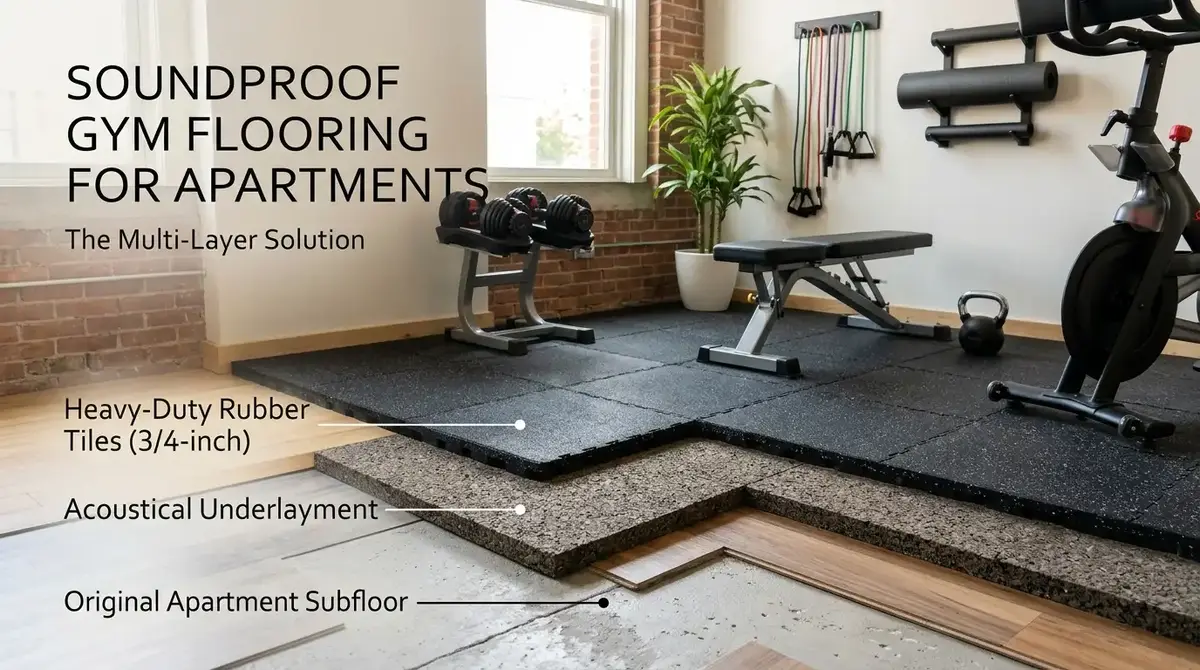

Soundproof gym flooring for apartments works best when you match the floor covering to the noise your workout creates. Dense rubber mats can help reduce some impact noise and protect the floor, while equipment-specific vibration pads may help with treadmill movement. EVA foam suits lighter workouts, but heavy weights and unstable equipment need firmer support. The building’s floor-ceiling construction ultimately determines how much noise reaches your neighbors.
Table of Contents
Best Flooring for Soundproofing an Apartment Gym
The best apartment gym flooring depends on whether you need to reduce footsteps, treadmill vibration, dropped-weight impacts, or general workout noise. For most compact home gyms, dense rubber flooring is a sensible starting point. Equipment-specific isolation pads can address vibration from machines, while low-impact exercises help reduce noise at its source.
Affiliate disclosure: This draft contains no affiliate purchase links. If affiliate links are added before publication, place the site’s disclosure near the top of the article, before the first affiliate link.
| Flooring type | Best for | Noise-control potential | Main limitation |
|---|---|---|---|
| Dense rubber mats or tiles | Dumbbells, benches, general strength training | Helps cushion some impacts and equipment contact | Cannot guarantee sound isolation |
| Rubber flooring rolls | Larger, permanent workout areas | Provides a continuous protective surface | Less convenient to remove or relocate |
| EVA foam tiles | Bodyweight workouts, stretching, light exercise | Cushions footsteps and light contact | May compress or feel unstable under heavy loads |
| Treadmill or equipment mats | Walking pads, exercise bikes, treadmills | Can reduce some machine movement and contact vibration | Performance depends on the machine and floor assembly |
| Purpose-designed acoustic underlayment | Specialized flooring systems | May reduce transmitted impact sound when properly specified | Must be compatible with the finished floor and equipment |
These are general material-selection guidelines, not laboratory rankings. Actual noise reduction depends on the product, installation, equipment, and apartment construction.
How Gym Noise Travels Through Apartment Floors
Apartment workout noise reaches neighbors through two main routes: airborne sound and structure-borne vibration. Choosing the right flooring begins with identifying which route causes the problem.
Impact noise versus airborne noise
Impact noise is created when something strikes or presses against a surface. Examples include jumping, setting down dumbbells, running on a treadmill, and dropping weights. The impact makes the floor vibrate, and those vibrations can travel through the building structure.
Airborne noise travels through the air. Music, spoken instructions, television audio, and some mechanical sounds can pass through walls, ceilings, doors, and gaps.
Rubber mats primarily help by cushioning contact, protecting the finished floor, and changing how impacts are transmitted. They may reduce some impact noise, but their performance varies. They do not automatically provide meaningful sound isolation against every airborne or low-frequency sound.
Why the apartment floor construction matters
A concrete slab, a timber-framed floor, and a floating floor can respond differently to the same workout. The ceiling below, joist arrangement, floor finishes, and existing insulation also affect how much vibration reaches the apartment underneath.
The ASTM E2179-21 floor-covering test standard addresses impact-sound reduction from floor coverings over concrete. Its test results should not be treated as a guarantee of performance on a timber-framed apartment floor.
The Impact Insulation Class (IIC) is a rating used to describe impact-sound insulation in a tested floor-ceiling assembly. It can help with building-material comparisons, but a rating for one assembly does not establish the exact noise level your neighbor will hear from a treadmill or dropped dumbbell.
Compare the Main Types of Noise-Reducing Gym Flooring
Dense rubber, foam tiles, and acoustic underlay serve different purposes. Choose flooring based on load capacity, stability, the noise source, and whether you need a removable setup.
1. Dense rubber gym mats and tiles
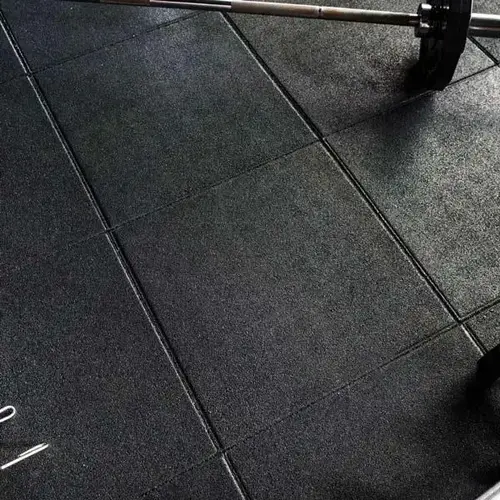
Rubber is a practical choice for dumbbells, benches, kettlebells, and general strength training. It creates a firm surface, protects many finished floors from equipment contact, and can cushion some impacts.
- Best for: Compact strength-training areas.
- Advantages: Durable, relatively firm, easy to clean.
- Limitations: Heavy tiles may be awkward for renters to move, and ordinary rubber flooring may not adequately isolate low-frequency vibration.
- Check before buying: Thickness, density, slip resistance, odor, and compatibility with the existing floor.
2. EVA foam interlocking tiles
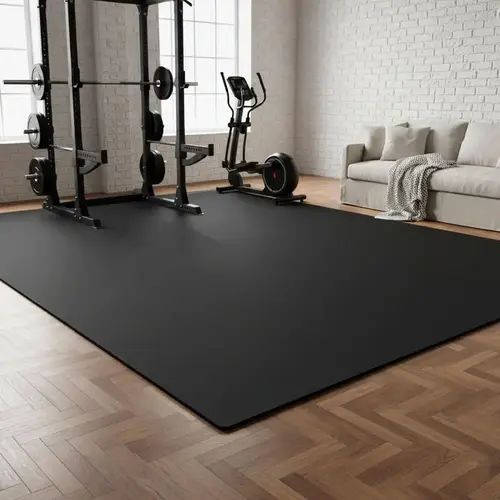
EVA foam tiles are lightweight, portable, and useful for yoga, stretching, Pilates, mobility work, and light bodyweight exercise.
- Best for: Low-impact training and temporary workout zones.
- Advantages: Easy to assemble, comfortable for floor exercises, simple to store.
- Limitations: Soft foam can compress under concentrated loads, shift under lateral movement, or become damaged by heavy equipment.
- Check before buying: Load recommendations, surface grip, joint stability, and whether the tiles can safely support your equipment.
3. Rubber flooring rolls
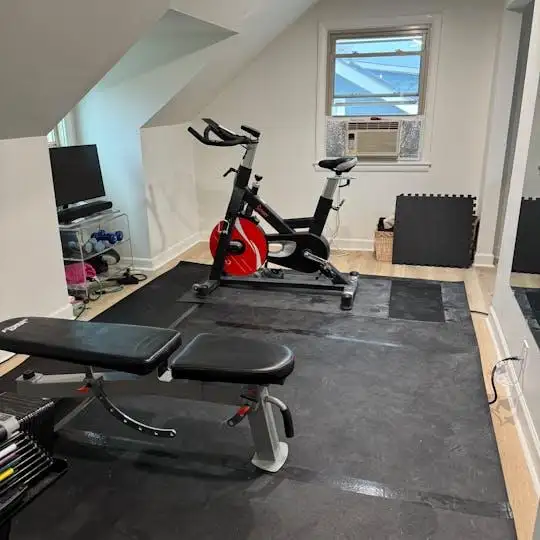
Rubber rolls create a relatively continuous surface for a larger home gym. They reduce exposed seams and work well for fixed equipment layouts.
- Best for: A dedicated workout room or larger training area.
- Advantages: Broad coverage, fewer seams, consistent footing when correctly installed.
- Limitations: Bulky to handle and may require careful edge treatment or installation.
- Check before buying: Product weight, thickness, adhesive requirements, and whether the installation can be reversed without damaging the floor.
4. Treadmill and equipment mats
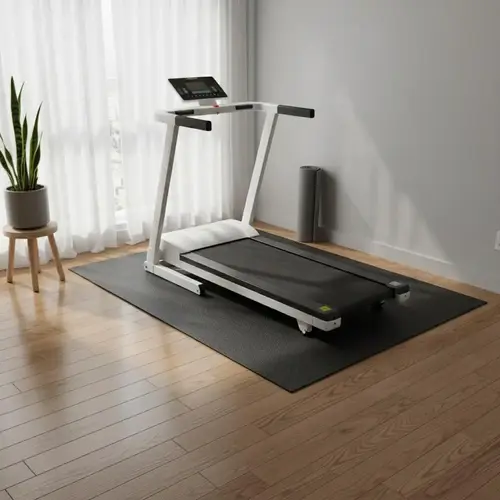
Equipment mats sit beneath a machine to protect the floor and help manage contact vibration. They can be useful under walking pads, treadmills, stationary bikes, and ellipticals.
- Best for: One noisy or vibration-producing machine.
- Advantages: Compact, easy to place, often easier to remove than room-wide flooring.
- Limitations: A basic protective mat is not necessarily an engineered vibration-isolation system.
- Check before buying: Machine dimensions, floor compatibility, mat load rating, and the manufacturer’s placement instructions.
5. Purpose-designed acoustic underlayment
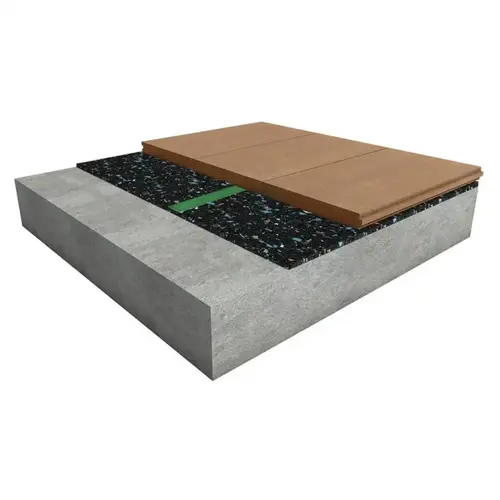
Acoustic underlayment is a resilient layer intended to reduce impact-sound transmission as part of a specified floor system. Some systems are designed for exercise spaces and heavy equipment.
- Best for: Persistent impact-noise problems where the building and floor finish allow a suitable installation.
- Advantages: Can offer measured acoustic performance when tested as part of a compatible assembly.
- Limitations: Costs, installation requirements, and load capacity vary. A soft underlayer beneath a heavy machine can compromise stability.
- Check before buying: Independent test data, the test-floor construction, permitted loads, and installation details.
A useful example of product-level documentation is Acousti Armour’s gym flooring technical information, which lists technical data and performance reports. Review the actual test documents and assembly details before applying any claimed result to your apartment
Choose Flooring for Your Workout
The most effective apartment gym setup combines suitable flooring with quieter exercise choices. Match the floor to the equipment that creates the most vibration or impact.
Treadmills, walking pads, and exercise bikes
Treadmills and walking pads create repeated footfall impacts and mechanical vibration. A properly sized equipment mat may help manage contact vibration and protect the underlying finish, but its effect depends on the machine and floor construction.
Use this checklist:
- Choose a mat that fully supports the machine’s contact points and stays flat during use.
- Follow the equipment manufacturer’s instructions for the permitted floor surface and ventilation.
- Check that the mat does not make the machine rock, slide, or sit at an unsafe angle.
- Use shock-absorbing footwear and select a comfortable walking pace rather than running if footfall noise is a problem.
- Place the machine away from shared walls when the room layout allows it, while preserving safe clearance.
A product specification sheet for Rubber-Cal’s treadmill mat describes a recycled-rubber mat intended for floor protection and reduced machine vibration. Its stated performance is a manufacturer’s claim, not proof that it will silence a particular apartment floor.
For additional guidance, see [INTERNAL LINK: Best Walking Pads for Apartments | anchor: choosing a walking pad for a small apartment].
Dumbbells and strength training
Dumbbells, kettlebells, and weight benches need a firm, stable surface. Dense rubber tiles are generally a better starting point than soft foam when equipment places concentrated loads on the floor.
To reduce noise:
- Lower dumbbells under control rather than dropping them.
- Use suitable rubber-coated weights where appropriate.
- Place a stable, load-rated protective surface beneath the training area.
- Keep equipment from striking walls, skirting boards, and furniture.
- Avoid Olympic-style lifts and heavy weight drops in an apartment unless the building, equipment, and purpose-designed floor system are suitable for those impacts.
A thick mat alone does not make heavy deadlifts or dropped weights apartment-friendly. The impact can travel through structural components, and excessive loading may damage flooring or the building.
See: Selecting stable flooring for strength training.
Bodyweight workouts and low-impact cardio
Yoga, stretching, Pilates, mobility sessions, and controlled bodyweight workouts generally require less impact protection than heavy lifting. EVA foam tiles or a compact exercise mat may be sufficient if the surface remains stable.
For quieter cardio, consider marching in place, controlled step movements, and low-impact routines that keep both feet close to the floor. Avoid repeated jumping if neighbors below are sensitive to impact noise.
How to Build a Quieter Apartment Gym Floor
A practical apartment gym floor starts with the existing floor, followed by a compatible protective layer and a stable surface for your equipment. Extra layers help only when they are suitable for the floor assembly and load.
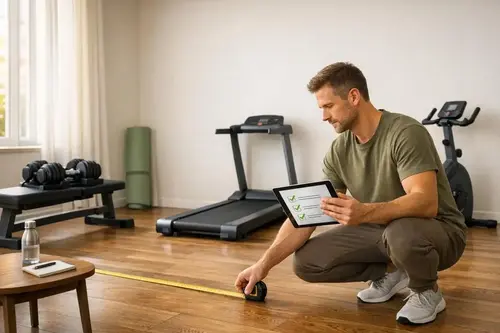
Step 1: Inspect and measure the floor
Check for uneven spots, loose boards, existing damage, moisture concerns, and floor finishes that could react with rubber. Measure the equipment footprint and leave enough room for safe movement and maintenance access.
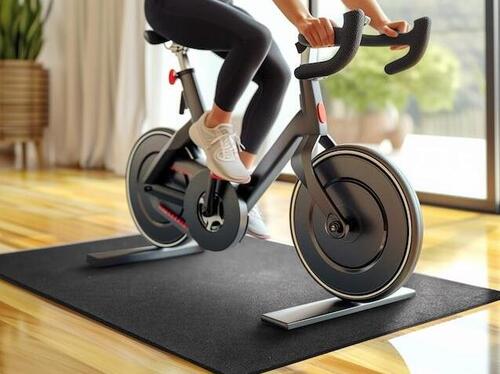
Step 2: Choose a suitable protective surface
Select dense rubber for stable strength-training equipment or a compatible equipment mat for cardio machines. Check the manufacturer’s load guidance and any restrictions on finished flooring.
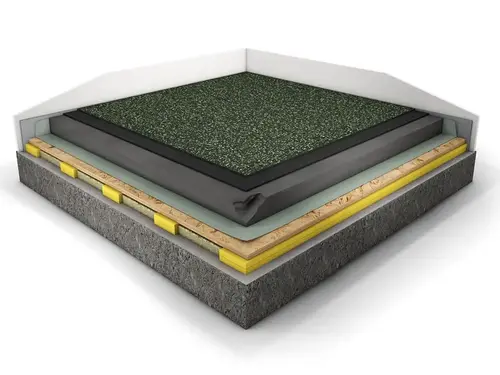
Step 3: Add acoustic layers only when appropriate
A purpose-designed resilient underlayment may help reduce impact transmission, but it must support the intended load without excessive compression or rocking. Follow the flooring system’s installation instructions rather than stacking unrelated foam and rubber products.
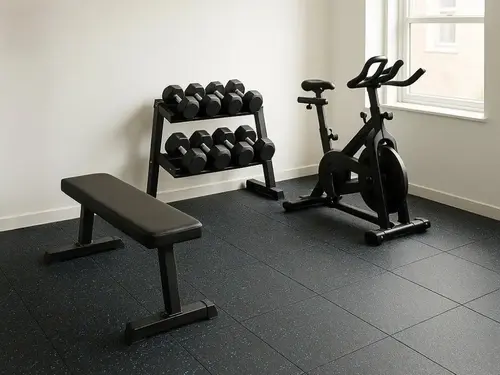
Step 4: Test the setup at low intensity
Start with walking, light weights, or controlled bodyweight exercises. Check for slipping, movement, floor marks, and vibration. If possible, ask your downstairs neighbor whether the change helped, then adjust your workout or equipment placement.
How thick should apartment gym flooring be?
There is no single thickness that works for every apartment gym. A thin protective mat may be sufficient for a stationary bike on a suitable floor, while strength equipment may require denser and thicker rubber. Specialized acoustic systems use their own specifications and load limits.
Choose by intended use and verified performance, not thickness alone. Thickness does not tell you how stiff, dense, resilient, or acoustically effective a material will be.
Should you put rubber directly on hardwood or laminate?
Check both the flooring and mat manufacturer’s guidance before installation. Some rubber compounds can discolor or mark certain finishes, and moisture trapped beneath a mat may cause problems depending on the floor material and environment.
For a rental, use a compatible removable protective layer, inspect underneath periodically, and avoid permanent adhesives unless the owner has approved them. The added layer must also remain flat and secure during exercise.
Common Flooring Mistakes to Avoid
Apartment gym flooring can create new problems when the material or installation does not match the equipment.
- Choosing foam solely because it is soft: Foam can compress under heavy loads and may become unstable under a bench or exercise machine.
- Assuming thicker means quieter: Thickness alone does not establish acoustic performance. Look for test results relevant to the product and floor construction.
- Stacking unrelated mats: Multiple loose layers can slide, buckle, or make equipment unstable.
- Ignoring the existing floor finish: Rubber, adhesives, and trapped moisture may damage some surfaces.
- Expecting flooring to eliminate all noise: Low-frequency vibration can travel through structural components even when the floor covering cushions an impact.
- Ignoring building rules: Leases, condominium policies, and building quiet hours may restrict noisy exercise or heavy equipment.
- Overlooking equipment clearance: A mat must not obstruct doors, vents, moving parts, or safe access around a machine.
If a treadmill continues to transmit noticeable vibration after you add a mat, reconsider the machine’s location, operating speed, maintenance, and isolation requirements before adding more layers. For persistent impact noise, an acoustics professional may be able to assess the floor-ceiling assembly and recommend an appropriate treatment.
Key Takeaways
- Soundproof gym flooring for apartments should be chosen according to the workout, equipment load, and noise source.
- Dense rubber mats are a practical option for many strength-training areas and can help protect finished floors.
- EVA foam is better suited to lighter exercise and floor-based routines than heavy equipment.
- Treadmill mats can help manage contact vibration, but ordinary protective mats do not guarantee sound isolation.
- Thickness alone is a poor way to judge acoustic performance. Check material properties, load ratings, and relevant test results.
- Layered flooring must remain stable and compatible with the existing floor finish.
- Lower-impact exercise, controlled weight placement, and suitable equipment often contribute as much to noise management as the floor covering.
- Persistent noise may require an assessment of the building’s floor-ceiling assembly.
Frequently Asked Questions
1. What is the best soundproof gym flooring for apartments?
Dense rubber flooring is a practical starting point for many strength-training areas because it offers a firm surface and helps cushion some impacts. For treadmills and walking pads, a compatible equipment mat may help with contact vibration. The best choice depends on your equipment, floor construction, and the type of noise you need to reduce.
2. Do rubber mats reduce noise for downstairs neighbors?
Rubber mats can reduce some impact and equipment-contact noise, but the amount varies by product and installation. Low-frequency vibration may still travel through the structure. Laboratory results for a floor covering should not be treated as a guarantee of the sound level in a particular apartment.
3. Is EVA foam or rubber better for apartment gym flooring?
EVA foam is generally better suited to stretching, yoga, and light bodyweight workouts where portability and comfort matter. Dense rubber is usually a better fit for stable strength-training equipment and concentrated loads. Neither material automatically provides soundproofing, so choose based on load capacity and the noise source.
4. How thick should gym flooring be in an apartment?
There is no universal thickness requirement. A protective mat under a stationary bike has different needs from flooring beneath dumbbells or heavy equipment. Compare the material’s density, compression behavior, load rating, and verified acoustic data, and follow the equipment manufacturer’s guidance.
5. Can you deadlift in an upstairs apartment with rubber flooring?
Rubber flooring can protect the surface and cushion some impact, but it cannot guarantee that deadlifts will be quiet enough for neighbors. Dropping weights can transmit substantial vibration through a floor. Controlled lowering is quieter, and heavy lifting should be considered only if the building, floor capacity, and training setup are appropriate.
6. How can I reduce treadmill vibration in an upstairs apartment?
Start with a stable, properly maintained treadmill and a compatible mat recommended for the machine. Place it on a suitable, level surface, check for loose components, and reduce running or high-impact use if necessary. If vibration persists, investigate the floor assembly and consider professional acoustic advice rather than stacking unstable mats.
7. Is soundproof gym flooring suitable for renters?
Removable rubber mats and interlocking tiles can suit renters when the materials are compatible with the existing floor and permitted by the lease. Check the floor for discoloration or moisture before and during use. Avoid permanent adhesives or heavy installations that could damage the property without approval.