
Okay, real talk — if you’ve ever walked into a physical therapy office, a CrossFit box, or a home gym that’s actually worth a darn, you’ve probably spotted them. Those colorful, stretchy bands hanging off doorframes or wrapped around someone’s ankles. That’s right — we’re talking about theraband, and they’re kind of a big deal.
TheraBand is a brand that’s been around since the 1970s, originally developed by a company called Performance Health (formerly Hygenic Corporation) for clinical rehabilitation. But here’s the thing — what started as a therapist’s tool quickly made its way into mainstream fitness, and for good reason. These products aren’t just for people recovering from injuries; they’re legitimate training tools used by Olympic athletes, weekend warriors, and seniors alike.
What makes TheraBands stand out in a crowded market? Two words: trust and consistency. Their color-coded resistance system is internationally recognized, their materials are clinically tested, and their product lineup covers everything from full-body conditioning to super-specific wrist rehab. Whether you’re a total beginner or a seasoned gym rat, there’s a TheraBands product with your name on it.
Table of Contents
Understanding the Core Types of TheraBand Equipment
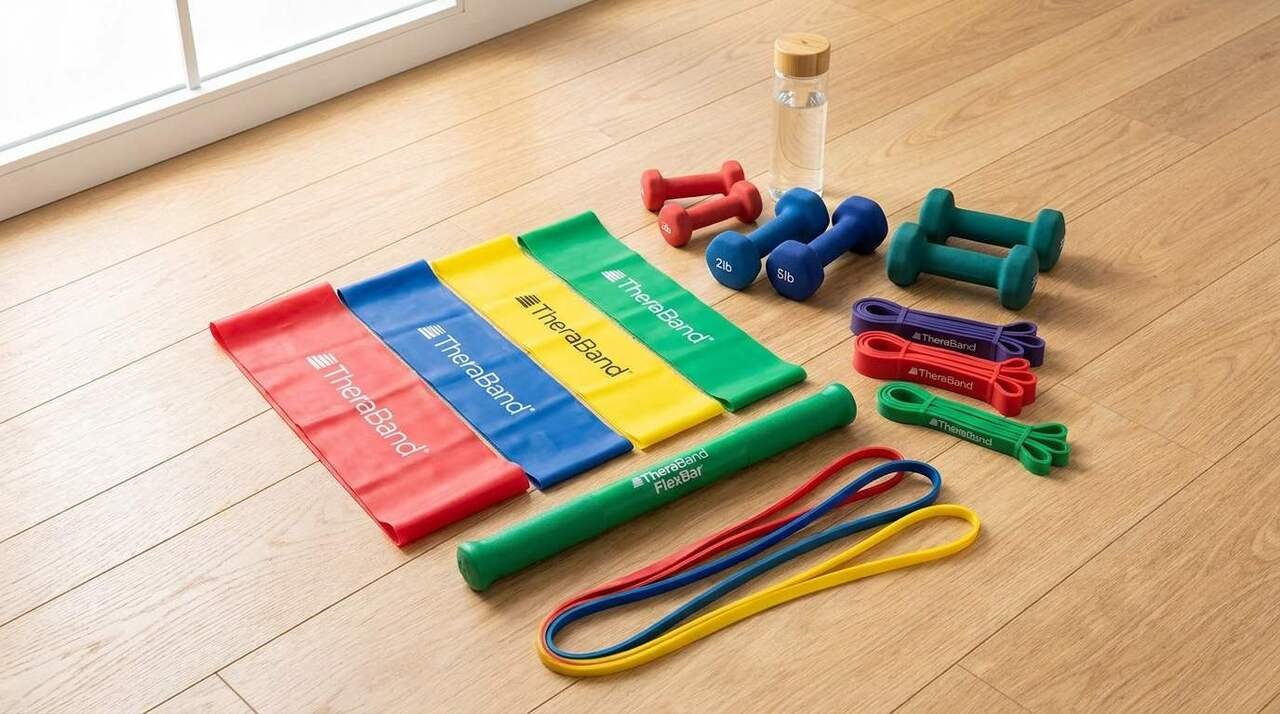
Let’s break down what’s actually in the TheraBands family, because it’s more than just one rubber band. Here’s the lineup:
TheraBands Resistance Bands are the classic flat latex bands — the OGs. They come in a roll or pre-cut strips and are the most versatile option for stretching, strengthening, and rehab work.
TheraBand FlexBar is a rigid, cylindrical rubber bar that flexes and twists. It’s specifically designed for grip strength, forearm rehab, and conditions like tennis elbow. More on this bad boy in a bit.
TheraBands Loop Bands are closed-loop mini bands — think of them as a rubber circle. Perfect for lower body activation, hip work, and glute training.
TheraBands Tubing is round and hollow (like a tube, obviously), and it’s often used with handle attachments for a more cable-machine-like feel.
TheraBands Resistance Tubes are similar to tubing but come with D-ring handles already attached, making them super beginner-friendly for functional training.
How TheraBand Resistance Levels Work
Here’s where things get interesting — and honestly, kind of genius. TheraBands uses a color-coded resistance system that makes it dead simple to know what you’re grabbing.
Here’s the hierarchy from lightest to heaviest:
- Tan — Ultra-light (for post-surgery, early rehab)
- Yellow — Thin (great starting point for most beginners)
- Red — Light (entry-level strength training)
- Green — Medium (a fan favorite for all-around use)
- Blue — Heavy (intermediate to advanced)
- Black — Extra Heavy (serious strength work)
- Silver — Super Heavy (elite athletes only, basically)
- Gold — Max Resistance (this is not for the faint of heart)
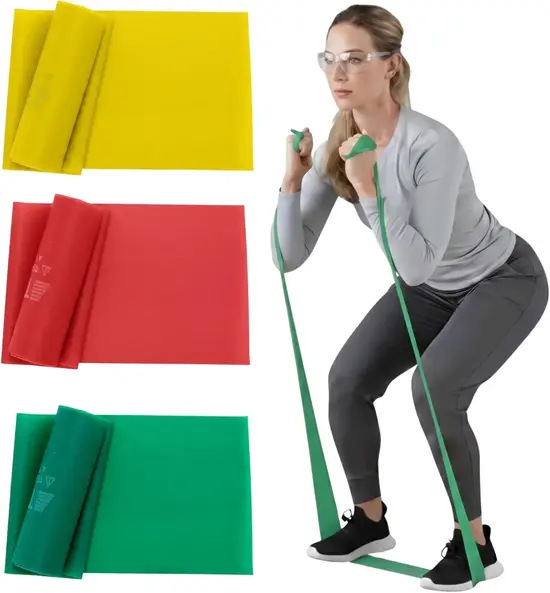
So what does the green TheraBands mean exactly? The green band represents medium resistance, making it one of the most popular all-around choices. It’s strong enough to actually challenge your muscles but forgiving enough to use with decent form. If you’re somewhere between “I’ve been working out a bit” and “I’m pretty consistent,” green is probably your sweet spot.
Beginners should honestly start with yellow or red and work their way up. Don’t let your ego pick your resistance level — your joints will thank you later.
TheraBands FlexBar Explained
Alright, let’s give the TheraBands FlexBar its moment in the spotlight, because this thing is genuinely one of the most underrated rehab and fitness tools ever made.
The FlexBar is a solid, flexible rubber bar — kind of looks like a chubby pool noodle, honestly — that comes in four resistance levels:
- Yellow — Extra Light (3 lbs)
- Red — Light (6 lbs)
- Green — Medium (10 lbs)
- Blue — Heavy (15 lbs)
The unique ribbed texture gives you grip security even when your hands are sweaty, and the natural rubber construction allows it to twist, flex, and oscillate — which is exactly what makes it so effective for treating things like tennis elbow and building grip strength.
Benefits of Using the TheraBands FlexBar
This is where the FlexBar earns its reputation. Here’s what it’s really good for:
Tennis Elbow Relief — The FlexBar is probably best known for the “Tyler Twist” exercise, which was specifically developed to treat lateral epicondylitis (that’s tennis elbow in plain English). Clinical studies have shown significant pain reduction with consistent use — we’re talking real, published research here, not just gym bro testimonials.
Golfer’s Elbow Recovery — The reverse version of the Tyler Twist targets medial epicondylitis, which is the inner-elbow version of the same problem. Same concept, opposite twist direction.
Grip Strength Enhancement — If you’ve ever struggled with pull-ups, deadlifts, or even just opening a jar of salsa, grip strength matters more than people realize. The FlexBar is excellent for building that forearm-to-finger chain of strength.
Wrist and Forearm Rehabilitation — For anyone who’s had a wrist sprain, carpal tunnel issues, or forearm strain, the controlled flex of this bar provides progressive resistance that’s hard to replicate with traditional weights.
Shoulder Stabilization — The oscillating motion you can create with the FlexBar activates the small stabilizer muscles around the shoulder joint — muscles that flat bench press will never touch.
Popular TheraBands FlexBar Exercises
The Tyler Twist — Hold the FlexBar vertically with both hands, flex it with your affected arm, then rotate both wrists toward the floor simultaneously. It sounds weird, it feels weirder, but it genuinely works.
Reverse Tyler Twist — Same movement pattern but reversed for golfer’s elbow. Start with palms up, flex, and rotate upward.
Wrist Flexion and Extension — Anchor one end under your foot or hold it still with your other hand, and do controlled wrist curls. Great for building forearm endurance.
Supination and Pronation Drills — Rotate the bar from palm-up to palm-down positions slowly. Fantastic for anyone in sports that require rotation (baseball pitchers, tennis players, climbers).
Upper Body Conditioning — You can also use the FlexBar for diagonal chopping patterns, shoulder rotations, and even core engagement by holding it at full extension while doing twisting movements.
TheraBands Resistance Bands for Full-Body Fitness
Don’t let the rehab reputation fool you — therabands are fully capable of delivering a complete, challenging workout. Here’s what a full session might look like:
Upper Body — Banded rows, chest presses, shoulder presses, bicep curls, and tricep extensions. Anchor the band to a door and suddenly you’ve got a cable machine.
Lower Body — Squats with the band around your thighs, deadlift patterns, side-stepping lateral band walks (oh, your glutes will feel it), and leg press simulations lying on the floor.
Core Stability — Pallof presses, banded dead bugs, anti-rotation holds, and woodchop patterns. The continuous tension from bands challenges your core in ways that crunches simply can’t.
Stretching and Mobility — Wrap the band around your foot for assisted hamstring stretches, use it to deepen hip flexor stretches, or assist in shoulder mobility work. Physical therapists use them this way constantly.
TheraBands Loop Bands
Loop bands are the mini bands of the TheraBands world — short, closed circles that you typically place around your legs. What makes them different from flat resistance bands? They don’t require anchoring, they stay in place during dynamic movements, and they’re seriously portable (like, fits-in-your-pocket portable).
Best exercises with loops:
- Clamshells — The classic glute med activator. Loop around thighs, lie on side, open that top knee like a book.
- Lateral Band Walks — Step side to side with the band around your ankles. Your hip abductors will revolt against you in the best way.
- Glute Bridges — Loop above the knees, push them out against the band as you bridge up. This is one of the best glute exercises, period.
- Squats — Loop above the knees to cue proper knee tracking and activate the outer glutes simultaneously.
In physical therapy, loop bands are frequently used for knee rehabilitation, hip strengthening after surgery, and balance training progressions.
TheraBands Tubing and Resistance Tubes
Tubing has a round cross-section instead of flat, and that changes how it feels to use. The round construction often gives a more consistent resistance curve throughout the movement, and when you add handle attachments, it honestly starts to feel like a proper cable machine setup.
The big win with tubing is portability meets functionality. You can anchor it to a door, a fence post, a park bench — basically anywhere — and run a full upper-body workout. This is gold for travelers, people with tiny apartments, or anyone who hates paying gym membership fees (so, everyone).
Resistance tubes vs. flat bands — Tubing is generally more comfortable for handle-based pulling exercises, while flat bands are better for wrapping around limbs or using as assisted stretching machine. Both have their place; most serious home gym folks eventually grab both.
Rehabilitation and Physical Therapy Applications
This is TheraBand’s original home turf, and they absolutely dominate here. Physical therapists worldwide trust TheraBands products because of their consistent resistance profiles — meaning a green band today should feel like a green band from any other batch.
Post-injury recovery — After a muscle strain or ligament sprain, you need progressive, controlled loading. TheraBands provides that graduated resistance in a safe, joint-friendly package.
Post-surgery strengthening — Rotator cuff repair, ACL reconstruction, hip replacement — all of these post-op protocols commonly incorporate resistance band work before patients can handle free weights.
Joint mobility improvement — The bands assist in end-range stretching without forcing the joint, making mobility work safer and more effective.
Balance and coordination training — Standing on one leg while performing banded exercises is a sneaky effective way to rebuild proprioception after injury.
Sports Performance Benefits
Athletes have caught on that therabands aren’t just for injured people — they’re actually excellent performance tools.
Warm-up activation — Firing up the glutes, rotator cuff, and hip flexors before a game or training session primes the nervous system and reduces injury risk.
Sport-specific resistance training — A pitcher can simulate throwing mechanics with bands. A swimmer can replicate pull patterns. A sprinter can do resisted hip drives. The applications are genuinely limitless.
Injury prevention — Strengthening the muscles that support vulnerable joints (knees, shoulders, ankles) through band work is one of the highest ROI things any athlete can do.
Home Workout Advantages
Let’s be real — building a home gym is partly about saving money and partly about never having to share equipment with the guy who doesn’t wipe down the machines. TheraBand products nail both motivations.
They’re compact (a full set fits in a drawer), affordable (far cheaper than a gym membership), quiet (no clanging weights at 6am), and low-maintenance (rinse with water, air dry, done). You can genuinely build a complete home gym around a few bands, a mat, and some creativity.
How to Choose the Best TheraBand Product
Here’s a quick cheat sheet:
- For rehab/recovery → Start with yellow or red flat bands, or a red FlexBar if it’s elbow/forearm related.
- For full-body fitness → A set of flat bands (yellow through blue) plus a set of loop bands covers most bases.
- For cable-machine replacement → Resistance tubes with handles and a door anchor.
- For grip and elbow issues → TheraBand FlexBar in red or green.
- On a tight budget → Red and green flat bands. These two cover 80% of what most people need.
Safety Tips for Using TheraBands
Don’t skip this section — seriously. Bands can snap, and a snapping band is not a fun experience.
Inspect before every use — Check for nicks, cracks, or thinning spots. If it looks iffy, toss it.
Anchor properly — Don’t anchor bands to sharp corners, wobbly furniture, or anything that could give way mid-exercise.
Control the movement — Don’t let the band snap back. The eccentric (returning) phase is where a lot of the benefit lives anyway.
Clean them right — Wipe down with a damp cloth and mild soap. Never use harsh chemicals — they’ll degrade the latex.
Replace regularly — Depending on use, every 3-6 months is reasonable. If you’re using them daily in a clinical setting, maybe more often.
Comparing TheraBand to Other Resistance Brands
Look, there are cheaper bands out there. Amazon is full of them. But here’s the thing — resistance accuracy matters, especially in rehab settings. Off-brand bands often have inconsistent resistance that can vary wildly even within the same “color.” TheraBand’s manufacturing standards are clinical-grade, which means what it says on the label matches reality.
Durability is also notably better — TheraBand latex holds up far longer under daily use than generic alternatives. And if you’re using bands post-surgery, do you really want to cheap out? Didn’t think so.
Common Mistakes to Avoid
- Using resistance that’s too heavy too soon — Your form breaks down, your joints take the hit. Start lighter than you think you need.
- Rushing through reps — Slow and controlled beats fast and sloppy every time.
- Skipping warm-up — Even though bands are low-impact, cold muscles and connective tissue still need prep time.
- Training to failure every session — Bands can fatigue you more than you realize. Leave a little in the tank, especially early on.
Accessories That Enhance TheraBand Workouts
A few add-ons that make a big difference:
- Door anchors — Transform any door into a cable machine anchor point. Non-negotiable for home users.
- Foam handles — Much more comfortable for pulling exercises than gripping flat bands.
- Exercise balls — Combine with bands for a killer core stability workout.
- Stability trainers/wobble boards — Add band exercises on an unstable surface for serious proprioception training.
TheraBand Workout Plans by Experience Level
Beginner (3x/week) — 3 sets of 12-15 reps: banded squats, rows, chest press, glute bridges, and lateral walks. Start with yellow or red.
Intermediate (4x/week) — Split upper/lower days. Add cable flyes, Romanian deadlifts, Pallof presses, and single-leg work. Green to blue resistance.
Advanced Athletic (5x/week) — Incorporate explosive band pull-aparts, resisted sprints, rotational power work, and complex compound movements. Blue to black.
Senior Mobility Program (daily) — Seated band rows, standing hip extensions, assisted stretches, light clamshells, and balance exercises. Yellow to red, always supervised initially.
Expert Tips for Maximum Results
Progress the resistance — Don’t stay on the same color forever. If 15 reps feels easy, it’s time to move up.
Combine with free weights — Bands and barbells are best friends. Adding a band to a barbell squat creates accommodating resistance — harder at the top where you’re strongest. Very smart training.
Track your progress — Note which color you’re using, how many reps, and how it felt. Progress is often subtle with bands, so tracking matters.
Prioritize recovery — Bands still cause muscle damage and fatigue. Sleep well, eat protein, and take rest days.
Where to Buy Authentic TheraBand Products
Counterfeit bands are real and genuinely dangerous — they can snap unexpectedly. Always buy from:
- Amazon — Stick to the official TheraBand storefront
- Direct from the TheraBand/Performance Health website
- Medical supply stores — These almost always carry authentic product
- Reputable fitness retailers like Dick’s Sporting Goods, Perform Better, or similar
Red flags for counterfeits — Suspiciously low prices, inconsistent color labeling, flimsy packaging, no resistance chart included.
Summary
TheraBand products are genuinely one of the best investments you can make for your home gym, rehabilitation journey, or athletic performance. Here’s the condensed version:
- FlexBar → Best for elbow, grip, and forearm rehab
- Flat resistance bands → Best all-around training and stretching tool
- Loop bands → Best for lower body activation and glute training
- Tubing with handles → Best for home cable machine simulation
Start with a green or red band and build from there. If you’ve got elbow issues, grab a red FlexBar and look up the Tyler Twist today. And always — always — buy authentic.
Frequently Asked Questions
Q: What’s the difference between TheraBand FlexBar and resistance bands? A: The FlexBar is a solid, rigid rubber bar designed for twisting and gripping exercises — primarily for elbow and forearm rehab. Resistance bands are flat or tubular latex bands used for a much wider range of strength and mobility training.
Q: Which color TheraBand should beginners use? A: Yellow (thin) or red (light) for most people. If you’re recovering from surgery or significant injury, tan or yellow. Don’t rush to heavier resistance.
Q: Is green TheraBand good for rehabilitation? A: Green (medium resistance) is often appropriate for intermediate rehab — typically several weeks post-injury once the initial healing phase is done. Early rehab usually starts with yellow or red.
Q: Can TheraBand FlexBar help with tennis elbow? A: Yes, and there’s actual clinical research backing this up. The Tyler Twist exercise with a green or blue FlexBar has been shown to significantly reduce pain and improve function in lateral epicondylitis patients.
Q: How long do TheraBand bands last? A: With proper care, 3-6 months of regular use is typical. Replace sooner if you notice any discoloration, thinning, stickiness, or surface cracks.
Q: Are TheraBand loops better than tubing? A: It depends on the exercise. Loops are better for lower body work and exercises where you need hands-free resistance. Tubing is better for upper body pulling and pushing patterns where handles improve comfort and grip.
Q: Can TheraBand replace gym equipment? A: For most general fitness goals, absolutely yes — especially for beginners and intermediate-level trainees. Advanced strength athletes will still want free weights for maximum loading, but bands can complement or substitute for a surprisingly large portion of a traditional gym workout.
Ready to build smarter, train safer, and recover faster? A set of quality therabands might just be the best $30-$50 you ever spend on your fitness.