
Amazon Associate Disclosure: As an Amazon Associate, this site earns from qualifying purchases. If you buy through an affiliate link, we may receive a commission at no extra cost to you.
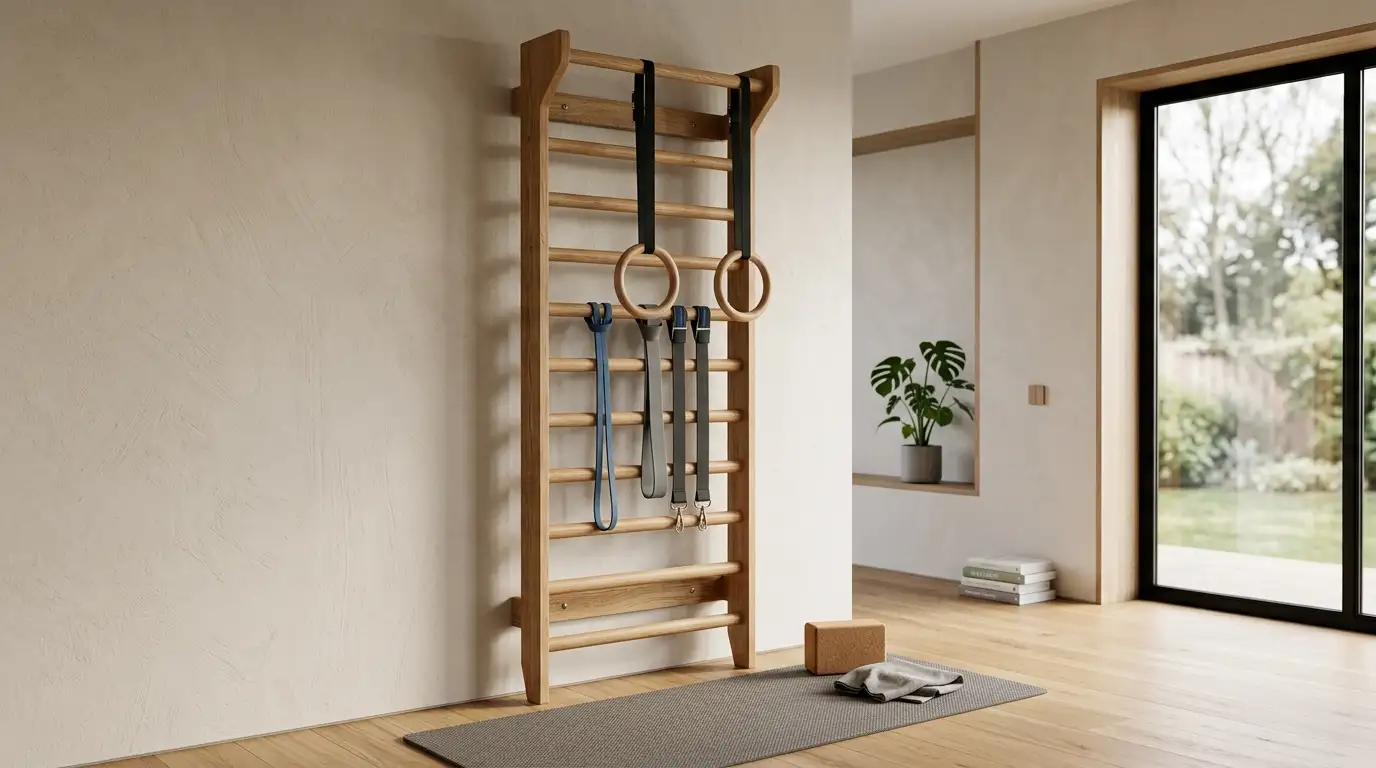
Wall-mounted wooden stall bars can turn a narrow section of wall into a surprisingly capable home training station. Also called Swedish ladders, Swedish wall bars, wall gym ladders, or stall bars, they give you fixed rungs for stretching, mobility drills, bodyweight exercises, resistance bands, suspension trainers, and supported strength work.
For most home gyms, the best choice comes down to three things: solid construction, a reliable wall-mounting system, and enough rung spacing for the exercises you actually plan to do.
Current stall-bar designs range from simple wooden ladders to heavier systems with pull-up bars, dip attachments, suspension points, and adjustable accessories. Some models are also being sold specifically for children and family use.
Table of Contents
Quick Comparison: Best Wooden Stall Bar Types
| Option | Best for | Main advantage | Watch out for |
|---|---|---|---|
| DHT Dynamic Health Tech Swedish Ladder | Adults, home gyms, mobility | Large 80 × 198.4 cm frame and high stated load capacity | Verify wall structure and supplied hardware |
| JOYMOR Wood Stall Bar | Families, stretching, bands | Versatile design and simple wooden construction | Installation instructions have received mixed feedback |
| Syedee Swedish Ladder Stall Bar | General home training | Pull-up, dip and suspension-training options | Wall mounting may require reinforcement |
| Traditional wooden Swedish ladder | Mobility and stretching | Clean, compact design | Fewer exercise attachments |
| Custom-made wooden stall bars | Unusual spaces | Can be built to fit your wall | Quality depends heavily on builder and hardware |
The DHT model lists an 80 × 198.4 cm footprint, wood/alloy-steel construction and a stated maximum weight recommendation of about 150 kg.
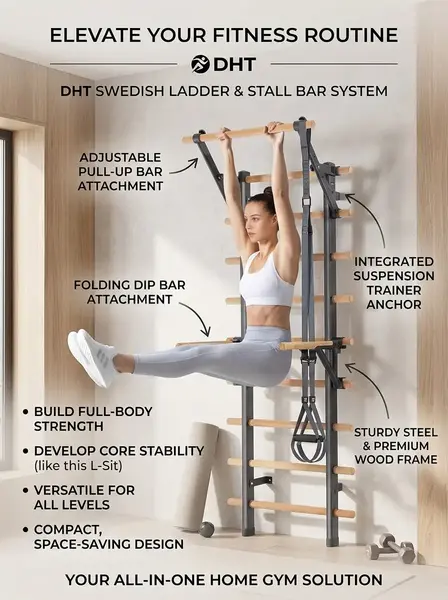
For buyers who want more than stretching, Syedee-style systems can include pull-up and dip attachments plus connection points for resistance bands or suspension trainers. Recent customer feedback also repeatedly points to the importance of attaching the unit securely to studs or suitable masonry.
What Are Wall-Mounted Wooden Stall Bars?
Wall-mounted wooden stall bars are vertical exercise ladders fixed directly to a wall. A typical unit has two vertical wooden rails connected by several horizontal rungs.
The concept comes from the traditional Swedish ladder, a piece of gym equipment designed around climbing, stretching, posture work, gymnastics and physical training.
Modern home versions have expanded the idea. A single set of bars can provide attachment points for:
- Stretching straps
- Resistance bands
- Suspension trainers
- Yoga straps
- Gymnastic rings
- Pull-up attachments
- Dip attachments
- Mobility accessories
The compact footprint is the biggest attraction. A stall bar can occupy roughly the same wall area as a tall shelving unit while supporting dozens of movements.
Why Use Swedish Wall Bars in a Home Gym?
A good stall bar gives you a fixed reference point.
That matters during mobility work because you can control your position against a stable surface rather than trying to balance while stretching.
For example, you can place one foot on a lower rung during a hamstring stretch, hold a higher rung during shoulder mobility work, or use the ladder as an anchor for resistance-band exercises.
The rungs also give you several height options. Instead of adjusting a cable machine or moving a bench, you simply change which rung you use.
Small Footprint
Wall bars make sense when floor space is tight.
They’re particularly useful in:
- Apartment gyms
- Spare bedrooms
- Garage gyms
- Home studios
- Physiotherapy spaces
- Children’s playrooms
- Multipurpose rooms
Once mounted, the equipment stays against the wall rather than consuming floor space.
Multiple Training Styles
One set of bars can support a mixture of mobility, strength and stretching work.
You might use it for a morning mobility routine and later attach resistance bands for a strength session.
Some models go further by adding pull-up and dip attachments. The Syedee system, for example, is marketed with pull-up, dip and suspension-training functionality.
Best Wall-Mounted Wooden Stall Bars to Consider
1. DHT Dynamic Health Tech Swedish Ladder
The DHT Dynamic Health Tech wooden stall bar is one of the more substantial options currently listed online.
The published specifications show an approximately 80 cm wide × 198.4 cm high unit weighing about 16.3 kg, with wood and alloy-steel construction and a stated maximum weight recommendation of approximately 150 kg.
Technical specifications
| Feature | DHT Swedish Ladder |
| Width | About 80 cm |
| Height | About 198.4 cm |
| Weight | About 16.3 kg |
| Material | Wood + alloy steel |
| Mounting | Wall mount |
| Stated maximum | About 150 kg |
Pros
- Tall frame suitable for many mobility exercises
- Compact wall-mounted format
- High stated weight capacity
- Suitable for home gyms and clinics
Cons
- Wall construction matters greatly
- Supplied accessories may not suit every wall
- Buyers should verify mounting hardware before installation
Who it’s for: Adults who want a substantial Swedish ladder for stretching, mobility and bodyweight training.
Who should skip it: Anyone unable to establish secure attachment points in their wall.
2. JOYMOR Wooden Stall Bar
JOYMOR’s wooden stall bar is aimed at home exercise, stretching, gymnastics and family use.
Its current product page shows 89 customer reviews, with 98% of those reviews at five stars on the manufacturer’s site. Customer feedback also mentions its usefulness for stretching, resistance bands and physical-therapy-style exercise.
One recurring theme in customer feedback is installation. Several users recommend attaching the structure to solid studs or adding a wooden mounting structure rather than relying on basic drywall anchors.
Pros
- Versatile exercise platform
- Attractive natural-wood appearance
- Useful for bands and stretching
- Can work well in a family home gym
Cons
- Instructions have received criticism
- Wall mounting may require extra preparation
- Some buyers report alignment or hardware issues
Who it’s for: Families and home-gym users who want a multipurpose wooden ladder.
Who should skip it: Anyone looking for a completely plug-and-play installation.
3. Syedee Swedish Ladder Stall Bar
Syedee’s Swedish ladder design is worth considering if you want a more exercise-focused setup.
Recent customer feedback describes uses including hangs, pull-ups, stretching, resistance bands and TRX-style suspension training. Several buyers also describe reinforcing drywall installations with boards attached directly to wall studs.
Pros
- Good range of exercise possibilities
- Pull-up and dip functionality on some versions
- Multiple attachment points
- Suitable for small home gyms
Cons
- Installation can require additional lumber or hardware
- Wall type affects installation
- Some accessories may have different quality levels
Who it’s for: People who want their Swedish ladder to serve as a broader bodyweight-training station.
Who should skip it: Renters or anyone who can’t make a secure permanent wall installation.
CTA: [Check Current Price on Amazon]
How to Choose Wooden Stall Bars
The wood itself gets plenty of attention, but the mounting system deserves at least as much scrutiny.
A beautiful ladder with poor attachment points doesn’t make a good home gym.
1. Check the Wall First
Before buying, identify what you’re mounting into.
Common wall types include:
- Timber studs
- Solid concrete
- Brick
- Blockwork
- Drywall over studs
- Plaster over masonry
A manufacturer’s supplied hardware may be suitable for one wall type and completely wrong for another.
Recent customer reports on several stall-bar products specifically recommend locating wall studs and using substantial screws or lag bolts for timber framing.
If you’re unsure about your wall, ask a qualified installer before loading the bars with your body weight.
2. Look at the Rung Spacing
Rung spacing changes how the ladder feels.
Closer rungs are useful when you’re working through controlled mobility positions or need many height choices.
Wider spacing can provide more room for larger movements.
Think about your actual exercises rather than choosing based solely on appearance.
3. Check the Overall Height
A nearly two-meter stall bar works well for many adults, but ceiling height still matters.
Measure:
- Floor-to-ceiling height
- Available wall width
- Baseboard height
- Door and window positions
- Clearance above the top rung
- Space in front of the ladder
A tall ladder can become awkward if a ceiling, light fitting or door interferes with the upper section.
4. Inspect the Wood
Look for straight rails, cleanly drilled holes and properly finished rungs.
The surface should feel smooth without sharp edges or splinters.
A good finish also makes frequent hand contact more pleasant.
5. Check the Maximum Load
Treat the stated weight capacity as one part of the buying decision.
Dynamic movements can create greater forces than simply standing on or hanging from a piece of equipment.
Pull-ups, swinging, kipping and aggressive transitions place different demands on the structure and wall connection than controlled stretching.
If your intended exercise creates substantial dynamic loading, choose equipment specifically designed for that use and follow the manufacturer’s instructions.
How to Install Swedish Wall Bars Safely
The safest installation starts with the wall, not the ladder.
Step 1: Identify Structural Fixing Points
For timber-framed walls, locate the studs.
For masonry, identify whether you’re dealing with solid brick, concrete or hollow block.
Don’t assume a generic drywall anchor can safely handle repeated bodyweight loading.
Step 2: Mark the Position
Use a level to mark the vertical rails.
Measure twice before drilling.
The ladder should sit squarely against the wall, with all mounting points positioned exactly where the installation instructions require them.
Step 3: Use Appropriate Hardware
Use the fasteners specified for your wall construction.
Some buyers have replaced supplied hardware with longer or stronger fasteners after discovering that the included screws didn’t suit their wall.
This is one area where buying the right hardware for your actual wall can matter more than saving a few minutes during installation.
Step 4: Tighten and Inspect
After installation, check every mounting point.
Apply gradual pressure before putting your full body weight onto the equipment.
Look for:
- Movement at the wall
- Flexing around mounting brackets
- Loose bolts
- Cracking wood
- Shifting rails
- Unusual noises
If anything moves unexpectedly, stop and correct the installation.
What Exercises Can You Do With Stall Bars?
Wooden stall bars are particularly useful for controlled exercises where you need a stable anchor.
Mobility
Try:
- Hamstring stretches
- Calf stretches
- Hip-flexor stretches
- Shoulder mobility drills
- Thoracic extension work
- Assisted deep squats
The ladder lets you choose a hand or foot position that matches your current mobility.
Core Training
Depending on the design and manufacturer’s instructions, stall bars can support:
- Knee raises
- Leg raises
- Dead-bug variations
- Hollow-body variations
- Isometric holds
Start with controlled movements.
Upper Body
With suitable attachments, you may be able to perform:
- Pull-ups
- Assisted pull-ups
- Rows
- Band presses
- Band curls
- Suspension-trainer exercises
Check the manufacturer’s load and attachment instructions before using accessories.
Lower Body
The fixed rungs are useful for:
- Assisted split squats
- Supported squats
- Hip mobility
- Calf stretching
- Single-leg balance work
The ladder becomes especially useful when you need something stable to hold while learning a new movement.
Stall Bars vs. Power Rack
These two pieces of equipment solve different problems.
| Feature | Stall Bars | Power Rack |
| Wall space | Excellent | Usually needs floor space |
| Mobility work | Excellent | Good |
| Stretching | Excellent | Moderate |
| Pull-ups | With suitable attachment | Usually built in |
| Barbell training | Limited | Excellent |
| Squats | Assisted variations | Full barbell squats |
| Storage footprint | Small | Larger |
| Visual appearance | Minimal wooden ladder | More industrial |
Choose stall bars when mobility, stretching and compact bodyweight training matter most.
Choose a power rack when barbell squats, bench pressing and heavy strength training are central to your program.
For some home gyms, the best setup is both.
Common Buying Mistakes
Buying for Appearance Alone
A Scandinavian-style wooden ladder can look fantastic on a bedroom or studio wall.
Still, check the dimensions, mounting system and load rating first.
Ignoring the Wall
This is probably the biggest mistake.
The ladder may be extremely strong while the wall connection remains the weak point.
Assuming Every Model Fits Every Exercise
A basic Swedish ladder and a multifunction stall-bar system can look similar in photographs while offering very different capabilities.
Check whether your chosen model supports the attachments you want.
Forgetting Clearance
You need room in front of the ladder.
A stall bar installed directly behind a sofa or beside a bed may technically fit while being difficult to use.
Skipping the Installation Manual
Read the instructions before drilling.
Some products have unusual assembly details. For example, customer feedback on one wooden Swedish ladder described intentionally offset holes designed to prevent the rungs from twisting during use.
Are Wooden Stall Bars Good for Small Home Gyms?
Yes. They’re one of the more space-efficient pieces of equipment you can add to a home gym.
The vertical design keeps the floor clear, while the rungs create multiple anchor points.
A compact setup might combine stall bars with:
- Adjustable dumbbells
- Resistance bands
- A folding bench
- A yoga mat
- Gymnastic rings
- A suspension trainer
That gives you a surprisingly broad training setup without filling an entire room with machines.
Are Stall Bars Suitable for Kids?
Some products are specifically marketed as children’s Swedish ladders or indoor climbing equipment.
For example, WEDANTA’s wooden Swedish ladder is marketed for children and family use, with customer reports describing children using it for climbing and play.
Safety depends heavily on installation, product design, supervision and the child’s age.
For children, follow the manufacturer’s age, weight and supervision requirements exactly. Don’t assume an adult fitness stall bar is automatically appropriate as children’s climbing equipment.
Wooden vs. Metal Stall Bars
Wood is popular because it feels warm, looks good indoors and provides comfortable hand contact.
Metal can offer a more industrial appearance and may suit users who prefer heavy-duty gym equipment.
| Factor | Wood | Metal |
| Appearance | Warm, furniture-like | Industrial |
| Hand feel | Generally comfortable | Can feel harder/cooler |
| Home decor | Excellent | Gym-focused |
| Durability | Very good with proper construction | Excellent |
| Maintenance | Check finish and wood condition | Check coatings and corrosion |
| Weight | Varies | Varies widely |
For a bedroom, studio or stylish home gym, wood often blends into the room more naturally.
How Much Wall Space Do Stall Bars Need?
Many adult Swedish ladders are roughly 70–90 cm wide and around 190–220 cm tall, although dimensions vary substantially by manufacturer.
The DHT model currently lists approximately 80 × 198.4 cm.
Measure your wall before ordering.
Leave enough open space around the unit to mount it, use attachments and move safely.
Also check whether the lower part of the ladder conflicts with baseboards. In some installations, users have modified the mounting arrangement to accommodate existing trim.
Frequently Asked Questions
What are wall-mounted wooden stall bars used for?
Wall-mounted wooden stall bars are used for stretching, mobility work, bodyweight exercises, resistance-band training, suspension training and selected gymnastics movements. Models with appropriate attachments can also support pull-ups and dips.
Are Swedish ladders good for home gyms?
Yes. Swedish ladders are particularly useful in small home gyms because they mount vertically and provide multiple fixed attachment points without taking much floor space.
Can you do pull-ups on stall bars?
Some stall bars support pull-ups through an integrated or removable pull-up bar. Check the manufacturer’s specifications before hanging from the structure, especially if you plan to use dynamic movements.
Can stall bars be installed on drywall?
They can sometimes be installed on drywall when the drywall is backed by suitable structural framing, but the load must transfer into appropriate structural members. Several current product reviews specifically describe reinforcing drywall installations by attaching lumber to studs first.
Are wooden stall bars safe?
A properly designed and correctly installed stall bar can be a safe training tool. The wall, fasteners, ladder, accessories and intended exercise all affect safety. Follow the manufacturer’s installation and load instructions.
How high should Swedish wall bars be?
Many adult models are around two meters tall. The ideal height depends on your ceiling, wall layout, body size and intended exercises. Measure the available wall before choosing a model.
Can you attach resistance bands to stall bars?
Many stall bars provide suitable attachment points for resistance bands. Check the manufacturer’s instructions to determine which rungs or mounting points are approved for this use.
Are stall bars worth buying?
They’re worth considering if you want a compact tool for mobility, stretching and bodyweight training. They become more useful when the design supports the accessories and exercises you actually plan to use.
Key Takeaways
- Wall-mounted wooden stall bars are compact Swedish ladders designed for stretching, mobility and bodyweight training.
- Check your wall construction before buying.
- A secure structural connection matters as much as the ladder’s wood construction.
- Look closely at height, width, rung spacing and weight capacity.
- Multifunction models can support pull-ups, dips, resistance bands and suspension trainers.
- Traditional Swedish ladders work especially well for mobility and stretching.
- Leave enough clearance around the ladder for safe movement.
- For children, follow the manufacturer’s age, weight and supervision requirements.
- Wood offers a warm appearance that works particularly well in bedrooms and stylish home gyms.
- Check Current Price on Amazon immediately before buying because availability and product specifications can change.
Final Verdict
Wall-mounted wooden stall bars are one of the smartest additions for a compact home gym when mobility, stretching and bodyweight training are priorities.
The best model depends on how you plan to use it. A simple Swedish ladder is excellent for stretching and mobility, while a multifunction stall bar with pull-up, dip or suspension attachments can become the central anchor for a much broader home workout.
Before you order, measure the wall, identify the structural fixing points and decide which exercises you’ll actually perform. Then choose the stall bar whose dimensions, mounting system and accessories match that plan.