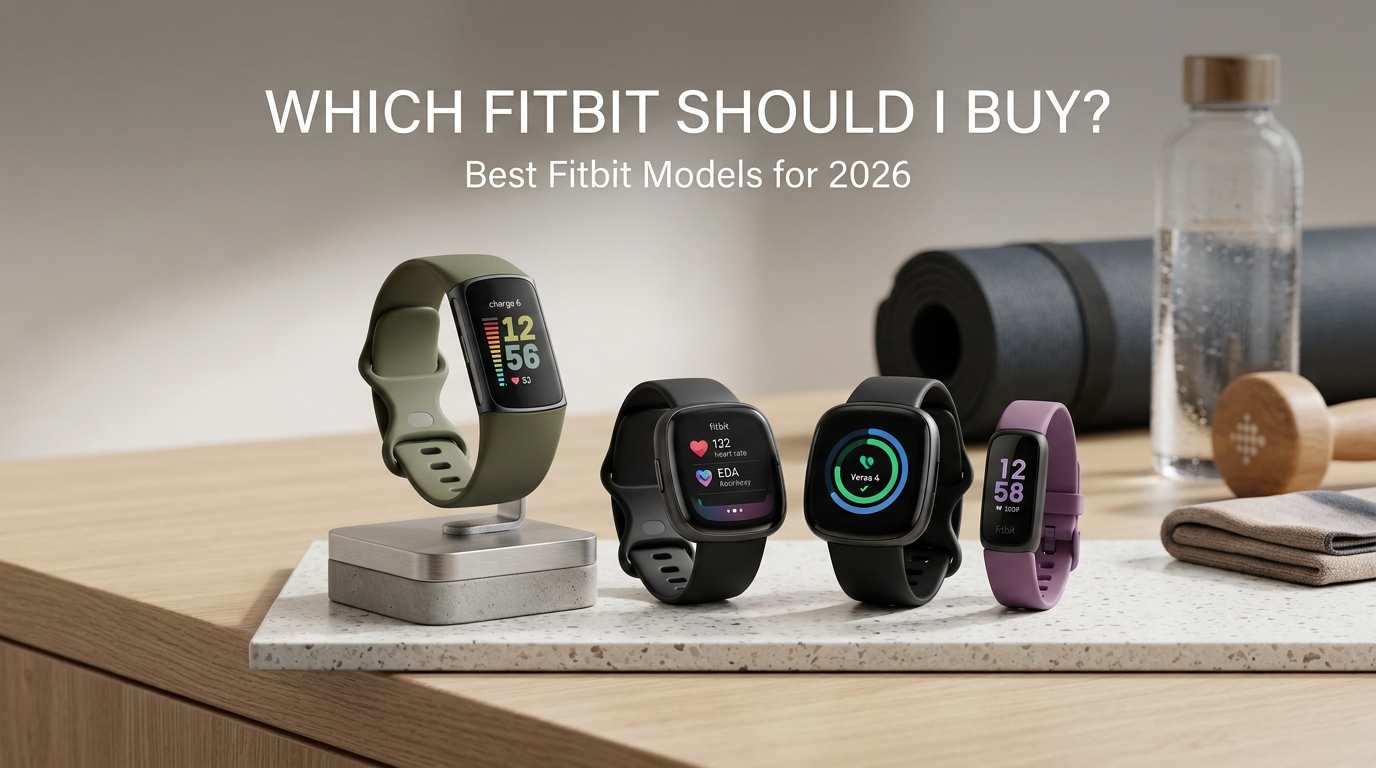

Choosing the right Fitbit in 2026 depends less on buying the most expensive model and more on matching the device to the way we actually use it. Fitbit’s current lineup ranges from simple fitness trackers to full-featured smartwatches, while Google’s broader wearable range now also includes Pixel Watch models.
For most people looking for a traditional Fitbit fitness tracker, the Fitbit Charge 6 offers the most complete combination of fitness tracking, health features, built-in GPS, Google services, and everyday convenience. Those who want something smaller and simpler may prefer the Fitbit Inspire 3, while users who prefer a larger smartwatch-style display can consider the Fitbit Versa 4 or Sense 2.
Table of Contents
Which Fitbit Is the Best for the Money?
The Fitbit Charge 6 is the model to consider when we want a balance between price, features, and everyday usability.
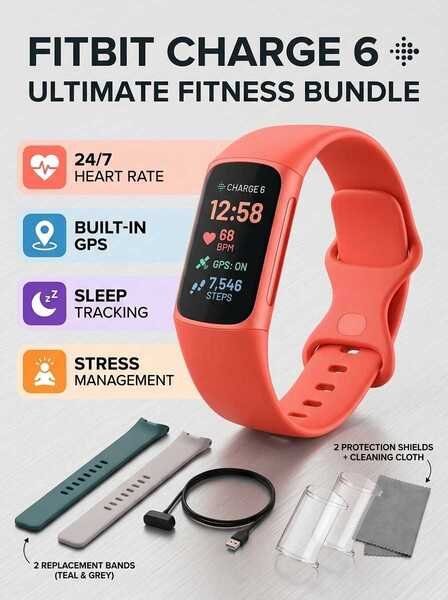
It sits between a basic activity tracker and a smartwatch. The Charge 6 provides a compact design while offering features such as heart-rate tracking, exercise monitoring, sleep tracking, GPS functionality, Google Maps, and Google Wallet support.
Its GPS system is particularly useful for people who regularly walk, run, hike, or cycle. Google lists the Charge 6 as supporting built-in GPS as well as connected GPS, depending on how the device is being used.
Google Maps is also available on the Charge 6, providing turn-by-turn directions on the wrist, although a phone needs to remain within Bluetooth range for navigation.
For people who want a small fitness tracker without giving up important smart features, the Charge 6 is a strong all-around option.
What Is the Most Recommended Fitbit?
There is no single Fitbit that suits every user. The right choice changes depending on priorities.
Fitbit Charge 6 — Best All-Around Fitbit
The Charge 6 makes sense for users who want a fitness-first wearable with useful smart features.
It combines a compact tracker format with features that are normally associated with more advanced wearables. We get activity tracking, heart-rate monitoring, sleep information, exercise modes, GPS, Google Maps, and Google Wallet in one device.
It also supports the Google ECG app in countries where the feature is available. Google’s documentation currently lists the Charge 6 among compatible devices, although ECG availability depends on the country or region.
The Charge 6 is particularly suitable for people who don’t want a large watch on their wrist but still want more than basic step counting.
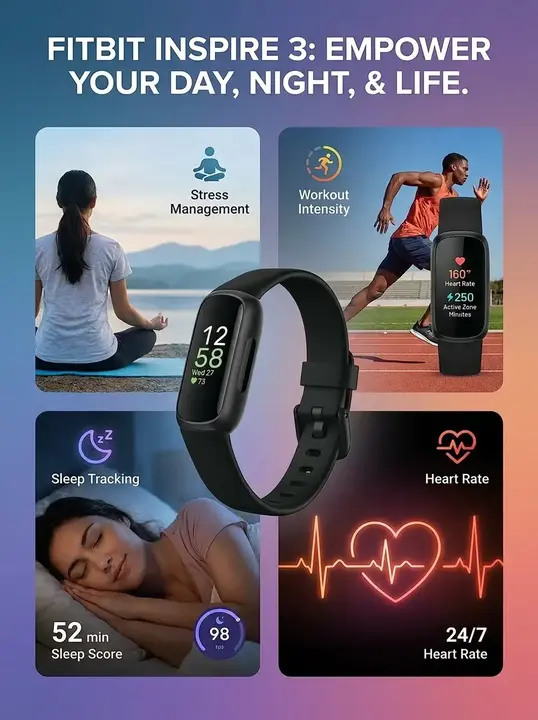
Fitbit Inspire 3 — Best for Simple Fitness Tracking
The Fitbit Inspire 3 is designed for people who want a lightweight and straightforward fitness tracker.
It is a better fit for someone who primarily wants to monitor daily activity, sleep, heart rate, and general wellness without needing a smartwatch-style experience.
One important distinction is GPS. Google’s current GPS documentation lists the Inspire 3 as using phone-connected GPS, rather than having built-in GPS.
That makes the Inspire 3 more suitable for users who normally carry their smartphone during outdoor workouts.
Its simpler approach can also be an advantage. We don’t always need a large screen, extensive apps, or smartwatch functions to stay consistent with exercise and daily movement.
Fitbit Versa 4 — Best Fitbit-Style Smartwatch
The Fitbit Versa 4 is worth considering when a traditional fitness tracker feels too small and we want a larger smartwatch-style design.
It has built-in GPS functionality and supports Google Maps.
The larger display makes information easier to view during workouts and throughout the day. It is also among the Fitbit devices supporting Google Wallet for contactless payments in supported locations.
For someone who wants Fitbit’s health and fitness ecosystem in a watch-like format, the Versa 4 is an option worth comparing with the Charge 6.
Fitbit Sense 2 — Best for Advanced Wellness Features
The Fitbit Sense 2 is aimed at users who place greater importance on wellness and stress-management features.
It includes advanced health sensors and supports the Google ECG app in supported regions.
Like the Versa 4, it has built-in GPS functionality and Google Maps support.
The Sense 2 therefore makes more sense for someone who wants a larger smartwatch design and a broader collection of health-focused features.
Fitbit Charge 6 vs. Inspire 3
The Charge 6 and Inspire 3 are two very different approaches to fitness tracking.
The Inspire 3 is the simpler choice. It works well for everyday activity, sleep tracking, and basic wellness monitoring.
The Charge 6 is more appropriate when we need additional functionality, particularly GPS, Google services, and more advanced fitness capabilities.
One of the most important differences is outdoor exercise tracking. The Charge 6 has built-in GPS, while the Inspire 3 relies on connected phone GPS.
For someone who regularly runs or cycles without wanting to carry a phone, this difference can be significant.
For someone who always has a smartphone nearby and mainly wants a lightweight tracker, the Inspire 3 may provide everything necessary.
Fitbit Charge 6 vs. Versa 4
The choice between the Charge 6 and Versa 4 largely comes down to form factor and display preference.
The Charge 6 has the more compact fitness-tracker design. It is better suited to people who want something relatively unobtrusive.
The Versa 4 has a larger smartwatch-style format. That makes it more practical for people who prefer viewing information on a larger screen.
Both support GPS functionality and Google Maps, and both are compatible with Google Wallet where supported.
If the priority is a compact fitness wearable, the Charge 6 is the more natural fit. If we want a larger smartwatch-style experience, the Versa 4 deserves consideration.
Is It Worth Buying a Fitbit in 2026?
A Fitbit can still be worthwhile in 2026, particularly for users who prioritize fitness tracking, sleep monitoring, daily activity, and wellness data rather than wanting a conventional smartwatch with every possible app and communication feature.
Google’s current Fitbit lineup continues to include the Charge 6, Inspire 3, Versa 4, and Sense 2, alongside newer Google wearable products.
The bigger question is what we expect from the wearable.
If we want a focused health and fitness device, Fitbit remains relevant. If we want a full smartwatch experience with a broader app ecosystem, Google Pixel Watch models may deserve comparison because Google’s current product lineup places Fitbit and Pixel Watch products alongside each other.
How to Choose a Fitbit
Before buying, we should look at five practical factors.
1. Consider GPS
If we run, walk, cycle, or hike outdoors, GPS can make a major difference.
The Charge 6, Versa 4, and Sense 2 support GPS functionality, while the Inspire 3 uses connected phone GPS.
2. Decide How Large We Want the Display
A compact tracker is easier to wear discreetly, while a larger smartwatch-style display can make notifications, workouts, and other information easier to read.
3. Think About Smart Features
Google Maps and Google Wallet are useful additions for people who want more than health tracking. Google currently supports Maps on the Charge 6, Sense 2, and Versa 4.
Google Wallet is supported on several Fitbit models, including the Charge 6, Sense 2, and Versa 4, subject to country and bank availability.
4. Check Regional Availability
Some Fitbit features are not universally available. ECG functionality, for example, is restricted to supported countries and regions.
Google Wallet also depends on supported countries and banks.
5. Buy for Actual Use, Not the Feature List
A long list of specifications doesn’t necessarily make a wearable better for every person.
Someone who wants basic activity and sleep tracking may be perfectly satisfied with the Inspire 3. A runner may benefit more from the Charge 6’s GPS capabilities. Someone who wants a larger screen may prefer the Versa 4, while a user interested in broader wellness features may look toward the Sense 2.
Which Fitbit Model Is Best?
For users who want the best balance of fitness tracking, smart functionality, and compact design, the Fitbit Charge 6 is the model to examine first.
The Inspire 3 is better suited to straightforward tracking and a lightweight design. The Versa 4 provides a larger smartwatch-style experience, while the Sense 2 focuses more heavily on advanced wellness features.
The best Fitbit is therefore the one that matches the way we exercise, sleep, travel, and use technology every day. Rather than paying for features we may never use, we can choose the model that provides the functions that matter most.