
Concept2 SkiErg Review: Features, Performance, Benefits & Buying Guide
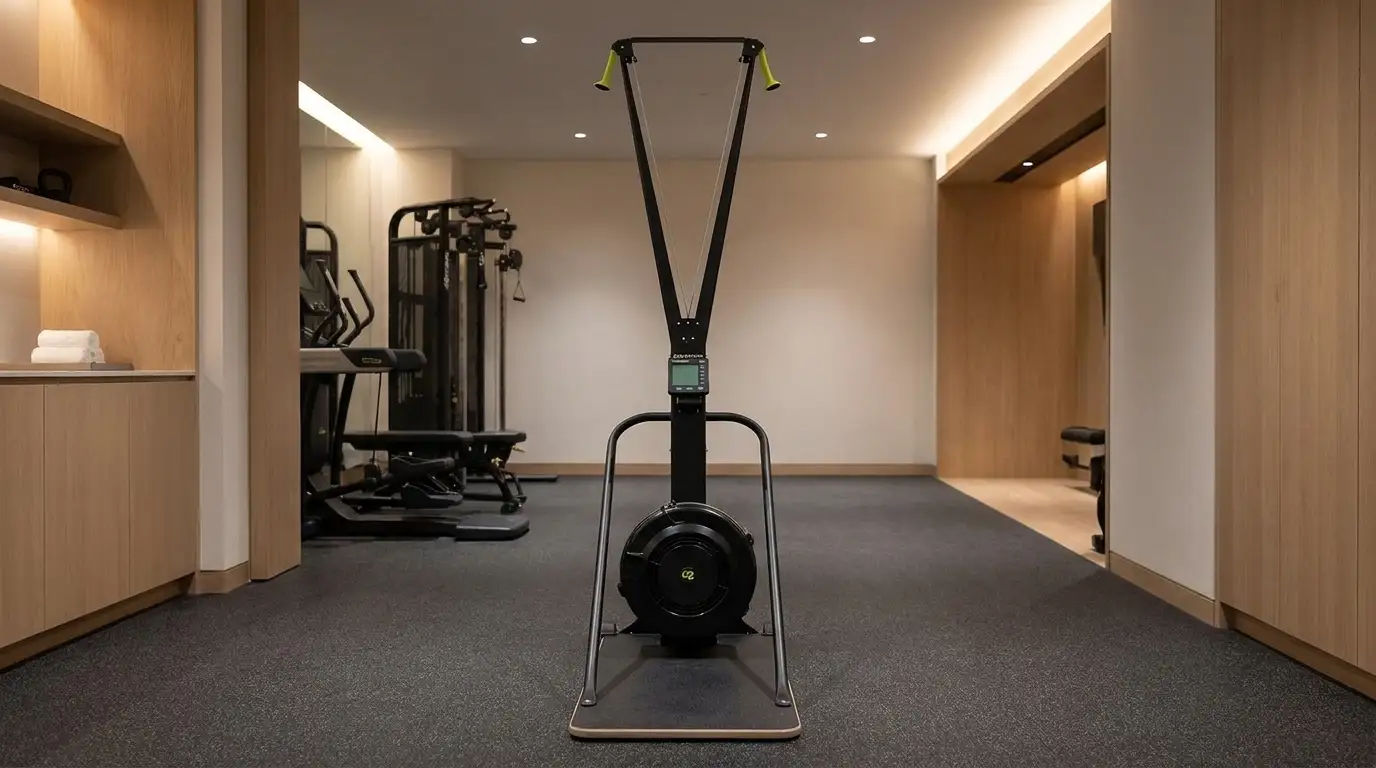
The Concept2 SkiErg is a specialized cardio machine designed to reproduce the powerful upper-body and full-body movements of cross-country skiing. Originally developed to help Nordic skiers maintain their conditioning throughout the year, it has become a popular piece of equipment in commercial gyms, functional fitness facilities, CrossFit boxes, and home workout spaces.
Unlike conventional treadmills, stationary bikes, and rowing machines, the SkiErg emphasizes a vertical pulling motion that challenges the arms, shoulders, back, abdominal muscles, and lower body. Its air-resistance system allows users to control workout intensity through their effort, making it suitable for endurance training, high-intensity intervals, and general cardiovascular conditioning.
Concept2 has established a strong reputation in indoor fitness equipment, particularly through its RowErg. The SkiErg follows a similar engineering philosophy, combining a flywheel resistance system, durable construction, and the company’s Performance Monitor technology.
But is the Concept2 SkiErg worth considering for a home gym? How does it perform, what muscles does it target, and what should buyers know before investing in one?
In this comprehensive Concept2 SkiErg review, we examine its design, resistance mechanism, performance monitoring, training applications, space requirements, advantages, limitations, and overall value.
Table of Contents
Concept2 SkiErg: An Overview of the Machine
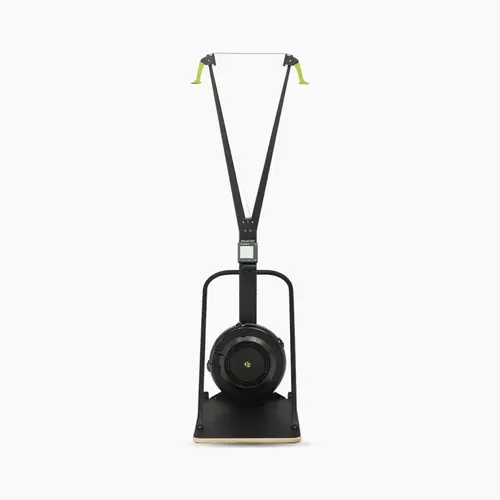
The Concept2 SkiErg is an indoor ski trainer that recreates the double-poling action used in cross-country skiing. Instead of moving along a track or using pedals, users stand in front of the machine and pull two independent handles downward in a controlled movement.
Each handle connects to an internal drive mechanism that turns a flywheel. As the user pulls harder and faster, the flywheel spins faster and generates greater air resistance.
This arrangement creates a responsive training experience. Rather than selecting a fixed resistance level that remains unchanged throughout a workout, users regulate their effort through the intensity of each pull.
The machine supports two principal movement patterns:
- Double-poling technique: Both arms move downward simultaneously, emphasizing coordinated upper-body and core engagement.
- Alternating-arm technique: The arms move independently in a cross-country skiing pattern, creating a different rhythm and coordination challenge.
This versatility makes the SkiErg useful for dedicated skiing preparation as well as general conditioning.
Concept2 introduced the original SkiErg in 2009 and developed its current-generation design in 2014. The machine shares important technology with the company’s indoor rowing equipment, including its flywheel and performance-monitoring approach. Concept2+1
Concept2 SkiErg Specifications
Understanding the machine’s technical specifications helps determine whether it suits a particular training environment.
The following table summarizes the manufacturer’s published specifications.
| Feature | Specification |
|---|---|
| Machine | Concept2 SkiErg |
| Resistance | Air resistance |
| Performance monitor | PM5 |
| Frame | Aluminum |
| Finish | Black powder coating |
| Drive system | High-strength synthetic drive cords |
| Handles | Ergonomic, strapless handles |
| Power | Two D-cell batteries |
| Wall-mounted height | 85 inches |
| Wall-mounted width | 19–20.5 inches |
| Wall-mounted depth | 16 inches |
| Machine weight | Approximately 41 lb |
| Optional floor stand | Standard or wide |
| Training movements | Double-poling and alternating-arm |
| Connectivity | Compatible with supported heart-rate equipment and fitness applications |
The wall-mounted configuration measures approximately 20.5 inches wide, 16 inches deep, and 85 inches tall. The optional standard floor stand requires approximately 23.5 × 50 inches of floor space, while the wide stand measures approximately 32 × 52 inches.
These dimensions make the wall-mounted version particularly interesting for home gyms where preserving floor space is important. Concept2+1
Air Resistance System: How Does the Concept2 SkiErg Work?
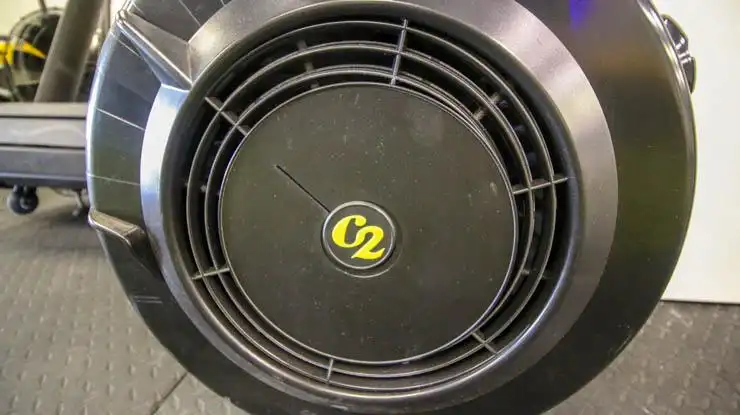
One of the most important features of the Concept2 SkiErg is its air-resistance mechanism.
The system uses a flywheel that spins as the user pulls the handles. Air moves through the flywheel housing, creating resistance that responds to the speed and intensity of the movement.
This means the machine does not impose the same workload on every user.
A beginner performing controlled, moderate pulls experiences a different level of resistance from an experienced athlete performing powerful, rapid repetitions.
Adjustable resistance through the damper
The SkiErg includes an adjustable damper that controls airflow through the flywheel housing.
The damper allows users to modify the machine’s airflow characteristics and the sensation of resistance.
However, it is important to understand that the damper does not work like a conventional weight-stack machine. Increasing the damper setting does not simply assign a fixed resistance value to every pull.
The actual workload still depends heavily on the user’s effort, technique, and pulling speed.
For endurance sessions, a moderate setting can help maintain a consistent rhythm without unnecessary fatigue. For shorter, more demanding intervals, users may experiment with different settings to find an appropriate training feel.
Why air resistance is useful
Air resistance offers several practical advantages:
- Resistance responds naturally to changes in effort.
- Users can increase workout intensity without adjusting weights.
- Different fitness levels can use the same machine.
- The system supports both steady-state and interval training.
- The flywheel creates a smooth, continuous pulling experience.
For home gym owners, this makes the SkiErg a versatile conditioning tool rather than a machine designed around one specific fitness level.
PM5 Performance Monitor: Tracking Every Workout
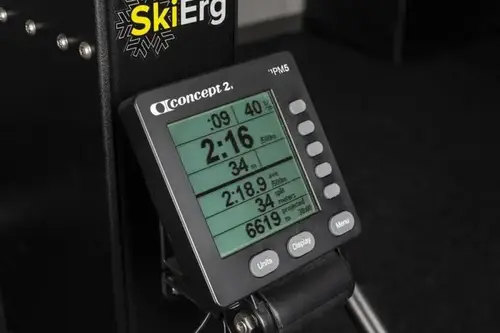
The PM5 Performance Monitor is one of the strongest reasons to consider the Concept2 SkiErg.
Instead of relying exclusively on workout duration or estimated calorie expenditure, the monitor provides performance information that helps users evaluate their training sessions.
Depending on the selected workout and display settings, users can monitor:
- Workout duration.
- Distance.
- Pace.
- Power output in watts.
- Calories.
- Stroke rate.
- Interval performance.
- Workout summaries.
These measurements are particularly useful for structured training.
For example, someone preparing for a skiing competition can monitor improvements in pace and power output over repeated sessions. A general fitness enthusiast can use the same information to compare interval performance and maintain consistent effort.
Workout programming
The PM5 supports different workout formats, including time-based and distance-based sessions.
This flexibility allows users to create training routines around specific goals.
A beginner might start with short intervals separated by recovery periods. More experienced athletes can use longer endurance sessions or demanding interval combinations.
The monitor also supports wireless connectivity for compatible heart-rate equipment and fitness applications.
Concept2’s ErgData application and Online Logbook provide additional options for recording and reviewing workout information.
This ecosystem is especially useful for individuals who prefer measurable progress instead of relying entirely on subjective impressions.
What Muscles Does the Concept2 SkiErg Work?
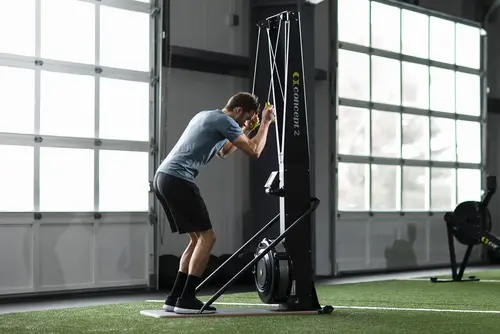
The Concept2 SkiErg offers a distinctive full-body conditioning movement, with particular emphasis on the upper body and core.
Unlike a stationary bike, which primarily emphasizes the lower body, the SkiErg requires coordinated pulling movements involving several major muscle groups.
Latissimus dorsi
The latissimus dorsi muscles, commonly called the lats, play an important role in pulling the handles downward.
These large back muscles contribute to the power and control required during each repetition.
Shoulders
The shoulders contribute to the movement by controlling the arms throughout the pulling phase.
Repeated SkiErg sessions can challenge shoulder endurance, particularly during longer workouts.
Triceps
The triceps help extend the elbows during the downward pulling movement.
They contribute to the final portion of each pull and work alongside the back and shoulder muscles.
Abdominal muscles and core
The abdominal muscles help stabilize the torso and coordinate the upper-body movement.
A controlled technique requires users to engage their core rather than relying exclusively on arm strength.
Glutes and hamstrings
The glutes and hamstrings contribute when users incorporate a coordinated hip hinge and lower-body movement.
Their involvement depends on technique and workout intensity.
Why muscle coordination matters
The SkiErg is not simply an arm-training machine. Effective movement requires coordination between the shoulders, back, arms, abdominal muscles, and hips.
This combination makes it particularly useful for functional conditioning and sports-specific preparation.
However, it should not replace a complete strength-training program. Individuals seeking balanced muscular development should combine SkiErg workouts with appropriate resistance exercises for the chest, legs, and other muscle groups.
Concept2 SkiErg for Home Gyms: Space and Installation
Space requirements are an important consideration when choosing specialized cardio equipment.
The Concept2 SkiErg has a relatively narrow vertical design, which makes it different from conventional cardio machines.
Wall-mounted configuration
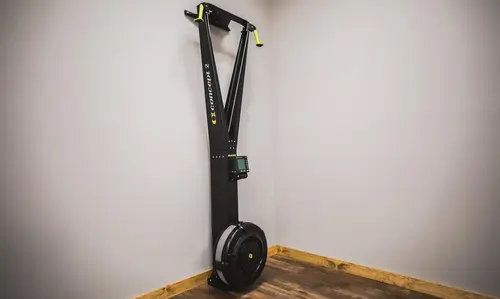
The wall-mounted version is particularly suitable for permanent home gym installations.
It requires approximately:
- 85 inches of height.
- 19–20.5 inches of width.
- 16 inches of depth.
This configuration keeps the machine close to the wall and minimizes the amount of floor space occupied.
Nevertheless, buyers should consider the clearance required for comfortable movement. Users need enough room to stand in front of the machine, extend their arms, and complete full pulling movements without obstruction.
Proper wall mounting is also essential. The installation surface must provide suitable structural support, and the machine should be installed according to the manufacturer’s instructions.
Optional floor stand
Not every training space has a suitable wall for mounting equipment.
Concept2 therefore offers an optional floor stand that allows the SkiErg to operate as a freestanding machine.
The standard stand measures approximately 23.5 × 50 inches, while the wider version measures approximately 32 × 52 inches.
This arrangement offers greater flexibility for shared training spaces, commercial gyms, and home gyms where equipment may need to be repositioned.
The stand also provides a more substantial base for users who prefer not to attach equipment to their walls.
Which configuration should buyers choose?
The wall-mounted version is generally the more space-efficient option for a dedicated workout area.
The floor stand makes more sense when wall installation is impractical or when the machine needs to remain portable within a gym.
Both configurations preserve the same basic SkiErg training experience.
Concept2 SkiErg Training Benefits
The Concept2 SkiErg offers several advantages for individuals who want to develop cardiovascular fitness, muscular endurance, and movement coordination.
Cardiovascular conditioning
The machine can support both moderate-intensity aerobic exercise and demanding interval training.
During longer sessions, users can maintain a sustainable pace while monitoring their performance. During shorter intervals, they can increase pulling intensity to create a more challenging cardiovascular workout.
This flexibility makes the SkiErg suitable for different conditioning objectives.
Upper-body endurance
Many conventional cardio machines emphasize repetitive lower-body movements.
The SkiErg introduces a different training stimulus by requiring repeated pulling actions involving the back, arms, and shoulders.
This can be particularly valuable for athletes who want to develop upper-body endurance alongside their regular cardiovascular training.
Low-impact exercise
The SkiErg does not require running, jumping, or repeated foot strikes.
This makes it an interesting option for people looking for cardiovascular exercise without the repetitive impact associated with running.
Users can also perform the exercise while seated or kneeling, reducing lower-body involvement when appropriate.
However, low-impact does not mean risk-free. The pulling movement still places demands on the shoulders, elbows, and back, making appropriate technique important.
Cross-training versatility
The SkiErg is particularly valuable when incorporated into a broader training program.
It can complement:
- Weight training.
- Indoor cycling.
- Rowing workouts.
- Functional fitness circuits.
- Cross-country skiing preparation.
- General endurance training.
Rather than replacing every other cardio machine, it adds a different movement pattern to the training environment.
Concept2 SkiErg vs. Concept2 RowErg: Which Is Better?
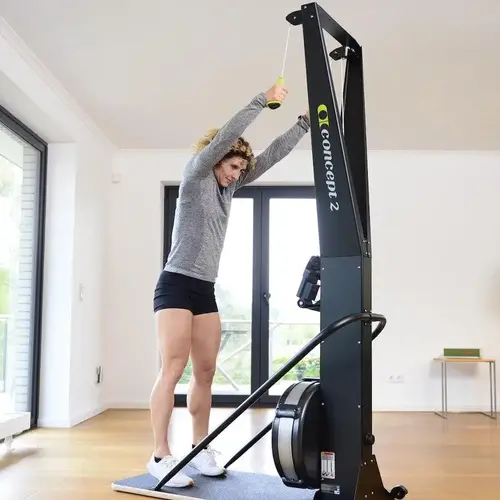
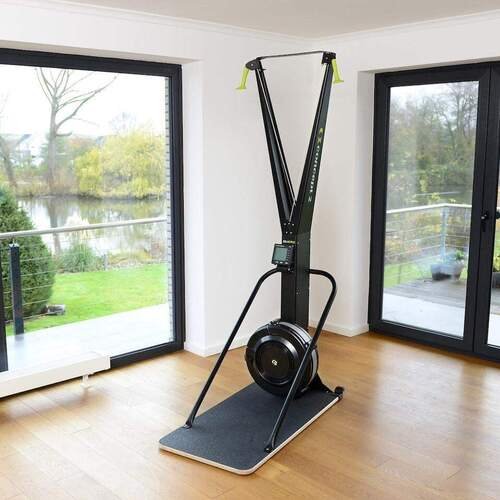
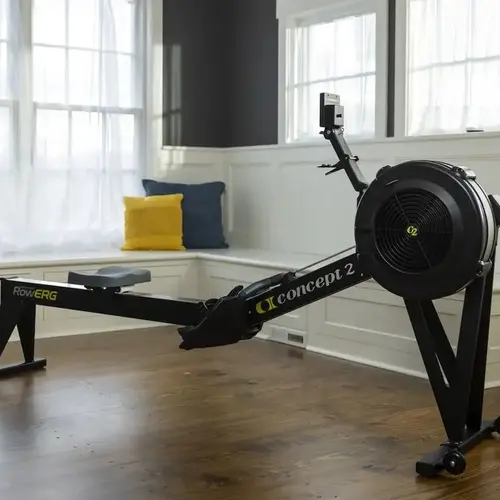
The Concept2 SkiErg and RowErg share an air-resistance training philosophy, but their movement patterns and muscular demands are considerably different.
The SkiErg focuses on vertical pulling, while the RowErg reproduces the horizontal rowing movement.
| Feature | Concept2 SkiErg | Concept2 RowErg |
|---|---|---|
| Main movement | Vertical pulling | Horizontal rowing |
| Primary emphasis | Upper body and core | Full body |
| Lower-body involvement | Technique dependent | Significant |
| Training position | Standing, seated or kneeling | Seated |
| Main muscle groups | Lats, triceps, shoulders, core | Legs, back, arms, core |
| Training focus | Ski-specific conditioning and upper-body endurance | General conditioning and rowing endurance |
| Space arrangement | Vertical wall-mounted or freestanding | Horizontal floor-based |
Neither machine is universally better.
The SkiErg is an attractive choice for athletes seeking upper-body conditioning and a skiing-specific movement.
The RowErg is generally more appropriate for people who want a conventional full-body rowing workout with substantial leg involvement.
For a closer examination of the rowing alternative, see our Concept2 Rower Review.
That comparison is particularly useful for buyers deciding which Concept2 machine deserves a place in their home gym.
Concept2 SkiErg vs. Other Home Gym Cardio Equipment
The SkiErg occupies a relatively specialized position in the home fitness market.
To understand its value, it helps to compare its training approach with other popular conditioning machines.
SkiErg vs. stationary bikes
Stationary bikes emphasize repetitive lower-body movement, making them useful for cycling preparation and general aerobic conditioning.
The SkiErg shifts the emphasis toward upper-body pulling and core engagement.
A stationary bike may be the more practical choice for someone who prefers seated cardio and lower-body endurance training.
The SkiErg offers greater movement variety for people who already own a treadmill or exercise bike.
For readers comparing specialist equipment, our Vulcan Fitness vs. Concept2 BikeErg comparison provides another perspective on the Concept2 ecosystem.
SkiErg vs. rowing machines
Rowing machines provide a coordinated movement involving the legs, hips, back, and arms.
The SkiErg emphasizes the upper-body pulling action and allows users to train in a standing position.
A rowing machine generally requires more horizontal floor space, whereas the wall-mounted SkiErg uses a compact vertical arrangement.
Both can provide challenging cardiovascular workouts, but they are not interchangeable from a movement or training perspective.
SkiErg vs. compact rowing machines
For people with limited workout space, compact rowing equipment can be an alternative worth considering.
However, folding mechanisms, rail length, resistance systems, and storage requirements differ considerably between models.
Our guide to compact rowing machines explores equipment designed for smaller training environments.
The key distinction is that compact rowing machines still reproduce a horizontal rowing movement, while the SkiErg provides a vertical pulling exercise.
Recommended Concept2 SkiErg Workouts
The SkiErg can accommodate different fitness levels, provided users adjust duration and intensity appropriately.
Below are several workout structures that demonstrate its versatility.
Beginner workout: Building technique and endurance
Beginner
| Exercise | Duration |
|---|---|
| Easy warm-up | 3 minutes |
| Moderate SkiErg effort | 2 minutes |
| Easy recovery | 1 minute |
| Repeat | 4 rounds |
| Cool-down | 3 minutes |
The objective is to develop a comfortable rhythm and become familiar with the resistance mechanism.
Beginners should prioritize controlled movements rather than trying to achieve maximum power.
Intermediate workout: Aerobic intervals
Intermediate
| Exercise | Duration |
|---|---|
| Warm-up | 5 minutes |
| Moderate-hard effort | 3 minutes |
| Easy recovery | 90 seconds |
| Repeat | 5 rounds |
| Cool-down | 3 minutes |
This workout develops the ability to sustain a demanding but controlled effort over repeated intervals.
Users should monitor their pace and avoid starting too aggressively.
Advanced workout: High-intensity intervals
Advanced
| Exercise | Duration |
|---|---|
| Warm-up | 5 minutes |
| High-intensity effort | 30 seconds |
| Recovery | 60 seconds |
| Repeat | 10 rounds |
| Cool-down | 5 minutes |
This format challenges cardiovascular conditioning and upper-body muscular endurance.
The intense intervals should remain technically controlled. If movement quality deteriorates, users should reduce intensity or extend recovery.
How frequently should you use the SkiErg?
Training frequency depends on individual fitness levels, recovery capacity, and other exercise commitments.
For general conditioning, two or three weekly sessions can provide a useful starting point.
People who also perform demanding strength training should account for accumulated fatigue, particularly in the shoulders, arms, and back.
A balanced program should include recovery days and exercises that develop other movement patterns.
Concept2 SkiErg Durability and Maintenance
Durability is an important consideration when purchasing specialized fitness equipment.
The Concept2 SkiErg uses an aluminum frame, a high-strength drive-cord system, and an enclosed flywheel mechanism.
Its construction is designed for repeated training in both home and commercial environments.
The manufacturer also emphasizes relatively straightforward maintenance.
Nevertheless, buyers should not assume that durable equipment requires no attention.
Basic maintenance recommendations
To keep the machine in good working condition:
- Wipe down the handles and accessible surfaces after workouts.
- Keep the flywheel housing free from excessive dust.
- Inspect the drive cords periodically.
- Check mounting hardware and fasteners.
- Follow the manufacturer’s maintenance instructions.
- Investigate unusual noises or changes in pulling resistance.
The machine should be installed and maintained according to the official documentation.
Replacement parts and manufacturer support are also important considerations when evaluating the long-term ownership experience.
For commercial facilities, regular inspection is particularly valuable because equipment may be used by several people throughout the day.
Advantages and Disadvantages of the Concept2 SkiErg
No specialized fitness machine is suitable for every buyer.
Although the Concept2 SkiErg offers an interesting combination of performance monitoring, responsive resistance, and space-efficient installation, its specialized movement pattern deserves consideration.
Main advantages
- Distinctive training movement: Provides a vertical pulling exercise that differs from conventional cardio machines.
- Responsive air resistance: Resistance adjusts naturally to the user’s effort.
- PM5 performance monitor: Provides measurable workout data.
- Versatile training: Supports endurance sessions, intervals, and ski-specific preparation.
- Wall-mounted option: Helps preserve valuable floor space.
- Freestanding configuration: Optional stands provide installation flexibility.
- Upper-body conditioning: Emphasizes the back, shoulders, arms, and core.
- Accessible movement options: Can accommodate seated or kneeling exercise variations.
- Established equipment platform: Benefits from Concept2’s existing performance-monitoring ecosystem.
Potential disadvantages
- Specialized movement: The SkiErg does not replace a treadmill, rowing machine, or stationary bike.
- Additional installation considerations: Wall mounting requires a suitable supporting surface.
- Optional floor stand: Buyers who cannot mount the machine may need to purchase additional equipment.
- Vertical clearance: Its approximately 85-inch height requires sufficient ceiling clearance.
- Technique matters: Poor pulling mechanics can place unnecessary stress on the upper body.
- Limited lower-body emphasis: People seeking substantial leg-focused cardio may prefer another machine.
The most important consideration is whether the SkiErg’s movement pattern matches your training objectives.
13. Who Should Buy the Concept2 SkiErg?
The Concept2 SkiErg is particularly appealing to several types of users.
Cross-country skiers: The machine reproduces an important skiing movement, making it useful for year-round conditioning and technique-related training.
Functional fitness athletes: The SkiErg introduces a demanding conditioning movement that can be incorporated into interval workouts and fitness circuits.
Home gym enthusiasts: Its wall-mounted configuration is attractive for people who want specialized cardio equipment without dedicating a large area to a conventional machine.
Endurance athletes: Runners, cyclists, and other endurance enthusiasts can use it to introduce upper-body conditioning into their training programs.
Commercial gym owners: Its distinctive movement pattern can diversify the cardio equipment selection and provide members with an alternative to traditional machines.
People seeking low-impact conditioning: Its lack of running or jumping movements makes it worth considering for individuals who prefer lower-impact cardio options.
However, buyers who primarily want a machine for leg-focused exercise, casual walking, or conventional cycling may find other equipment more appropriate.
Is the Concept2 SkiErg Worth the Investment?
The value of the Concept2 SkiErg depends on how frequently it will be used and whether its specialized training benefits justify the purchase.
It is not simply another general-purpose cardio machine. Its strongest selling point is the ability to provide a different conditioning experience through a controlled, repeatable pulling movement.
The PM5 monitor adds measurable performance information, while the air-resistance mechanism accommodates a wide range of workout intensities.
For dedicated skiers and functional fitness athletes, these features can make the machine a valuable part of a broader training environment.
For home gym owners, the wall-mounted design is another advantage, particularly when compared with equipment that occupies a substantial horizontal footprint.
However, the optional floor stand, installation requirements, and available workout space should be included in the overall purchasing decision.
We recommend comparing the complete purchase cost, including any necessary accessories, shipping, and installation requirements, rather than evaluating the machine’s base price alone.
It is also worth checking the current manufacturer warranty and regional pricing before ordering, as these details can vary by market.
What to Check Before Buying a Concept2 SkiErg
Before purchasing, we recommend evaluating several practical considerations.
1. Available installation space
Measure the available wall or floor area and check ceiling clearance. Remember that users need additional room in front of the machine to perform the pulling movement comfortably.
2. Wall mounting or floor stand
Determine whether your gym has an appropriate mounting surface. If not, include the optional floor stand in your budget.
3. Training objectives
Consider whether upper-body conditioning, cross-country skiing preparation, and functional fitness are important parts of your routine.
4. Performance monitoring
The PM5 is useful for people who enjoy structured training and tracking measurable improvements.
5. Total ownership cost
Compare regional prices, shipping expenses, accessories, and warranty conditions. Avoid assuming that the machine’s advertised base price represents the complete installation cost.
6. After-sales support
Check the availability of replacement parts and technical assistance in your country. This is particularly important when purchasing specialized fitness equipment internationally.
Frequently Asked Questions About the Concept2 SkiErg
Is the Concept2 SkiErg good for beginners?
Yes. The Concept2 SkiErg can accommodate beginners because users control their effort through their pulling intensity. New users can start with short, moderate sessions and gradually increase workout duration as their technique and conditioning improve.
Does the Concept2 SkiErg build muscle?
The SkiErg challenges the lats, triceps, shoulders, abdominal muscles, and other supporting muscle groups. It can help develop muscular endurance, but it should complement rather than replace progressive resistance training when muscle growth is the primary objective.
Can you use the Concept2 SkiErg while sitting down?
Yes. The machine can accommodate seated and kneeling training variations. These positions reduce lower-body involvement while allowing users to continue performing the pulling movement with their upper body and core.
Is the Concept2 SkiErg better than a rowing machine?
Neither machine is universally better. The SkiErg emphasizes vertical pulling and upper-body conditioning, whereas the RowErg involves a horizontal rowing movement with substantial lower-body contribution. The better choice depends on individual training objectives.
Does the Concept2 SkiErg require electricity?
The PM5 uses two D-cell batteries. During exercise, the monitor also draws power from the spinning flywheel to extend battery life. The machine does not require a conventional electrical outlet for normal operation.
Can the Concept2 SkiErg be mounted on any wall?
No. The mounting surface must provide appropriate structural support. Buyers should follow Concept2’s installation instructions and use suitable mounting hardware. When wall mounting is impractical, the optional floor stand provides an alternative.
How much space does a Concept2 SkiErg require?
The wall-mounted machine requires approximately 20.5 inches of width, 16 inches of depth, and 85 inches of height. Additional clearance is necessary for comfortable exercise. The standard floor stand requires approximately 23.5 × 50 inches of floor space.
Is the Concept2 SkiErg suitable for CrossFit workouts?
Yes. Its ability to accommodate different intensities and interval formats makes it suitable for functional fitness circuits, conditioning workouts, and structured training sessions.
Can the Concept2 SkiErg replace a treadmill?
Not completely. Both machines provide cardiovascular exercise, but their movement patterns and muscular demands are different. The SkiErg emphasizes upper-body pulling, while a treadmill reproduces walking or running.
Final Verdict: Should You Buy the Concept2 SkiErg?
The Concept2 SkiErg is a specialized cardio machine that brings an effective and distinctive training movement into the home or commercial gym.
Its responsive air-resistance mechanism, PM5 Performance Monitor, durable construction, and wall-mounted installation option make it an interesting choice for athletes and fitness enthusiasts seeking something different from conventional cardio equipment.
Its greatest strength is its versatility within its intended training category. Users can perform steady endurance sessions, short intervals, and more demanding conditioning workouts while monitoring their performance.
The machine is particularly attractive for cross-country skiers, functional fitness athletes, and home gym owners who want to develop upper-body conditioning without relying exclusively on traditional cardio equipment.
Nevertheless, it is important to recognize its limitations. The SkiErg does not offer the same lower-body emphasis as a stationary bike or rowing machine, and its specialized movement may not suit everyone’s training preferences.
Our overall recommendation: Consider the Concept2 SkiErg if you want a dedicated upper-body conditioning machine with reliable performance monitoring, adjustable air resistance, and flexible installation options. If your priority is conventional full-body cardio, compare it with the Concept2 RowErg and other compact rowing alternatives before making your final decision.
For the right training environment, the Concept2 SkiErg can be a valuable addition to a well-designed home gym.