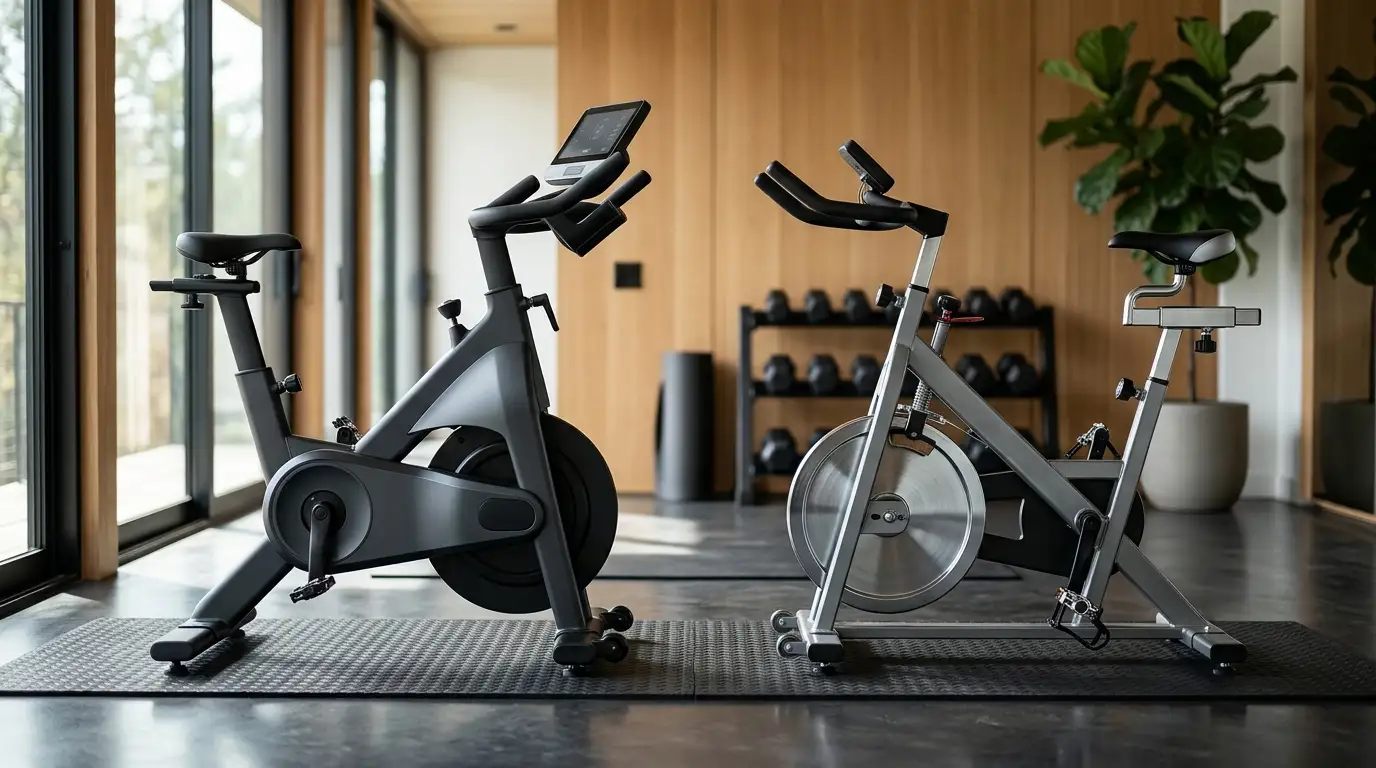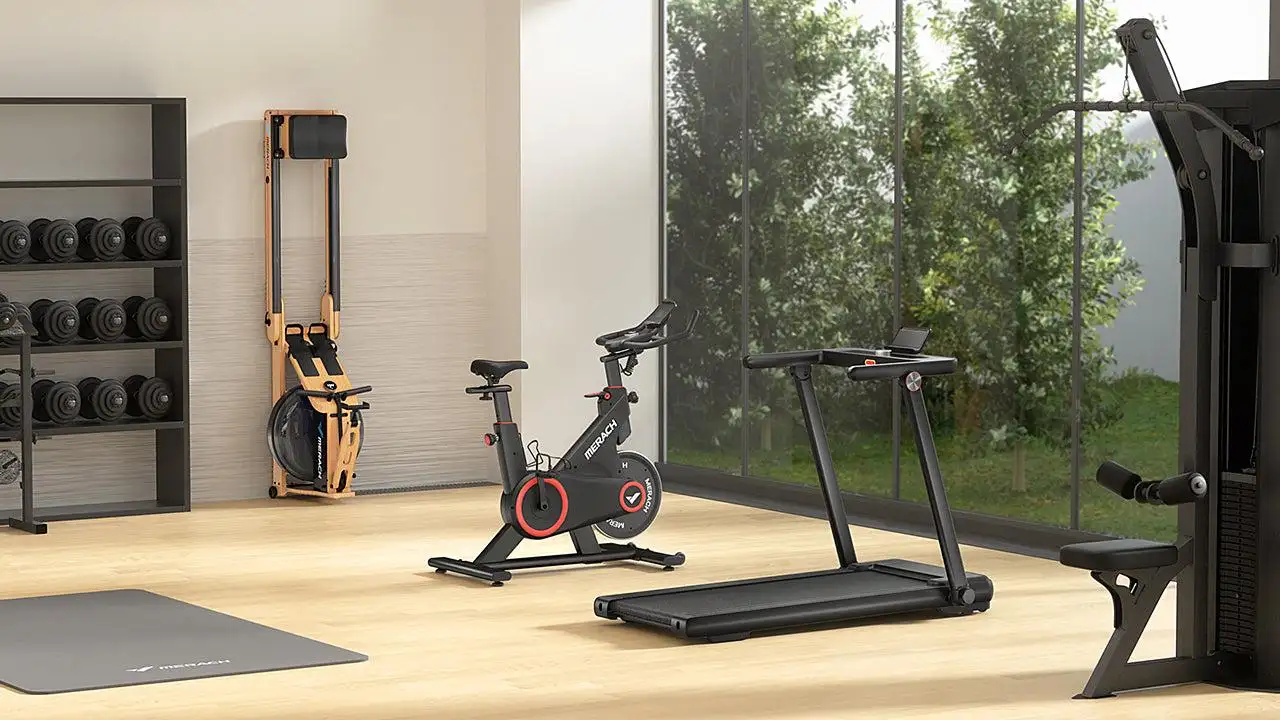
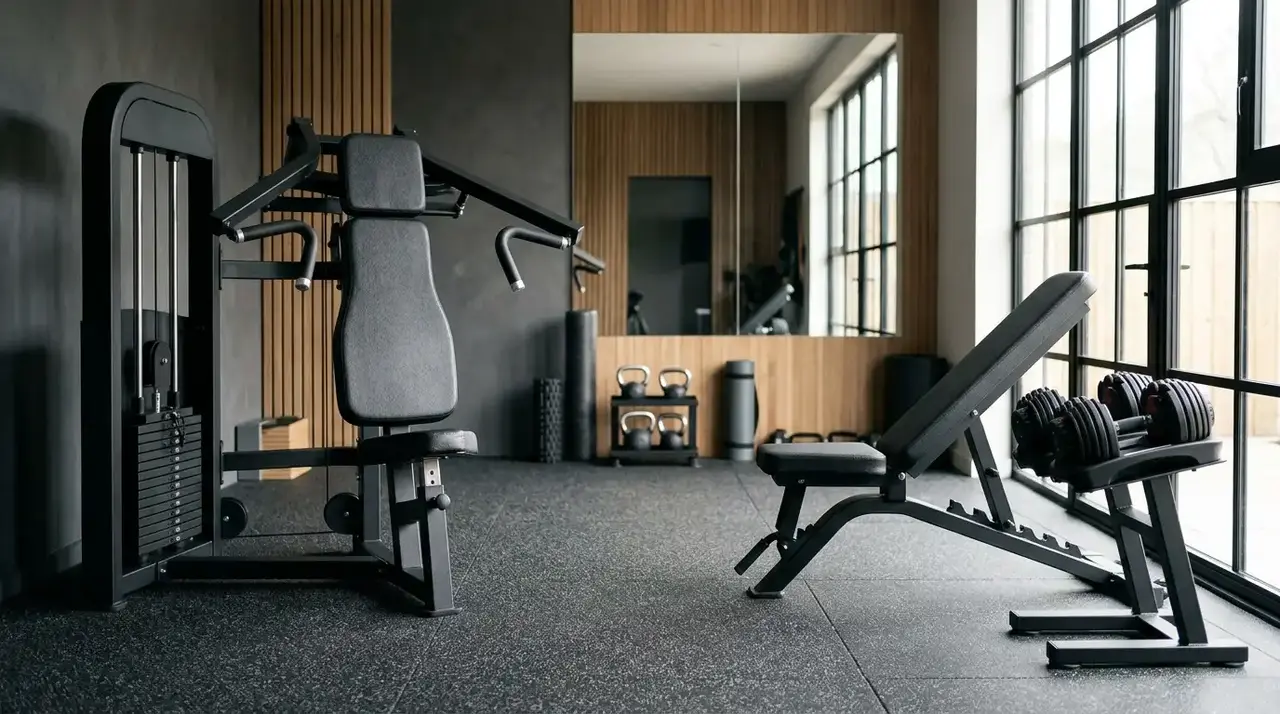

Choosing between a shoulder press machine and dumbbells can significantly influence how effectively we build shoulder strength at home. Both options help develop the deltoids, improve upper-body strength, and support pressing performance, but they differ considerably in cost, space requirements, movement freedom, resistance control, and overall versatility.
For a home gym, the best choice isn’t necessarily the equipment that offers the heaviest resistance. It’s the one that fits our available space, training experience, budget, and long-term fitness goals without making workouts unnecessarily complicated.
In this shoulder press machine vs dumbbells comparison, we’ll examine the practical differences between both options, including their advantages, disadvantages, storage requirements, exercise variety, and suitability for different home gym setups.
Table of Contents
Shoulder Press Machine vs Dumbbells: Understanding the Difference
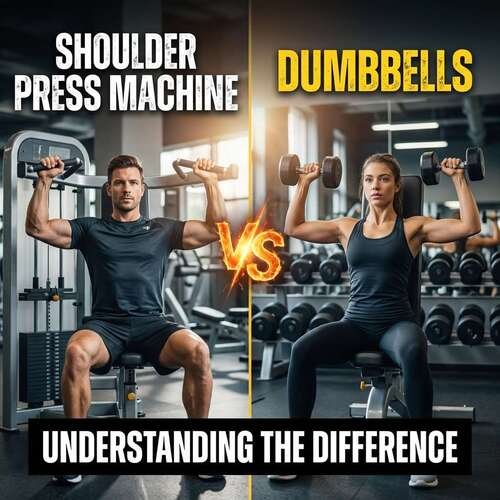
A shoulder press machine and a pair of dumbbells perform a similar pressing movement, but they create different training experiences.
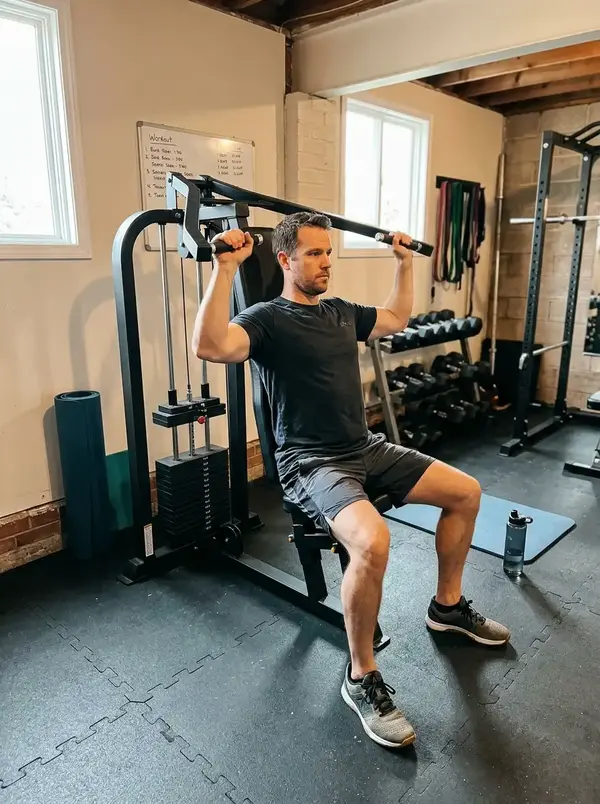
A shoulder press machine typically uses a fixed movement path, allowing us to push resistance through a guided range of motion. Depending on the model, it may include a seat, backrest, independent handles, weight stack, plate-loading arms, and adjustable positioning.
Dumbbells, on the other hand, provide free movement. We control the direction of each weight, stabilize our arms throughout the exercise, and adjust our grip, elbow position, and pressing angle according to our natural movement pattern.
The difference becomes particularly important when training at home, where we need to balance equipment functionality with space, affordability, and the ability to perform multiple exercises using the same setup.
| Feature | Shoulder Press Machine | Dumbbells |
|---|---|---|
| Movement path | Guided or partially guided | Free movement |
| Stability | Higher external stability | Requires more stabilization |
| Initial cost | Usually higher | Low to moderate |
| Storage | Larger footprint | Compact, especially adjustable models |
| Exercise variety | Primarily pressing variations | Multiple upper- and lower-body exercises |
| Resistance adjustment | Weight stack or plates | Fixed or adjustable weights |
| Setup | Seat and machine adjustments | Minimal setup |
| Beginner accessibility | Generally straightforward | Requires coordination and technique |
| Long-term versatility | Limited to machine functions | Broad exercise selection |
Neither option is automatically superior. The right choice depends on how we intend to use our home gym.
1. Shoulder Press Machine: Benefits for Home Strength Training
A shoulder press machine is designed to make overhead pressing more controlled and consistent. Instead of balancing weights independently, we push handles attached to a mechanical system that guides or partially stabilizes the movement.
More Stability During Shoulder Presses
One of the main advantages of a shoulder press machine is its stability. The seat and backrest help support our body while the machine controls much of the movement path.
This can make it easier to concentrate on pressing the resistance without constantly adjusting our balance. For people who are still learning shoulder exercises, the guided movement may feel more predictable than pressing free weights overhead.
However, machine stability doesn’t eliminate the need for proper technique. We still need to position the seat correctly, maintain comfortable shoulder alignment, avoid excessive arching of the lower back, and use a resistance level we can control throughout the repetition.
Convenient Resistance Progression
Many shoulder press machines use a weight stack with a selector pin, allowing us to change resistance quickly between sets.
This is especially useful when performing structured workouts involving different repetition ranges. We can increase the load for heavier sets, reduce it for controlled higher-repetition work, or adjust resistance when fatigue begins affecting our technique.
Plate-loaded machines offer a different experience. They require loading weight plates manually, but can provide substantial resistance for more advanced strength training.
A Consistent Pressing Movement
The guided movement path helps keep each repetition relatively consistent. This can be beneficial when we want to focus on progressive overload, repeat the same exercise from workout to workout, and track improvements in strength.
Nevertheless, machine designs differ. Some shoulder press machines have a fixed path that feels natural, while others may place the shoulders in an uncomfortable position depending on our body proportions and mobility.
Whenever possible, we should choose a machine with adjustable seat height, comfortable handles, and a pressing path that allows our elbows and shoulders to move without unnecessary discomfort.
Limitations of a Shoulder Press Machine
The biggest drawback is that a shoulder press machine primarily serves one movement pattern.
Even a well-designed machine may not replace the versatility of a complete dumbbell set. It occupies dedicated floor space, costs more than a basic pair of weights, and requires us to work around its dimensions rather than easily moving the equipment to another location.
For homeowners with a dedicated gym room, these limitations may be manageable. For apartment workouts or multipurpose rooms, they can become significant disadvantages.
2. Dumbbells: Why They Make More Sense for Many Home Gyms
Dumbbells offer something a shoulder press machine cannot easily replicate: freedom of movement and exercise variety.
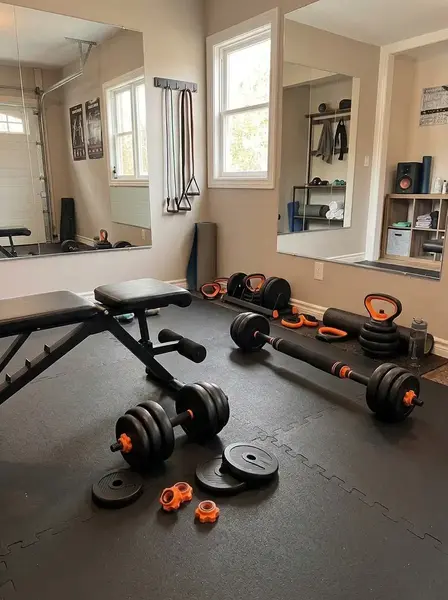
A pair of dumbbells can be used for shoulder pressing, lateral raises, front raises, rowing movements, curls, triceps exercises, chest presses, lunges, and numerous other exercises.
This flexibility makes them particularly attractive when we have limited room or want to build a complete strength-training routine without purchasing several specialized machines.
Natural Movement and Adjustable Pressing Angles
With dumbbells, we can adjust the direction of our palms, the position of our elbows, and the width of our pressing movement.
For example, a neutral-grip shoulder press allows our palms to face one another rather than pointing forward. Some people find this position more comfortable because it provides flexibility in how the upper arms move.
We can also modify our range of motion, lower the weights more gradually, or use one arm at a time when appropriate.
This freedom is valuable, but it requires control. Dumbbells move independently, meaning we must stabilize both arms and maintain a balanced pressing position throughout the exercise.
Greater Exercise Variety With One Purchase
Dumbbells aren’t limited to shoulder workouts. They allow us to train almost every major muscle group using a relatively small amount of equipment.
A single pair of adjustable dumbbells can support a workout involving:
- Dumbbell shoulder presses
- Lateral raises and rear-delt raises
- Chest presses and floor presses
- Bent-over rows
- Biceps curls and hammer curls
- Goblet squats and split squats
- Romanian deadlifts
- Dumbbell lunges
This makes dumbbells a practical choice for anyone who wants to develop a balanced home workout routine instead of focusing exclusively on shoulder pressing.
Easy Storage and Flexible Placement
Traditional fixed-weight dumbbells can take up space when we collect multiple pairs. Adjustable dumbbells help solve this problem by combining several resistance levels into one compact system.
We can store them on a small stand, under a sturdy bench, or in a dedicated corner of the workout room. When the workout is finished, they can be moved out of the way without rearranging the entire room.
For renters, apartment dwellers, and people who use their living room as a workout area, this flexibility can make the difference between maintaining a consistent training routine and avoiding workouts because the equipment is inconvenient.
3. Cost Comparison: Which Equipment Is More Affordable?
Budget is one of the most important considerations when choosing home gym equipment.
A basic pair of dumbbells is generally cheaper than purchasing a dedicated shoulder press machine. However, the total cost depends on the resistance we need and whether we choose fixed weights or an adjustable system.
| Equipment | Typical Cost Consideration | Long-Term Value |
|---|---|---|
| Basic fixed dumbbells | Lower initial investment | Good for simple routines |
| Multiple fixed-weight pairs | Costs increase as resistance range expands | Convenient but requires storage |
| Adjustable dumbbells | Moderate initial investment | High versatility and space efficiency |
| Compact shoulder press machine | Higher purchase price | Good for dedicated pressing |
| Plate-loaded shoulder press | Machine cost plus weight plates | Suitable for progressive strength training |
| Selectorized shoulder press | Often higher investment | Convenient resistance adjustments |
Dumbbells generally offer better value for beginners who want to build a complete home gym gradually.
A shoulder press machine becomes more financially attractive when we already own other equipment, have enough room for it, and know that dedicated shoulder pressing is a regular part of our training program.
When evaluating equipment prices, we should also account for shipping, assembly, floor protection, storage accessories, and the space required to use the equipment safely.
4. Storage and Space Requirements: Dumbbells vs Shoulder Press Machines
Space is often the biggest obstacle to building a home gym. Unlike commercial gyms, our home workout area may share space with a bedroom, office, living room, or garage.
Shoulder Press Machine Space Requirements
A shoulder press machine requires a permanent or semi-permanent location. We need enough room for the machine itself, comfortable access to the seat, and clearance for the handles and moving parts.
The footprint alone doesn’t tell us whether a machine fits. We must consider how far the handles extend during exercise, whether the seat can be adjusted easily, and whether we can enter and exit the machine without obstacles.
Some compact models are designed specifically for smaller home gyms, but they still require more dedicated space than a pair of dumbbells.
Dumbbell Storage Requirements
Dumbbells are easier to adapt to small spaces because they don’t require a dedicated exercise station.
Fixed dumbbells can be arranged on a rack, while adjustable models reduce the number of individual weights we need to store. We can also use a foldable bench to create a more complete workout station without permanently occupying a large area.
For apartment training, we should prioritize equipment that is easy to move, store, and retrieve. A compact setup is more likely to remain practical over time.
If we need more ideas for building a strength-training setup in a smaller home, our guide to adjustable dumbbells for apartments offers another useful starting point.
5. Adjustability and Comfort: Which One Adapts to Our Body?
Adjustability determines how easily we can modify an exercise to suit our height, mobility, strength, and training preferences.
Adjustable Shoulder Press Machines
A quality shoulder press machine should offer enough adjustment to position the handles comfortably in relation to our shoulders.
Seat height is particularly important. If the handles start too low or too high, we may struggle to achieve a comfortable starting position. Some machines allow us to change the grip or pressing angle, while others offer a single fixed configuration.
The more adjustable the machine, the easier it may be to accommodate different users. However, we shouldn’t assume every machine is suitable for every body type simply because it includes a few adjustment settings.
Dumbbell Adjustability
Dumbbells offer a different type of adjustability.
Instead of changing the machine’s movement path, we modify our grip, elbow position, stance, and range of motion. Adjustable dumbbells also allow us to select different weight increments, helping us match the resistance to the exercise.
For instance, shoulder presses may require significantly more resistance than lateral raises. A single adjustable dumbbell system can accommodate both movements without requiring separate equipment.
This flexibility is especially helpful when designing workouts that train multiple shoulder muscles and other upper-body muscle groups in the same session.
6. Versatility: What Can We Train With Each Setup?
Versatility is where dumbbells have a clear advantage for most general home fitness routines.
A shoulder press machine is excellent for its intended purpose, but dumbbells allow us to build a wider range of workouts around the same equipment.
| Exercise | Shoulder Press Machine | Dumbbells |
|---|---|---|
| Seated shoulder press | Yes | Yes |
| Standing shoulder press | Usually no | Yes |
| Neutral-grip shoulder press | Depends on handles | Yes |
| Lateral raises | No | Yes |
| Front raises | No | Yes |
| Rear-delt raises | No | Yes |
| Chest press | No | Yes |
| Biceps curls | No | Yes |
| Triceps extensions | No | Yes |
| Goblet squats | No | Yes |
| Romanian deadlifts | No | Yes |
A machine may be useful for focused shoulder training, particularly when we prefer a stable pressing environment. Dumbbells are more suitable when we want one piece of equipment to support an entire strength program.
For a broader approach to shoulder training, we can also explore our guide to shoulder strengthening exercises for additional movements to incorporate into our workouts.
7. Shoulder Press Machine vs Dumbbells for Beginners
Beginners should prioritize learning movement patterns, building consistency, and using manageable resistance rather than chasing heavier weights immediately.
A shoulder press machine may be easier to approach because it provides external stability and a consistent movement path. This can help new lifters become familiar with overhead pressing without having to manage two independent weights.
Dumbbells are equally valuable for beginners, especially when starting with light resistance. They encourage coordination, balance, and control while allowing us to adjust the movement to our comfort level.
The best choice depends on our confidence and the equipment available.
If we’re new to strength training, we can begin with light dumbbells, practice controlled repetitions, and avoid forcing the weights into an uncomfortable overhead position. If a machine feels more comfortable, it can serve as a useful starting point.
Either way, we should increase resistance gradually and stop when we can no longer maintain proper technique.
8. Which Equipment Is Better for Progressive Overload?
Progressive overload means gradually increasing the demands placed on our muscles as they adapt to training.
Both dumbbells and shoulder press machines support progressive overload, but the experience differs.
A weight-stack machine allows us to change resistance quickly by moving a selector pin. Depending on the machine, weight increments may be relatively consistent and convenient for tracking progress.
Adjustable dumbbells also support progressive overload, although the weight increments vary by model. Some systems provide smaller increases, while others require larger jumps between resistance levels.
For shoulder exercises, small increases can be useful because the deltoids are involved in movements where excessive weight often compromises technique.
We can progress by:
- Increasing resistance when repetitions become consistently manageable.
- Adding repetitions while maintaining the same weight.
- Improving control during the lowering phase.
- Increasing the quality and consistency of each repetition.
- Maintaining a comfortable range of motion.
Progress isn’t limited to lifting heavier. Consistent technique, improved control, and better workout execution also represent meaningful improvements.
9. Can Dumbbells Replace a Shoulder Press Machine?
For most home gym users, dumbbells can replace a shoulder press machine quite effectively.
A pair of adjustable dumbbells allows us to perform seated or standing shoulder presses, choose different grips, and combine pressing exercises with lateral raises, rear-delt work, and other upper-body movements.
However, dumbbells don’t reproduce the exact experience of a machine. They require independent stabilization, and some users may prefer the supported position of a shoulder press machine when training with heavier resistance.
If our goal is to develop stronger shoulders while maintaining a versatile home gym, dumbbells are often sufficient.
If our goal is to build a dedicated strength-training space with several specialized machines, adding a shoulder press machine may make sense alongside other equipment.
10. Best Home Gym Setup: Dumbbells, Machine, or Both?
The most effective equipment setup depends on how much space we have and how frequently we train.
For Small Apartments
Adjustable dumbbells are usually the most practical option.
They require less space, are easier to store, and support a wide variety of exercises. Pairing them with a foldable adjustable bench can create a capable strength-training setup without turning an entire room into a gym.
For Dedicated Home Gyms
A shoulder press machine may be worth considering if we have enough room and want a stable pressing station.
It becomes particularly useful when our training routine includes regular machine-based strength work and we value convenience over equipment portability.
For Balanced Strength Training
Combining dumbbells with a shoulder press machine can offer the best of both worlds.
We can use the machine for controlled pressing work and dumbbells for lateral raises, rear-delt exercises, unilateral training, and other movements. However, this combination is not necessary for everyone. We should purchase additional equipment only when it solves a genuine training limitation.
11. Shoulder Press Machine vs Dumbbells: Final Verdict
When comparing a shoulder press machine vs dumbbells for home workouts, we should look beyond the exercise itself and consider the value each piece of equipment delivers throughout the week.
A shoulder press machine offers stability, convenient resistance adjustments, and a dedicated pressing station. It’s a strong option for people who have adequate space and prefer a consistent machine-based movement.
Dumbbells offer more flexibility, lower entry costs for basic setups, easier storage, and a wider range of exercises. They can support a complete strength-training routine rather than one isolated movement.
For most home gym users, adjustable dumbbells are the more practical investment. They provide enough versatility to train shoulders, arms, chest, back, and legs while keeping the equipment footprint relatively small.
A shoulder press machine is worth the investment when dedicated pressing is a priority and our home gym has the space, budget, and training frequency to justify it.
Ultimately, the best equipment is the one that supports consistent training, fits comfortably into our home, and helps us build strength without creating unnecessary complexity.