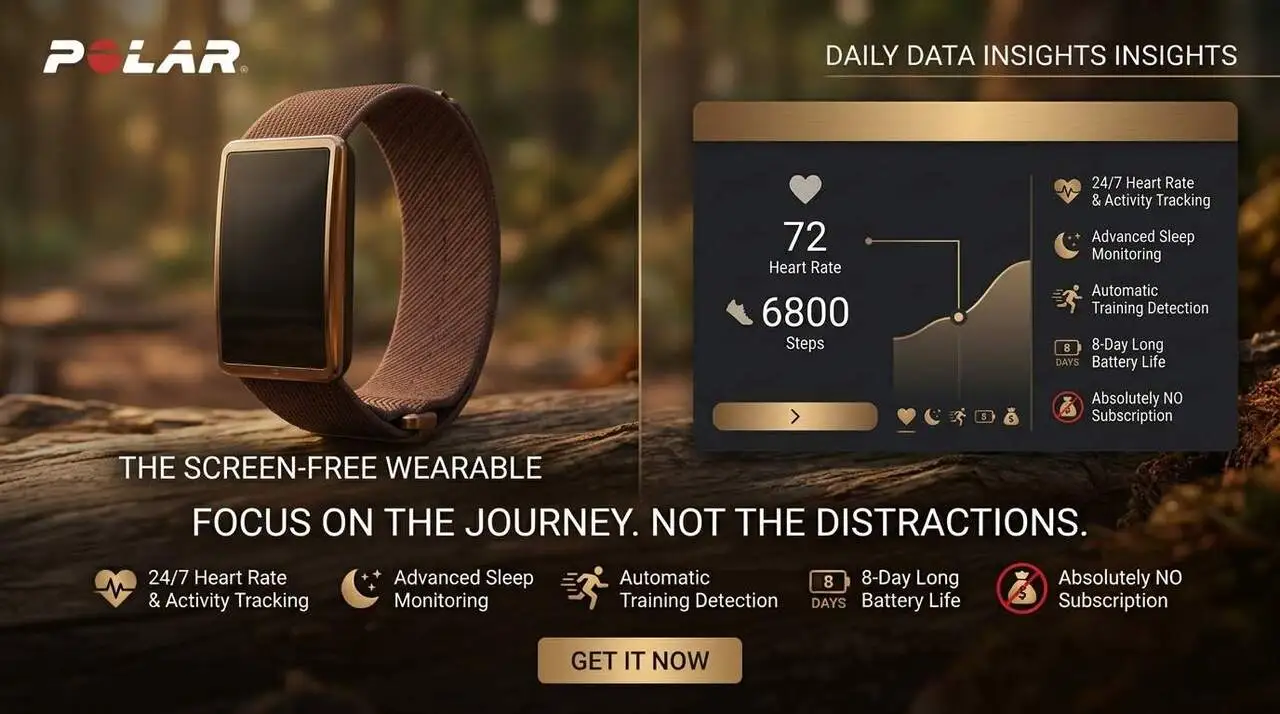

If you want a fitness tracker that quietly monitors your activity, sleep, heart rate, and recovery without putting another bright screen on your wrist, Polar Loop takes an unusually minimalist approach.
Unlike a conventional fitness smartwatch, the Polar Loop is designed as a smart screen-free wearable. There is no traditional watch face demanding your attention throughout the day. Instead, the band collects your health and fitness data while you wear it, with detailed information available through the Polar Flow ecosystem.
That makes the Polar Loop particularly interesting for people who want the benefits of wearable technology without constant notifications and screen time.
But is it the right health and fitness band for you? And how does it compare with products such as the older Polar Loop 2 activity tracker, the POLAR Ignite 2 Series, or the POLAR Unite Waterproof Fitness Watch?
This guide takes a closer look at what Polar Loop offers, who it’s designed for, its main features, limitations, and what to consider before buying.
Quick verdict: Polar Loop is best for people who want discreet 24/7 health and activity tracking without a smartwatch display. If you need built-in GPS, live workout statistics, or extensive on-wrist controls, a Polar fitness watch may be a better choice.
Table of Contents
What Is Polar Loop?
Polar Loop is a screen-free fitness and wellness band designed for continuous wear.
Polar describes it as a screen-free, subscription-free fitness band that helps users stay active, sleep better, and understand recovery without the distractions associated with a traditional smartwatch.
Instead of displaying your steps, heart rate, notifications, or workout statistics directly on your wrist, the Polar Loop focuses on collecting information in the background.
You can then review your data using Polar Flow.
This creates a different type of wearable experience.
The idea isn’t to interact with the device constantly. It’s to wear it, let it track, and review the information when you want to.
Polar Loop at a glance
| Feature | Polar Loop |
|---|---|
| Product type | Screen-free fitness and health band |
| Display | No traditional screen |
| Activity tracking | Yes |
| Heart-rate tracking | Yes |
| Sleep tracking | Yes |
| Recovery insights | Yes |
| Polar Flow | Yes |
| Subscription | No |
| Water resistance | WR30 |
| Battery | Up to 8 days according to Polar |
| Best for | Discreet 24/7 wellness tracking |
Polar’s current support information identifies Loop specifically as a screen-free and subscription-free fitness band.
Why Choose a Screen-Free Wearable?
The biggest selling point of Polar Loop is also the feature that makes it different from most fitness watches: there’s no screen.
That might sound like a disadvantage at first.
Why buy a wearable if you can’t look at your wrist and see your statistics?
For some people, however, that’s exactly the appeal.
A traditional smartwatch can become another source of notifications, messages, reminders, and distractions. A screen-free fitness tracker takes a much quieter approach.
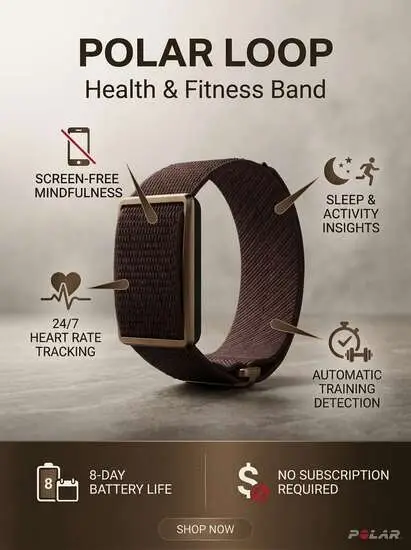
A screen-free wearable can be useful if you:
- Want fewer digital distractions
- Don’t need notifications on your wrist
- Prefer minimalist accessories
- Want continuous health tracking
- Already spend plenty of time looking at your phone
- Want to concentrate during exercise
- Care more about long-term trends than checking metrics every few minutes
Polar Loop essentially separates tracking from interaction.
The wearable collects the information.
Your phone provides the detailed analysis.
That can be a refreshing approach for anyone who wants technology to support healthy habits rather than constantly demand attention.
Polar Loop Features
The Polar Loop isn’t simply a basic step counter.
Its feature set covers several areas of everyday health and fitness, including activity, heart rate, sleep, recovery, and training.
24/7 Activity Tracking
The Polar Loop is designed to monitor your activity throughout the day.
Instead of manually recording every movement, the wearable continuously collects activity information.
This can help you understand:
- How active you are during a normal day
- Whether you spend long periods inactive
- How your activity changes throughout the week
- Whether you’re reaching your activity goals
- How exercise fits into your overall routine
For someone trying to become more active, this can be more useful than focusing exclusively on formal workouts.
A 30-minute workout is valuable, but what you do during the other 15 or 16 hours you’re awake also matters.
Polar Loop Activity Tracker and Step Counting
If you’re searching for a Polar Loop activity tracker, step counting is one of the most familiar features you’ll find.
Steps provide a simple way to monitor everyday movement.
However, a good fitness tracker shouldn’t be viewed as a device that exists solely to reach an arbitrary step number.
Your overall activity pattern matters more.
For example, you might have a day with fewer steps because you’re recovering from a demanding workout. Another day might involve plenty of walking but no structured exercise.
Polar Loop gives you information that can help put those days into context.
Polar Loop Heart-Rate Tracking
Heart-rate monitoring is another important part of the Polar Loop experience.
The current Polar Loop uses optical heart-rate technology to monitor your heart rate from the wrist. Polar lists its Generation 3.5 optical heart-rate technology among the device’s features.
Heart-rate information can help you understand your body’s response to:
- Exercise
- Daily activity
- Rest
- Sleep
- Recovery
- Different levels of physical effort
The advantage of continuous monitoring is that you don’t need to manually check your heart rate every time you want additional information.
However, wrist-based optical heart-rate measurements can be affected by movement, fit, skin contact, and other conditions. A fitness wearable should therefore be treated as a useful tracking tool rather than a medical diagnostic device.
Polar Loop Sleep Tracking
One of the most appealing reasons to choose a health and fitness band is the ability to monitor sleep.
Polar Loop works with Polar’s sleep-tracking ecosystem, including Sleep Plus Stages, which provides information about sleep duration and sleep stages.
The system looks at periods of light, deep, and REM sleep and provides sleep-related feedback.
This is particularly useful because sleep can influence how you feel and perform during the following day.
Instead of looking at one night’s result, it’s better to use sleep tracking to identify patterns.
For example:
Pattern 1: You consistently sleep longer after days with more moderate activity.
Pattern 2: Several late nights appear alongside poorer recovery.
Pattern 3: Your sleep improves when your bedtime becomes more consistent.
Those trends can be much more useful than obsessing over a single sleep score.
Polar Loop Recovery Tracking
Recovery is another area where Polar Loop moves beyond basic activity tracking.
The Polar ecosystem combines information about sleep, activity, heart rate, and recovery to help you understand how prepared you may be for another demanding day.
This is particularly useful for people who exercise regularly.
Training isn’t just about how hard you work.
It’s also about how well you recover.
If your training volume increases while your sleep and recovery deteriorate, that information can help you reconsider how you’re approaching your routine.
Polar Loop isn’t there to make every decision for you. Instead, it gives you additional data to consider.
Polar Flow: Where Your Data Comes Together
Because Polar Loop doesn’t have a traditional screen, Polar Flow is an important part of the experience.
Polar Flow is Polar’s platform for tracking, analyzing, and planning fitness and wellness data.
The wearable collects information while you’re wearing it, while the app and web service give you the detailed view.
This includes information related to:
- Activity
- Training
- Heart rate
- Sleep
- Recovery
- Progress
- Historical trends
The screen-free design therefore doesn’t mean you’re missing information.
It means the information is moved from your wrist to your phone.
That distinction is important when deciding whether Polar Loop suits you.
Is Polar Loop Good for Exercise?
Yes, but the answer depends on how you like to train.
If you’re primarily interested in monitoring your overall activity, heart rate, sleep, recovery, and exercise habits, Polar Loop can make sense.
However, dedicated runners and athletes who need live pace, distance, route information, and other workout metrics directly on the wrist may prefer a traditional sports watch.
That’s one of the biggest trade-offs of a screen-free fitness band.
Polar Loop is better for:
- General fitness
- Daily activity
- Wellness tracking
- Sleep monitoring
- Recovery awareness
- Low-distraction workouts
- Long-term habit tracking
A fitness watch may be better for:
- Running with live pace data
- Outdoor GPS workouts
- Detailed on-wrist training metrics
- Navigation
- Interval training
- Frequent interaction during workouts
So the question isn’t whether Polar Loop is “good enough.”
The better question is how much information do you want on your wrist while exercising?
Polar Loop Battery Life
Battery life is particularly important for a wearable designed to be worn day and night.
Polar’s current product information lists the Loop with a rechargeable battery and up to 8 days of use, depending on usage conditions.
Longer battery life has an obvious benefit for sleep tracking.
You don’t want to remove a wearable every night because it needs to be charged.
Consistent wear also means fewer gaps in your activity and sleep history.
For a wearable designed around 24/7 tracking, that matters.
Is Polar Loop Waterproof?
Polar Loop has a WR30 water-resistance rating and is intended for activities such as bathing and swimming.
That makes it practical as an everyday fitness band rather than something that needs to be removed whenever it encounters water.
However, water resistance isn’t the same as being a diving instrument.
As with Polar’s other water-resistant products, users should follow the manufacturer’s guidance regarding underwater use.
If swimming is part of your normal routine, the ability to keep your fitness band on in the water is a useful convenience.
Polar Loop Design and Comfort
A wearable intended to track you around the clock needs to be comfortable enough to forget you’re wearing it.
Polar Loop follows a relatively minimalist design philosophy.
There’s no bulky watch case and no large touchscreen competing for space on your wrist.
That makes it particularly appealing if you prefer the look of a traditional fitness band rather than a smartwatch.
For people who dislike sleeping with a large watch, a slimmer screen-free wearable can also be an attractive alternative.
Polar Loop vs Polar Loop 2
If you’ve been searching for Polar Loop 2 or Polar Loop 2 activity tracker, it’s important to understand that the Loop and Loop 2 are different generations.
The older Polar Loop 2 included an LED display and a 3D accelerometer. Polar’s technical documentation lists its battery at 38 mAh and its water resistance at 20 meters.
The current Polar Loop takes a very different approach.
Polar Loop vs Polar Loop 2
| Feature | Polar Loop | Polar Loop 2 |
|---|---|---|
| Generation | Current | Older |
| Display | Screen-free | LED display |
| Main focus | Health, activity, sleep and recovery | Activity tracking |
| Heart-rate approach | Modern wrist-based tracking | Older ecosystem with compatible HR sensor support |
| Water resistance | WR30 | 20 m |
| Design philosophy | Minimalist and screen-free | Traditional activity tracker |
If you’re shopping specifically for the Polar Loop 2 fitness tracker, remember that you’re looking at an older product.
For a new purchase, it’s worth comparing its condition, battery health, compatibility, and price against newer alternatives.
Polar Loop vs POLAR Ignite 2 Series
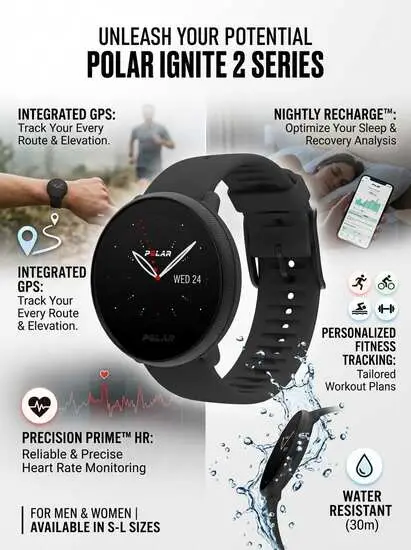
The POLAR Ignite 2 Series takes a very different approach.
The Ignite 2 is a full fitness watch with a 1.2-inch color touchscreen, built-in GPS, wrist-based heart-rate monitoring, FitSpark workout guidance, sleep and recovery features, music controls, weather information, and phone notifications.
That means the decision is relatively straightforward.
Choose Polar Loop if:
- You don’t want a screen
- You prefer minimalism
- You want passive tracking
- You don’t need live workout statistics
- You want fewer distractions
Choose Ignite 2 if:
- You want a display
- You need built-in GPS
- You want workout information on your wrist
- You want smartwatch features
- You want personalized workout guidance
The Ignite 2’s built-in GPS can track speed, pace, distance, altitude, and routes during outdoor workouts.
So these products aren’t direct replacements for each other.
They’re designed for different types of users.
Polar Loop vs POLAR Unite Waterproof Fitness Watch
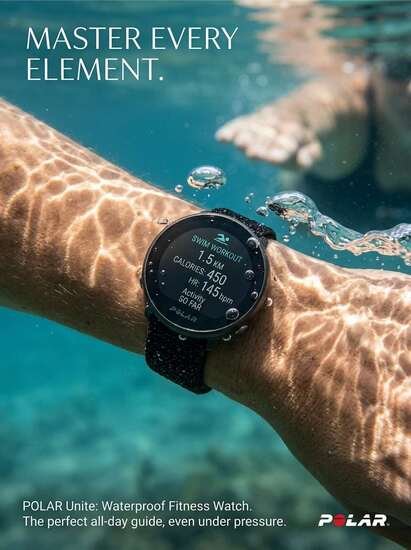
The POLAR Unite Waterproof Fitness Watch is another product that shoppers may encounter when researching Polar’s fitness lineup.
Unlike Polar Loop, Unite has a color touchscreen. It also supports connected GPS through a paired smartphone. Polar’s documentation states that the Unite uses the phone’s GPS to record outdoor training routes, speed, pace, and distance.
The Unite also has a 30-meter water-resistance rating suitable for swimming.
Polar Loop makes more sense if:
You want a screen-free health and fitness band with minimal interaction.
Polar Unite makes more sense if:
You want a traditional fitness-watch interface but don’t necessarily need built-in GPS.
This makes the comparison useful for shoppers who aren’t sure whether they want a fitness band or fitness watch.
Which Polar Wearable Is Right for You?
Here’s a simple buying framework.
| If you want… | Consider |
|---|---|
| A screen-free wearable | Polar Loop |
| A modern health and fitness band | Polar Loop |
| An older basic activity tracker | Polar Loop 2 |
| A fitness watch with built-in GPS | POLAR Ignite 2 Series |
| A touchscreen fitness watch using phone GPS | POLAR Unite Waterproof Fitness Watch |
| Minimal distractions | Polar Loop |
| Live workout information | Ignite 2 / fitness watch |
| Sleep and recovery tracking | Polar Loop or Polar fitness watch |
The biggest deciding factor is surprisingly simple:
Do you want to look at your wrist during the day?
If the answer is “not really,” Polar Loop becomes much more compelling.
Pros and Cons of Polar Loop
Pros
- Screen-free design
- Minimalist appearance
- Designed for continuous wear
- Activity tracking
- Heart-rate monitoring
- Sleep tracking
- Recovery insights
- Polar Flow ecosystem
- Multi-day battery life
- Water resistance
- Subscription-free positioning
Cons
- No traditional display
- Not ideal for viewing live workout metrics
- Less smartwatch functionality than a fitness watch
- Users must rely on Polar Flow for detailed information
- May not suit athletes who want extensive on-wrist data
- Older Polar models can cause confusion when shopping
The lack of a screen is both the product’s greatest strength and its biggest limitation.
Who Should Buy Polar Loop?
Polar Loop is worth considering if your priorities are health, wellness, activity, sleep, recovery, and simplicity.
It’s especially appealing to:
Minimalist users
You want useful technology without another screen.
Wellness-focused users
You’re interested in sleep, recovery, daily movement, and overall habits rather than just workout performance.
Fitness beginners
You want to understand your activity without learning a complicated sports-watch interface.
Busy professionals
You want tracking in the background while focusing on work and everyday life.
People reducing screen time
You want wearable technology that doesn’t create another stream of alerts and information.
Who Should Skip Polar Loop?
You may want a traditional fitness watch instead if you need:
- Built-in GPS
- Live pace and distance
- On-wrist workout statistics
- A visible clock
- Phone notifications
- Music controls
- Navigation
- Advanced sports-watch functionality
In those cases, something like the POLAR Ignite 2 Series is likely to be a better match because it provides a touchscreen, built-in GPS, training guidance, and smartwatch functions.
Is Polar Loop Worth Buying?
For the right buyer, yes.
Polar Loop isn’t trying to compete with every smartwatch feature. Its appeal comes from doing something different.
It provides a way to monitor important health and fitness information while removing the screen that usually comes with wearable technology.
That’s a meaningful difference.
If you want to check your pace every few minutes during a run, Polar Loop probably isn’t your ideal device.
But if you want to understand how much you move, how you sleep, how your heart rate behaves, and how you’re recovering—without constantly interacting with your wrist—Polar Loop is a much more interesting proposition.
The Polar Loop fitness tracker is ultimately built around a simple philosophy:
Track more. Interrupt less.
Final Verdict: Should You Buy Polar Loop?
The Polar Loop is a compelling choice for anyone looking for a modern screen-free fitness tracker rather than another smartwatch.
Its combination of activity tracking, heart-rate monitoring, sleep insights, recovery information, Polar Flow integration, water resistance, and multi-day battery life makes it more capable than a basic activity band.
Its biggest limitation is also its defining feature: there’s no screen.
For some users, that will be a deal-breaker.
For others, it’s the entire reason to buy it.
If you want a smart screen-free wearable that quietly tracks your day and night, Polar Loop is worth considering.
If you want a traditional watch with live workout data and GPS, look toward Polar’s watch lineup instead. The Ignite 2, for example, includes built-in GPS, a touchscreen, FitSpark training guidance, sleep tracking, and recovery tools.
And if you’re considering the older Polar Loop 2 activity tracker, remember that it’s a previous-generation device with an LED display, 3D accelerometer, and 20-meter water resistance.
For distraction-free health tracking, Polar Loop is the clear choice. For on-wrist fitness features, a Polar fitness watch is the better option.
Key Takeaways
- Polar Loop is the main screen-free fitness band in this guide.
- It is designed for discreet 24/7 health and activity tracking.
- It tracks activity, heart rate, sleep, and recovery.
- Polar Flow provides the detailed data analysis.
- The current Loop is positioned as subscription-free.
- Its screen-free design is ideal for reducing digital distractions.
- Polar Loop 2 is an older-generation activity tracker.
- The Polar Loop 2 activity tracker has an LED display and 20 m water resistance.
- The POLAR Ignite 2 Series is better for users who want built-in GPS and on-wrist fitness features.
- The POLAR Unite Waterproof Fitness Watch offers a touchscreen and connected GPS.
- Polar Loop is best suited to people who want tracking without constant interaction.
Frequently Asked Questions
Is Polar Loop a fitness tracker?
Yes. Polar Loop is a screen-free fitness and health band designed to track activity, heart rate, sleep, recovery, and other wellness information.
Does Polar Loop have a screen?
No. The current Polar Loop is specifically designed as a screen-free wearable.
Does Polar Loop track heart rate?
Yes. Polar Loop uses optical heart-rate technology for wrist-based heart-rate tracking.
Does Polar Loop track sleep?
Yes. Polar Loop works with Polar’s sleep-tracking features, including Sleep Plus Stages and sleep-stage analysis.
Is Polar Loop waterproof?
Polar Loop has WR30 water resistance and is designed for activities including bathing and swimming.
How long does the Polar Loop battery last?
For someone buying a newer device, the current Polar Loop offers a substantially different experience because it is screen-free and built around newer health-tracking capabilities. Polar Loop 2 is an older activity tracker with an LED display and 20-meter water resistance.
Is Polar Loop better than Ignite 2?
It depends on what you need. Polar Loop is better for screen-free, low-distraction tracking. Ignite 2 is better if you want built-in GPS, a touchscreen, live workout information, and smartwatch features.
Does Polar Unite have GPS?
Polar Unite uses connected GPS through a compatible smartphone rather than having the same built-in GPS approach as the Ignite 2.