
Pull-ups are one of the most effective bodyweight exercises for developing the back, arms, shoulders, grip, and core. However, they can also be challenging, especially when we are still building the strength required to perform a full repetition.
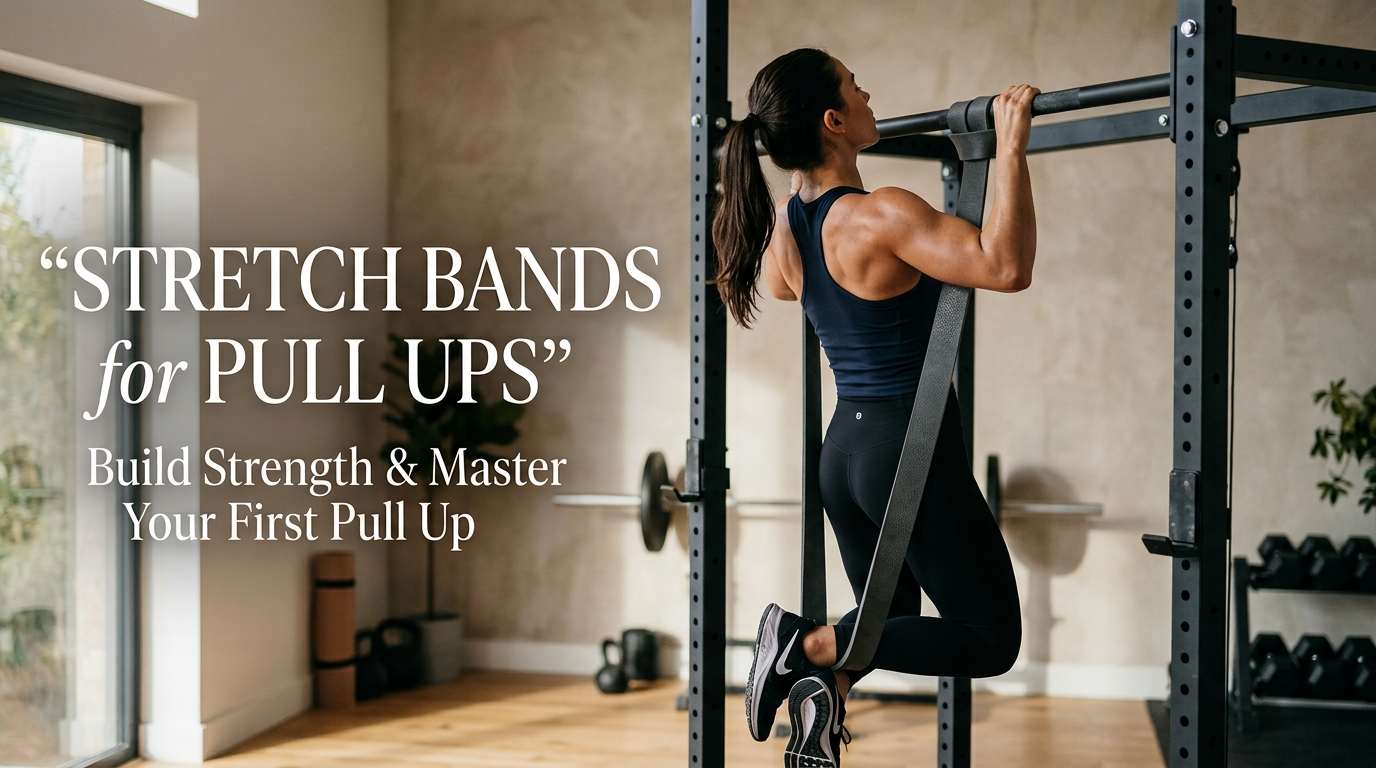
This is where stretch bands for pull ups become extremely useful. A resistance band can provide assistance throughout the movement, allowing us to practice proper pull-up mechanics while gradually developing the strength needed to perform unassisted repetitions.
Whether we are complete beginners, returning to training, or trying to increase our pull-up repetitions, the right band can turn a difficult exercise into a manageable and progressive part of a workout routine.
Table of Contents
What Are Stretch Bands for Pull Ups?
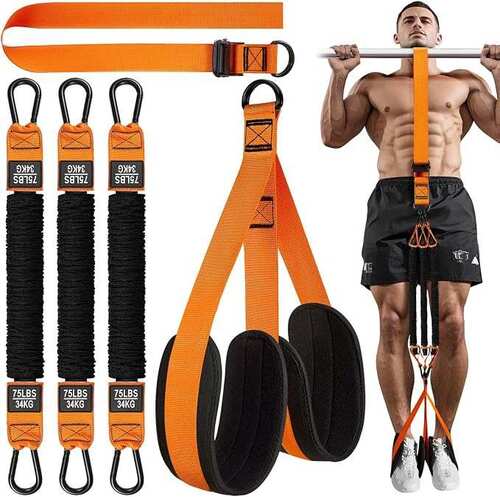
Stretch bands for pull ups are long, elastic resistance bands designed to provide assistance during pull-up exercises. We commonly see them made from natural latex or similar elastic materials, with different thicknesses and resistance levels available.
Unlike traditional resistance bands with handles, pull-up assistance bands are generally continuous loops. We can attach the loop to a pull-up bar and place a foot or knee inside the lower portion of the band.
When we begin pulling upward, the stretched band produces resistance in the opposite direction. Because the band is anchored above us, that elastic tension effectively helps move our body toward the bar.
The amount of assistance depends largely on the band’s thickness, elasticity, and how far it is stretched.
How Do Pull-Up Assistance Bands Work?
The basic principle is simple.
We attach the stretch band securely to a pull-up bar and position ourselves so that one or both feet or knees rest inside the loop. As we pull upward, the band stretches and generates assistance.
The assistance is generally greatest when the band is stretched farther. This means it can provide substantial help near the bottom of the movement, where many beginners struggle to initiate the pull.
As we approach the top of the pull-up, the band may provide less assistance because its level of stretch changes.
This allows us to perform a movement that resembles a conventional pull-up while reducing the amount of bodyweight our muscles have to move.
Benefits of Using Stretch Bands for Pull Ups
1. They Make Pull Ups More Accessible
A full pull-up requires us to lift a significant portion of our bodyweight. If we cannot yet perform one repetition, simply practicing unassisted pull-ups may be frustrating.
A resistance band reduces the effective difficulty, giving us an opportunity to practice the complete movement.
Instead of focusing exclusively on whether we can reach the bar, we can concentrate on controlled movement, proper body positioning, and consistent technique.
2. They Help Us Practice Proper Form
Pull-up technique matters.
With appropriate band assistance, we can practice starting from a controlled hanging position, engaging the shoulders, pulling the elbows down, and maintaining a stable torso.
The goal should not be to let the band perform the exercise for us. We should actively pull while using the band only for the amount of assistance necessary.
3. They Support Progressive Training
One of the biggest advantages of stretch bands is that we can gradually reduce assistance.
We might begin with a stronger band that provides substantial support. As our strength improves, we can move to a lighter band and eventually attempt unassisted repetitions.
This creates a straightforward progression:
Heavier assistance → moderate assistance → lighter assistance → unassisted pull-ups
That progression can make pull-up training much easier to structure.
4. They Are Portable
Pull-up assistance bands are relatively lightweight and easy to transport. We can keep one in a gym bag, take it outdoors, or use it with a suitable pull-up bar at home.
For people who prefer flexible workouts, this portability is a major advantage.
5. They Can Be Used for More Than Pull Ups
A quality resistance band does not have to remain dedicated to pull-up assistance.
Depending on its design and resistance level, we can also use it for banded rows, shoulder exercises, mobility drills, presses, squats, warm-ups, and other resistance-training movements.
This makes a set of bands a versatile addition to a home gym.
How to Choose the Right Stretch Band for Pull Ups
Choosing the correct band is important because too much assistance can make the exercise unnecessarily easy, while too little assistance may prevent us from performing quality repetitions.
Band Resistance
Stretch bands are commonly available in different resistance levels. Thicker bands generally provide greater assistance, although the exact resistance depends on the band and how far it is stretched.
A useful starting point is to choose a band that allows us to complete several controlled repetitions without completely taking over the movement.
We should be able to feel our back and arm muscles working rather than simply being lifted by the elastic.
Band Length
Length also matters.
The band must be long enough to create an appropriate setup when attached to the pull-up bar. A band that is too short may create excessive tension or make positioning uncomfortable.
Before purchasing, we should check the manufacturer’s recommended dimensions and intended use.
Material and Construction
Durability is particularly important because pull-up bands are placed under significant tension.
We should look for high-quality elastic construction, consistent thickness, and a band designed specifically for resistance training.
Regularly inspecting the band is also important. Cracks, cuts, excessive thinning, or visible damage are reasons to replace it rather than continuing to use it.
How to Use a Stretch Band for Pull Ups
Start by securing the band around the pull-up bar according to the manufacturer’s recommended method.
Once the band is firmly positioned, place one foot or knee into the lower section of the loop. Keep the other leg controlled rather than allowing it to swing freely.
From the hanging position, brace the core and establish a stable starting position.
Pull the shoulders down and back, then drive the elbows toward the floor as we pull our chest toward the bar.
At the top, maintain control rather than aggressively pulling the chin over the bar.
Then lower ourselves slowly until the arms are extended again.
The lowering phase deserves attention because it allows us to practice eccentric control, which is an important part of developing pull-up strength.
Should We Use One Foot or Both Feet?
Both approaches can work.
Using one foot inside the band may allow us to maintain a more natural body position and gives us greater control over how much assistance we receive.
Using both feet can provide more stability and may feel easier for beginners.
A knee-in-band setup is another option, although it requires careful positioning.
The most important consideration is maintaining a stable and controlled movement rather than choosing a particular setup simply because it feels more difficult.
Common Mistakes When Using Pull-Up Bands
Using Too Much Band Assistance
One of the most common mistakes is choosing a band that provides far more assistance than necessary.
If the band launches us upward with minimal effort, we may not be getting enough meaningful strength work.
A better approach is to use the lightest assistance that allows us to perform controlled repetitions with good technique.
Swinging the Body
Kipping or excessive swinging can make band-assisted pull-ups look easier without necessarily improving strict pull-up strength.
We should keep the torso controlled and minimize unnecessary momentum.
Ignoring the Lowering Phase
Some people focus entirely on getting their chin above the bar and then drop quickly.
Instead, we should treat the descent as part of every repetition. A controlled lowering phase helps us develop strength and body awareness.
Allowing the Shoulders to Collapse
We should avoid hanging passively throughout the entire repetition.
Maintaining appropriate shoulder control helps us establish a stronger pulling position and keeps the movement more deliberate.
A Simple Band-Assisted Pull-Up Progression
We can structure our progression around gradually decreasing assistance.
Stage 1: Strong Assistance
Use a relatively strong band and focus on learning the movement pattern.
Perform controlled repetitions without swinging.
Stage 2: Moderate Assistance
Move to a lighter band once the stronger band feels manageable.
Continue emphasizing full-range movement and controlled repetitions.
Stage 3: Light Assistance
At this stage, the band should provide only limited help.
We should focus on producing most of the movement ourselves.
Stage 4: Unassisted Attempts
Once light-band repetitions are strong and controlled, we can introduce unassisted pull-up attempts.
Even one clean repetition can be useful evidence that our strength is progressing.
We can then alternate between unassisted attempts and band-assisted repetitions to accumulate quality training volume.
How Many Band-Assisted Pull Ups Should We Do?
There is no single number that works for everyone.
Our training volume should depend on our current strength, recovery, experience, and broader workout program.
A practical approach is to perform several sets of controlled repetitions while stopping before technique deteriorates.
For example, if we can perform eight excellent band-assisted repetitions but struggle badly on repetitions nine and ten, there may be little benefit in forcing additional repetitions with poor form.
Quality matters more than simply accumulating a high number of repetitions.
Can Stretch Bands Help Us Get Our First Pull Up?
Yes, band-assisted training can be incorporated into a progression toward an unassisted pull-up.
However, we should not rely exclusively on the band.
We can combine band-assisted pull-ups with exercises such as scapular pull-ups, rows, dead hangs, assisted eccentrics, and controlled negative pull-ups.
This gives us several ways to strengthen the muscles and movement patterns involved in pulling.
The long-term objective is to gradually reduce assistance rather than becoming dependent on a particular band.
Band-Assisted Pull Ups vs. Negative Pull Ups
Negative pull-ups focus primarily on the lowering portion of the exercise.
We begin from the top position and lower ourselves under control.
Band-assisted pull-ups, on the other hand, allow us to practice the complete movement from the bottom through the top and back down.
Both approaches can have a place in a pull-up progression.
For beginners, combining them can provide a useful mixture of full-range practice and controlled eccentric work.
Safety Tips for Stretch Bands
We should inspect the band before every demanding session, especially if it has been used frequently.
Avoid using a band that shows visible cracks, tears, cuts, unusual thinning, or other signs of deterioration.
The band should also be attached securely to a suitable pull-up bar. We should verify that the bar and mounting system are designed to support the forces involved in dynamic exercise.
During training, avoid positioning the face directly in the path of a band that could potentially break or become detached.
Most importantly, we should follow the manufacturer’s instructions for setup and usage.
How Long Does It Take to Progress to an Unassisted Pull Up?
Progress varies considerably from person to person.
Someone with previous strength-training experience may progress relatively quickly, while someone starting from little pulling strength may need considerably more time.
Bodyweight, training consistency, grip strength, back strength, arm strength, technique, and recovery can all affect progress.
Instead of focusing on an exact timeline, we can track measurable improvements such as:
- Using a lighter assistance band
- Performing more controlled repetitions
- Improving range of motion
- Holding the top position longer
- Controlling the descent more effectively
- Performing the first unassisted repetition
These indicators give us a clearer picture of progress.
Final Thoughts on Stretch Bands for Pull Ups
Stretch bands for pull ups can be an effective tool for learning and improving the pull-up movement. They allow us to practice the complete exercise while reducing the amount of strength required to move our bodyweight.
The key is to use the band as an assistance tool rather than allowing it to replace our effort.
We should choose an appropriate resistance level, maintain controlled technique, gradually reduce assistance, and combine band work with other pulling exercises.
With consistent practice, a structured progression, and attention to technique, band-assisted pull-ups can become a practical bridge between our first assisted repetition and stronger unassisted pull-ups.