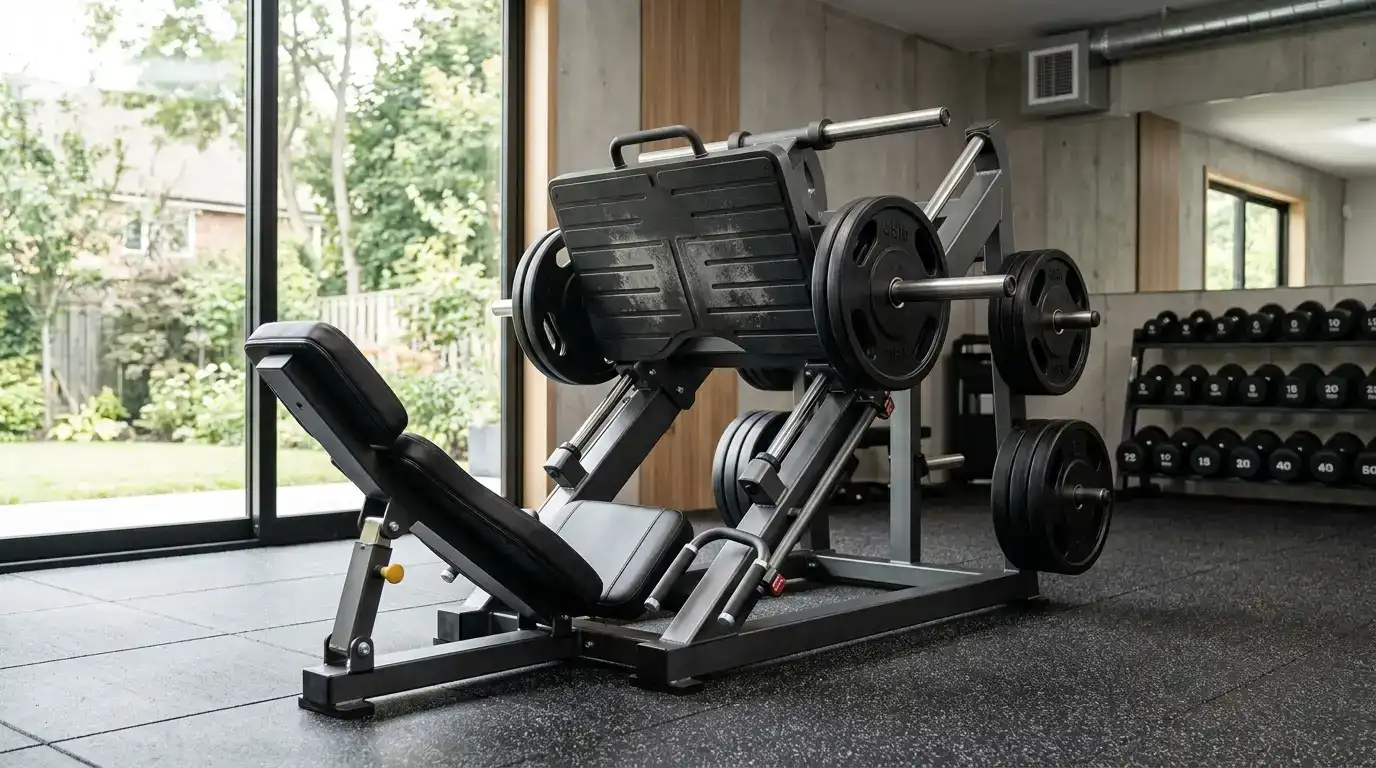

A good leg press machine can turn a home gym into a serious lower-body training space. The right model gives you a stable platform for training your quads, glutes, and hamstrings while letting you load progressively without needing a spotter for every set.
The catch is size, construction, resistance type, and price. A compact leg press may suit a spare room, while a commercial-style 45-degree machine can consume a large section of your gym.
This guide breaks down Leg Press Machines for Home Gyms, including the different designs, what to measure before buying, which features matter, common mistakes, and how to choose a machine that fits your training and your room.
Quick answer: For most home gyms, look for a leg press with a solid steel frame, a large footplate, adjustable safety stops, smooth carriage travel, comfortable back support, and a weight capacity that leaves plenty of room for future progression.
This review is part of our complete home gym equipment guide.
Table of Contents
Leg Press Machines for Home Gyms at a Glance
| Feature | What to Look For |
|---|---|
| Machine type | 45-degree, horizontal, vertical, or combo |
| Frame | Heavy-gauge steel |
| Footplate | Large, textured, stable |
| Safety | Adjustable safety stops or locking mechanism |
| Resistance | Weight plates or selectorized stack |
| Back pad | Firm support with adjustable positioning |
| Carriage | Smooth travel with minimal side-to-side movement |
| Weight capacity | Well above your current training load |
| Footprint | Compatible with your available floor space |
| Ceiling height | Especially important for vertical designs |
| Warranty | Multi-year frame coverage is preferable |
What Is a Leg Press Machine?
A leg press machine is a resistance-training machine that lets you push a weighted platform away from your body using your legs. Depending on the machine’s design, you may press at an angle, horizontally, or vertically.
The movement primarily trains the quadriceps, glutes, and hamstrings. Your calves and other lower-body muscles also contribute depending on your foot position and range of motion.
The major benefit for a home gym is stability. Your back and torso stay supported while your legs perform the pressing movement.
That makes the leg press useful for strength training, muscle building, and lower-body volume.
Types of Leg Press Machines for Home Gyms
The machine’s geometry changes the feel of every repetition. Before shopping, decide which design makes sense for your room and training style.
45-Degree Leg Press
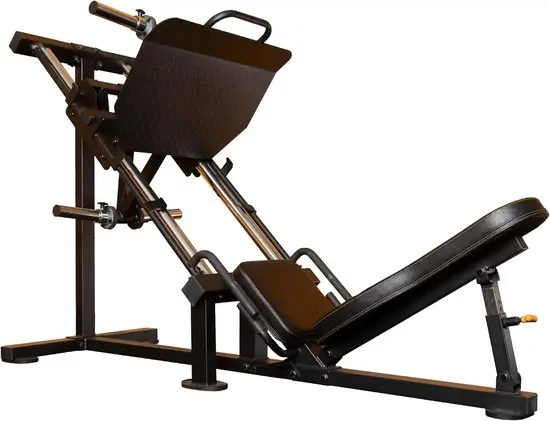
The 45-degree leg press is the familiar commercial-gym design.
You sit in a reclined position and push a sled upward along angled rails. Weight plates are usually loaded onto pegs attached to the sled.
This design offers substantial loading potential and a familiar pressing motion. It also tends to be large and heavy.
Best for: Dedicated home gyms, serious strength training, and lifters who want substantial loading capacity.
Horizontal Leg Press
A horizontal leg press places you in a more upright or slightly reclined position while the resistance travels forward.
These machines can be easier to fit into some rooms than large 45-degree sleds, although dimensions vary considerably between models.
Best for: Home users who prefer a straightforward pressing motion and want easier access to the machine.
Vertical Leg Press
A vertical leg press positions you beneath a platform that moves vertically.
The design can have a relatively small footprint, which makes it attractive for compact spaces. Ceiling clearance becomes especially important.
Best for: Smaller gyms with suitable ceiling height and users who specifically prefer the vertical pressing position.
Leg Press and Hack Squat Combos
Some machines combine a leg press with a hack squat station.
This can make sense when floor space is limited because one frame provides two lower-body movements.
The trade-off is usually size, complexity, and cost compared with a dedicated leg press.
Best for: Lifters who want several lower-body exercises from one machine.
How Much Space Does a Home Leg Press Need?
Measure the entire area before ordering.
Start with the machine’s listed length, width, and height. Then add room around the machine for loading plates, entering and exiting, and moving safely during training.
A 45-degree machine can occupy considerably more floor area than its basic width suggests because the sled travels along an angle.
Think about three dimensions, not just floor space:
- Floor footprint
- Maximum machine height
- Sled travel clearance
For a garage gym, also check whether the machine can pass through your doors and around corners during installation.
A Simple Measurement Checklist
Before buying, measure:
- Available floor length.
- Available floor width.
- Ceiling height.
- Doorway width.
- Doorway height.
- Loading space around the machine.
- Clearance above the moving sled.
- Clearance for your feet and knees at full range.
Leave practical working room rather than squeezing the machine against walls.
Plate-Loaded vs. Selectorized Leg Press Machines
Resistance systems create a major difference in how a machine works.
Plate-Loaded Leg Press
Plate-loaded machines use Olympic or standard weight plates, depending on the machine.
You control resistance by adding or removing plates from the loading horns.
Advantages:
- Large potential loading capacity
- Simple mechanical design
- No weight stack
- Easy to see how much weight you’ve loaded
- Excellent for progressive strength training
Drawbacks:
- Plates take up storage space
- Loading and unloading can take time
- Heavy plates may be awkward to handle
- Total machine footprint can be substantial
Selectorized Leg Press
Selectorized machines use a built-in weight stack and a pin to select resistance.
They’re convenient for quick changes between sets and can work particularly well in shared or multi-user gyms.
Advantages:
- Fast resistance changes
- No plate storage required
- Cleaner setup
- Convenient for multiple users
Drawbacks:
- Weight stacks limit maximum resistance
- Machines can be expensive
- The stack adds to the machine’s overall footprint
For a dedicated strength-focused home gym, plate-loaded equipment is often the more natural choice. For convenience and fast adjustments, selectorized equipment has a strong advantage.
What Weight Capacity Should You Choose?
Choose capacity based on your expected training progression rather than today’s strongest set.
If you’re currently comfortable with a relatively modest load, a machine with substantial additional capacity gives you room to progress.
Also look at the manufacturer’s definition of “weight capacity.” Some machines list the maximum amount of loaded weight, while others may describe a maximum user-plus-load rating.
Those numbers aren’t interchangeable.
A machine’s mechanical design also affects how the resistance feels. A 2:1 resistance ratio, for example, can mean the sled travels farther while requiring less force from the user than a 1:1 setup.
Read the specifications carefully before comparing machines solely by their advertised capacity.
Why the Footplate Matters
The footplate is one of the most important contact points on a leg press.
A good footplate should give you enough room to establish a stable stance without forcing your feet into an awkward position.
Look for:
- Plenty of usable surface area
- A secure, textured surface
- Strong attachment to the frame
- Enough width for your preferred stance
- Geometry that allows comfortable ankle and knee movement
Your preferred stance can also change how different muscle groups contribute.
A shoulder-width stance, for example, feels different from a wider stance. Higher or lower foot placement changes joint angles and the emphasis you may feel through your lower body.
The machine should give you enough room to experiment safely.
Safety Features You Shouldn’t Ignore
Leg presses can handle serious loads. Safety hardware deserves more attention than cosmetic features.
Adjustable Safety Stops
Safety stops can limit sled travel and provide a physical backup if you can’t complete a repetition.
A machine with adjustable stops lets you set the range around your own body position and training preference.
Locking Mechanism
Many machines use a locking system that secures the sled during setup and when you’re finished.
Check that you can operate it naturally from your seated position.
Stable Frame
A heavy frame reduces unwanted movement during pressing.
Look closely at:
- Weld quality
- Base width
- Frame tubing
- Rail construction
- Fastener quality
- Carriage stability
A machine can have an impressive specification sheet and still feel poor if the carriage has excessive lateral movement.
How Smooth Should a Leg Press Feel?
The sled should travel predictably through its range.
Some machines use linear bearings, rollers, or other carriage systems. The exact hardware matters less than the result: controlled travel with minimal binding and unwanted movement.
Listen during the first few repetitions.
A little mechanical noise can be normal. Grinding, catching, jerky movement, or obvious side-to-side play deserves attention.
Lubrication and maintenance also matter over time, especially in garage gyms where dust and temperature changes can be significant.
Back Support and Seat Position
Your back pad should keep your torso firmly supported throughout the movement.
The angle affects your hip and knee positions, so adjustability can be useful.
When evaluating a machine, check:
- Back-pad angle
- Seat depth
- Head support
- Padding thickness
- Range-of-motion adjustment
- Ease of adjustment
You want a position where your hips and lower back remain stable as you press.
If your pelvis starts shifting dramatically at the bottom of a repetition, your range may be too deep for your current position or the machine’s geometry may not suit you.
Range of Motion Matters More Than Maximum Load
A huge weight capacity looks impressive on a product page.
Your ability to perform controlled repetitions through a suitable range matters far more for everyday training.
The sled should allow you to find a comfortable starting position and maintain control throughout the movement.
Avoid choosing a machine simply because it advertises an enormous maximum load.
A machine that fits your body, allows consistent positioning, and moves smoothly can be far more useful than one with a higher headline capacity.
What to Look for in the Best Leg Press Machines for Home Gyms
When comparing machines, score them across these areas:
1. Construction
Heavy steel construction generally makes sense for equipment designed to handle repeated high loads.
2. Machine Geometry
Your height, mobility, preferred stance, and training style all interact with the machine’s geometry.
3. Safety
Prioritize adjustable stops and reliable locking mechanisms.
4. Carriage Quality
Look for smooth, controlled travel with minimal unwanted movement.
5. Footplate Size
Make sure it supports your preferred stance comfortably.
6. Adjustability
Seat position, back angle, and safety-stop adjustments can make a major difference.
7. Maintenance
Check whether the manufacturer provides replacement parts and clear maintenance instructions.
8. Warranty
Pay attention to frame, moving components, and labor coverage rather than looking only at the headline warranty length.
Common Mistakes When Buying a Home Leg Press
Buying Before Measuring
This is probably the easiest mistake to avoid.
A machine that fits the product specifications can still overwhelm your room once you account for loading and movement space.
Choosing Maximum Capacity Over Usability
You may never use the machine’s advertised maximum.
Prioritize fit, stability, movement quality, and adjustability first.
Ignoring Plate Storage
A plate-loaded machine creates a second storage problem.
If you already own a barbell setup, account for where additional plates will live.
Forgetting Delivery and Assembly
Large leg presses can arrive in several heavy boxes.
Check delivery requirements, assembly instructions, and whether the manufacturer recommends more than one person for installation.
Comparing Machines by Price Alone
Two machines with similar dimensions can have very different frame construction, carriage systems, adjustment mechanisms, and warranties.
Look at the entire specification sheet.
Can a Leg Press Replace Squats?
A leg press can provide excellent lower-body training, but it doesn’t reproduce every demand of a squat.
The supported position reduces the stabilization requirements of the exercise. Squats also involve balance and coordination between more parts of the body.
For many home lifters, the two exercises work well together.
A typical lower-body session might include a squat or squat variation, followed by leg presses and then isolation work such as leg curls or calf raises.
If your main goal is lower-body muscle growth, a leg press can be particularly useful for accumulating controlled pressing volume without requiring a barbell on your back.
How to Use a Home Leg Press Safely
Set the seat and safety stops before loading heavily.
Place your feet securely on the platform and keep your knees tracking in the same general direction as your toes.
Release the carriage using the machine’s intended locking mechanism.
Lower the platform under control. Keep your hips and back supported against the pad.
Press through your feet without aggressively locking your knees at the top.
Use a range of motion you can control while maintaining a stable position.
When you’re finished, engage the machine’s locking mechanism before unloading.
If you’re new to the movement, start with a conservative load and learn the machine’s specific geometry before adding substantial weight.
How to Progress on a Leg Press
Progressive overload doesn’t require adding enormous amounts of weight every session.
You can progress by:
- Adding a small amount of resistance
- Performing an additional repetition
- Adding a set
- Improving control
- Increasing your usable range of motion
- Reducing unnecessary rest
- Maintaining better consistency
Keep your technique repeatable.
If adding weight changes your movement dramatically, the previous load may have been more productive for your current training.
Are Leg Press Machines Worth It for a Home Gym?
For many lifters, yes.
The value increases when you have enough space for a dedicated machine and regularly train your lower body.
A leg press can provide a stable movement for accumulating training volume, and a well-built model can remain useful for years.
The calculation changes for very small home gyms. In that situation, a squat rack, adjustable bench, and free weights may offer more exercises per square foot.
Think about your entire training setup rather than purchasing a machine in isolation.
Who Should Buy a Home Leg Press?
A leg press makes sense for:
- Dedicated home-gym users
- Lifters focused on lower-body development
- People who enjoy machine-based strength training
- Users with adequate floor space
- Families or training partners sharing a gym
- Lifters who want additional quad and glute volume
You may want a different solution if your gym occupies a tiny bedroom, you’re primarily training with bodyweight, or you need equipment that can be stored after every workout.
Key Takeaways
- Leg Press Machines for Home Gyms come in 45-degree, horizontal, vertical, and combination designs.
- Measure floor space, ceiling height, doorways, and sled travel before buying.
- Prioritize safety stops, stable construction, and smooth carriage movement.
- A large footplate gives you more flexibility with stance and positioning.
- Plate-loaded models suit serious strength-focused home gyms, while selectorized models offer faster resistance changes.
- Don’t choose a machine based solely on its maximum weight capacity.
- Good positioning and controlled range of motion matter more than impressive numbers on the specification sheet.
- Consider the leg press as part of your complete home-gym setup rather than as a standalone purchase.
Frequently Asked Questions
Are leg press machines good for home gyms?
Yes. A leg press can be an excellent home-gym addition when you have enough space and regularly perform lower-body strength training. Look for stable construction, smooth carriage travel, reliable safety stops, and comfortable positioning.
What type of leg press is best for a home gym?
A 45-degree plate-loaded leg press is a strong choice for dedicated home gyms because it offers substantial loading potential and a familiar movement pattern. Compact horizontal or vertical designs can make more sense when floor space is limited.
How much does a home leg press weigh?
The machine’s own weight varies widely by design and construction. Heavy commercial-style 45-degree machines can be extremely difficult to move, so check shipping and assembled weight before purchasing.
How much weight can a home leg press hold?
Capacity varies by model and resistance ratio. Always check the manufacturer’s specifications and determine whether the listed capacity refers to loaded plates, the sled, or a combined rating.
Is a 45-degree leg press better than a horizontal leg press?
Neither design is automatically better for everyone. A 45-degree machine is popular for heavy training, while a horizontal model may suit users who prefer its geometry or have different space requirements.
Can beginners use leg press machines?
Yes. Beginners can use leg presses effectively when they learn the machine’s setup, start with manageable resistance, maintain controlled movement, and use the safety mechanisms correctly.
How much space should I leave around a leg press?
Leave enough room to access the machine, load resistance, operate safety mechanisms, and move around the equipment safely. Follow the manufacturer’s clearance recommendations and account for the sled’s complete travel path.
Should I buy a leg press or squat rack first?
For most home gyms, a squat rack offers more exercise options because it can support squats, presses, pulls, and other movements. A leg press becomes more attractive when lower-body machine training is a major priority and you have enough space for it.
Suggested Reads
Best Home Gym Mirrors: From Budget DIY to Premium Wall Installations
Best All-in-One Home Gym Machines: Multi-Station Reviews
Best Smith Machines for Home Gyms: Reviews, Setup & Buying Guide
Best Functional Trainers for Home Gyms (2026): Top Picks for Every Budget