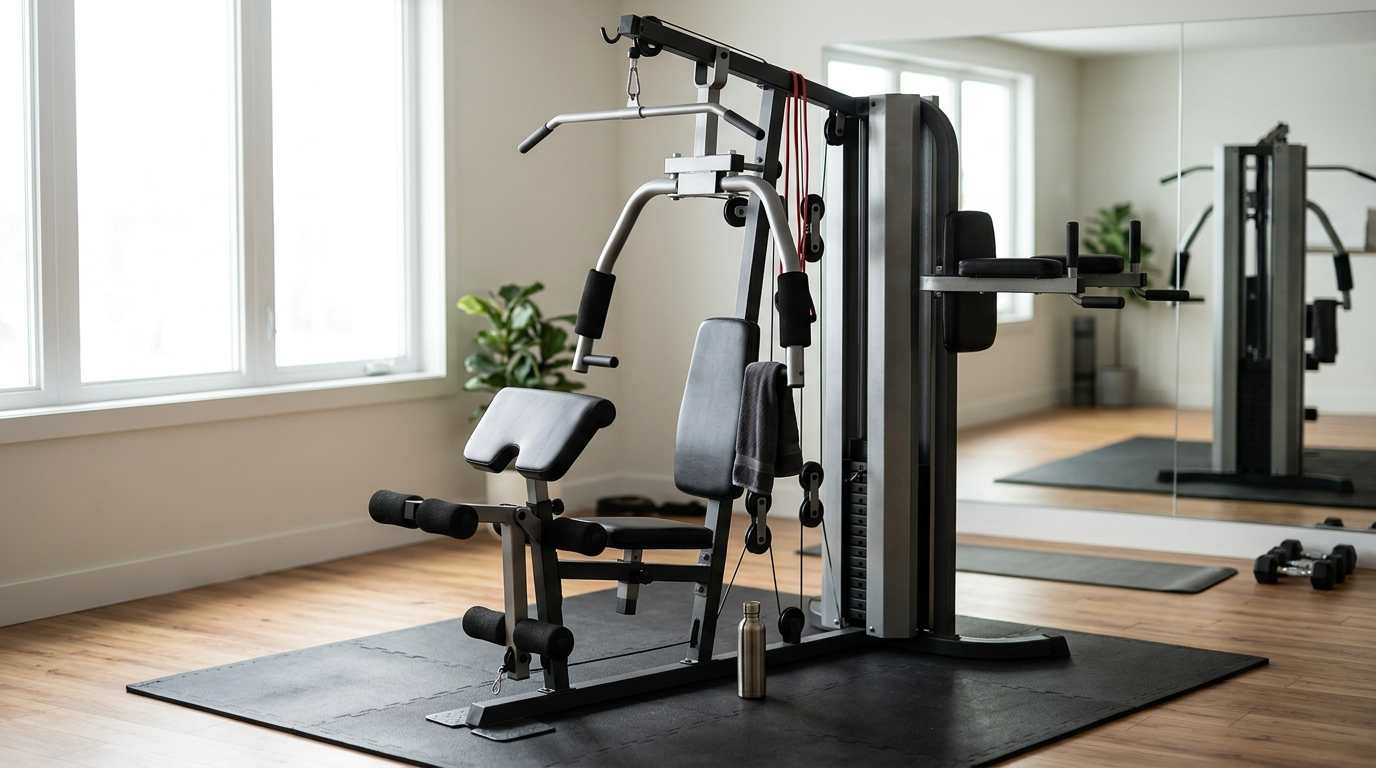

The Weider Pro 6900 can cover most major muscle groups from one home-gym station when you use its exercise stations in a sensible order. The best approach is to build workouts around the chest press, lat pulldown, leg developer, low pulley, and other cable-based movements rather than trying to squeeze every possible exercise into one session.
If you’re deciding whether the machine fits your training style, see our full Weider Pro 6900 review for a closer look at the machine itself.
Table of Contents
Weider Pro 6900 Workout Overview
A simple Weider Pro 6900 workout can train the chest, back, shoulders, arms, legs, and core in roughly 45–60 minutes.
| Muscle Group | Weider Pro 6900 Exercise | Sets | Reps |
|---|---|---|---|
| Chest | Chest Press | 3 | 8–12 |
| Back | Lat Pulldown | 3 | 8–12 |
| Back | Low-Pulley Row | 3 | 10–12 |
| Shoulders | Cable/Press Variation | 2–3 | 10–12 |
| Biceps | Low-Pulley Curl | 2–3 | 10–15 |
| Triceps | Cable Pushdown Variation | 2–3 | 10–15 |
| Legs | Leg Extension | 3 | 10–15 |
| Legs | Leg Curl Variation | 2–3 | 10–15 |
| Core | Cable Crunch Variation | 2–3 | 10–15 |
The exact exercise selection depends on your machine configuration, attachments, available range of motion, and personal comfort.
What Exercises Can You Do on the Weider Pro 6900?
The Weider Pro 6900 is built around several stations that allow you to move between pressing, pulling, leg work, and cable exercises.
The most useful movements include:
- Chest press
- Lat pulldown
- Seated or low-pulley rows
- Leg extensions
- Leg curls, depending on configuration
- Biceps curls
- Triceps cable movements
- Shoulder exercises
- Abdominal cable movements
- Various low-pulley exercises
That gives you enough exercise variety for full-body training without needing a separate bench, rack, and cable machine.
Your exercise selection should still follow the basic movement patterns: push, pull, squat/leg work, hinge, and core.
Weider Pro 6900 Chest Workout
The chest press is one of the easiest places to start because the machine provides a fixed movement path.
1. Chest Press
Sets: 3
Reps: 8–12
Rest: 60–90 seconds
Adjust the seat and handles so you can press without your shoulders being forced too far backward.
Keep your upper back against the pad. Press the handles forward under control, then return slowly.
Avoid locking your elbows aggressively at the top.
2. Cable Chest Fly
Sets: 2–3
Reps: 10–15
If your particular setup allows a comfortable cable-fly variation, use a lighter resistance than you would for pressing.
Think about bringing your hands together with a controlled motion rather than simply moving the weight from point A to point B.
3. Chest-Focused Finisher
Perform another 1–2 lighter sets of the chest press for 12–15 repetitions.
This works well when you want a short chest session rather than a complete full-body workout.
Weider Pro 6900 Back Workout
The machine’s pulldown and pulley functions make it particularly useful for basic back training.
1. Lat Pulldown
Sets: 3
Reps: 8–12
Sit securely and pull the bar toward the upper chest.
Keep your torso relatively stable throughout the movement. Your elbows should travel down rather than flaring wildly outward.
Avoid turning the exercise into a body-swinging movement.
2. Low-Pulley Row
Sets: 3
Reps: 10–12
Start with your arms extended while maintaining a controlled torso position.
Pull toward your midsection and squeeze your shoulder blades together before slowly returning to the starting position.
3. Straight-Arm Cable Pulldown
Sets: 2
Reps: 12–15
If your attachment and cable path allow it, this can provide another way to train the lats.
Use a relatively light resistance and concentrate on moving through the shoulders rather than bending and extending the elbows excessively.
Weider Pro 6900 Arm Workout
You can train your biceps and triceps immediately after chest and back work, or dedicate a separate session to your arms.
Biceps Curl
Sets: 3
Reps: 10–15
Use the low pulley with an appropriate handle.
Keep your elbows close to your body and control the lowering phase.
Avoid leaning backward to move heavier resistance.
Cable Triceps Extension
Sets: 3
Reps: 10–15
Use a comfortable cable attachment and keep your elbows relatively stable.
Extend your arms without swinging your shoulders forward.
Simple Arm Superset
For a faster workout, alternate:
- Biceps curls — 10–15 reps
- Triceps extensions — 10–15 reps
- Rest 60 seconds
- Repeat for 3 rounds
This gives you a compact arm workout while keeping the session moving.
Weider Pro 6900 Leg Workout
The leg station can add useful lower-body work to a home-gym routine.
Leg Extension
Sets: 3
Reps: 10–15
Position your knees and ankles according to the machine’s instructions.
Move the resistance smoothly and avoid kicking the pad upward.
Leg Curl
Sets: 3
Reps: 10–15
If your particular configuration supports a leg-curl movement, adjust the machine carefully before adding resistance.
The goal is controlled knee flexion rather than using momentum.
Add a Free-Weight Movement
If you have additional equipment available, pairing the machine with exercises such as goblet squats or Romanian deadlifts can give your lower-body training more variety.
For more ideas, you can also explore our guide to home gym equipment for small spaces if you’re building a compact setup around the Weider.
Best Full-Body Weider Pro 6900 Workout
For many home users, a full-body routine three times per week is easier to maintain than a complicated bodybuilding split.
Try this structure:
Workout A
1. Chest Press
3 × 8–12
2. Lat Pulldown
3 × 8–12
3. Leg Extension
3 × 10–15
4. Low-Pulley Row
3 × 10–12
5. Biceps Curl
2 × 10–15
6. Triceps Extension
2 × 10–15
7. Core Exercise
2 × 10–15
Rest approximately 60–90 seconds between most sets.
The goal isn’t to finish with exhausted muscles after every session. The goal is to perform quality repetitions and recover well enough to train again.
A Simple 3-Day Weider Pro 6900 Workout Plan
If you want more structure, use three sessions per week.
Monday: Full Body
- Chest press — 3 × 8–12
- Lat pulldown — 3 × 8–12
- Leg extension — 3 × 10–15
- Low-pulley row — 3 × 10–12
- Biceps curl — 2 × 10–15
- Triceps extension — 2 × 10–15
Wednesday: Upper Body
- Chest press — 3 × 8–12
- Lat pulldown — 3 × 8–12
- Low-pulley row — 3 × 10–12
- Shoulder movement — 2 × 10–15
- Biceps curl — 3 × 10–15
- Triceps extension — 3 × 10–15
Friday: Full Body
- Chest press — 3 × 10–12
- Lat pulldown — 3 × 10–12
- Leg extension — 3 × 12–15
- Leg curl variation — 3 × 10–15
- Low-pulley row — 3 × 10–12
- Cable core movement — 2–3 × 10–15
Leave at least one rest day between sessions.
How Much Weight Should You Use?
Choose a resistance that lets you complete your planned repetitions with good control.
For example, if your target is 10–12 reps, the last few repetitions should feel challenging while your technique remains consistent.
A simple progression system works well:
- Choose a comfortable starting resistance.
- Perform your planned sets.
- Record your repetitions.
- Add repetitions before adding resistance.
- Increase resistance when you can consistently reach the top of your target range.
- Repeat the process.
You don’t need to increase the weight every workout.
Consistent progression over several weeks matters more.
How Many Times a Week Should You Use the Weider Pro 6900?
For most beginners, two or three resistance-training sessions per week provide plenty of practice and recovery time.
More experienced lifters may prefer four sessions, particularly when workouts are divided by muscle group.
A practical schedule looks like this:
| Training Experience | Weekly Sessions | Suggested Approach |
|---|---|---|
| Beginner | 2–3 | Full-body |
| Intermediate | 3 | Full-body or upper/lower |
| Experienced | 3–4 | Split routines |
Recovery, sleep, nutrition, and your overall training volume all affect how frequently you should train.
How to Get Better Results From Weider Pro 6900 Workouts
Use Controlled Repetitions
The resistance should remain under control throughout the movement.
A slow return to the starting position can make lighter resistance considerably more demanding.
Track Your Workouts
Write down:
- Exercise
- Resistance
- Repetitions
- Sets
- Workout date
After a few weeks, you’ll have a clear record of whether you’re progressing.
Suggested Reads: Using Wearables For Progress Tracking
Don’t Change Everything at Once
If your chest press improves while your pulldown stays the same, that’s useful information.
You don’t need to replace your entire routine every few weeks.
Prioritize Technique
The machine can make resistance training easier to organize, but it can’t fix poor positioning.
Before increasing resistance, make sure your seat, handles, pads, and cable attachments are correctly positioned.
Common Weider Pro 6900 Workout Mistakes
Using Too Much Resistance
A heavier setting can feel productive, but excessive resistance often changes the movement pattern.
If you’re swinging, twisting, bouncing, or shortening the range of motion to finish a set, reduce the load.
Doing Too Many Exercises
A full-body workout doesn’t need 15 different movements.
Six to eight well-selected exercises can cover a lot of ground.
Ignoring the Back
Chest presses are easy to understand, so beginners often spend more time pressing than pulling.
Balance your routine with pulldowns and rowing movements.
Skipping the Warm-Up
Start with several minutes of general movement, then perform lighter warm-up sets before your working sets.
Your first working set shouldn’t feel like a cold start.
Training to Failure Every Time
You can occasionally push a set close to failure, but every set doesn’t need to become a maximum-effort attempt.
Leaving some room for clean repetitions can make it easier to recover and train consistently.
Weider Pro 6900 vs. a Traditional Home Gym Setup
The main appeal of the Weider Pro 6900 is convenience.
A single station can combine several movements that would otherwise require multiple pieces of equipment.
| Feature | Weider Pro 6900 | Separate Equipment |
|---|---|---|
| Space requirement | Compact relative to a full collection | Usually higher |
| Exercise variety | Good | Very high |
| Setup simplicity | High | Varies |
| Cable training | Yes | Depends on equipment |
| Free-weight movements | Limited | Excellent with rack/bench |
| Beginner friendliness | Good | Depends on setup |
| Exercise progression | Good for general fitness | Greater flexibility |
For an apartment, spare room, or compact home gym, this distinction can matter.
If you’re comparing the machine with other home-gym options, our home gym layout design ideas can also help you plan the available space.
Is the Weider Pro 6900 Good for Building Muscle?
Yes, the Weider Pro 6900 can support muscle-building workouts when you use progressive resistance, adequate training volume, proper technique, and sufficient recovery.
The machine’s biggest advantage is exercise accessibility. You can perform several major upper- and lower-body movements without changing between multiple pieces of equipment.
The main limitation is exercise selection compared with a well-equipped free-weight or commercial cable setup.
For general strength and hypertrophy training at home, though, it can provide a useful foundation.
Can Beginners Use the Weider Pro 6900?
Yes. The guided nature of many machine exercises can make the Weider Pro 6900 approachable for beginners.
Start with light resistance and learn the movement pattern before increasing the load.
A beginner could start with:
- Chest press
- Lat pulldown
- Low-pulley row
- Leg extension
- Biceps curl
- Triceps extension
Perform two sets of each exercise for the first few sessions. Once the movements feel familiar, gradually increase your training volume.
Key Takeaways
- The Weider Pro 6900 can support full-body resistance workouts at home.
- Chest presses, lat pulldowns, rows, and leg exercises form the foundation of a useful routine.
- Beginners can start with two or three sessions per week.
- A 45–60-minute workout is enough for most full-body sessions.
- Use controlled repetitions rather than chasing heavier resistance.
- Track sets, reps, and resistance to measure progress.
- Three full-body sessions can work well for beginners and intermediate users.
- The machine is especially useful when space and equipment simplicity matter.
Weider Pro 6900 Workout FAQ
How many exercises can you do on a Weider Pro 6900?
You can perform a range of chest, back, arm, leg, shoulder, and cable exercises. The exact exercise selection depends on the machine configuration and attachments.
What muscles does the Weider Pro 6900 work?
A properly designed routine can train the chest, back, shoulders, biceps, triceps, quadriceps, hamstrings, and core.
Can you build muscle with a Weider Pro 6900?
Yes. Progressive resistance, adequate training volume, nutrition, recovery, and consistent workouts are the main factors.
How often should you use a Weider Pro 6900?
Two to three full-body sessions per week work well for many beginners. More experienced users can structure additional sessions around their training goals and recovery.
How many reps should I do on the Weider Pro 6900?
A practical starting range is 8–12 repetitions for many compound movements and 10–15 for smaller isolation exercises.
Is the Weider Pro 6900 good for beginners?
Yes. Its guided movements can provide a straightforward introduction to resistance training, provided the user learns correct setup and technique.
Should I train to failure on every set?
No. Most sets can stop when you have only a few good repetitions left. Occasional harder sets can be used without making every set a maximum effort.
Can the Weider Pro 6900 replace a full gym?
It can replace many basic resistance-training movements, particularly for general fitness and home strength training. A full gym still offers considerably more exercise variety and loading options.