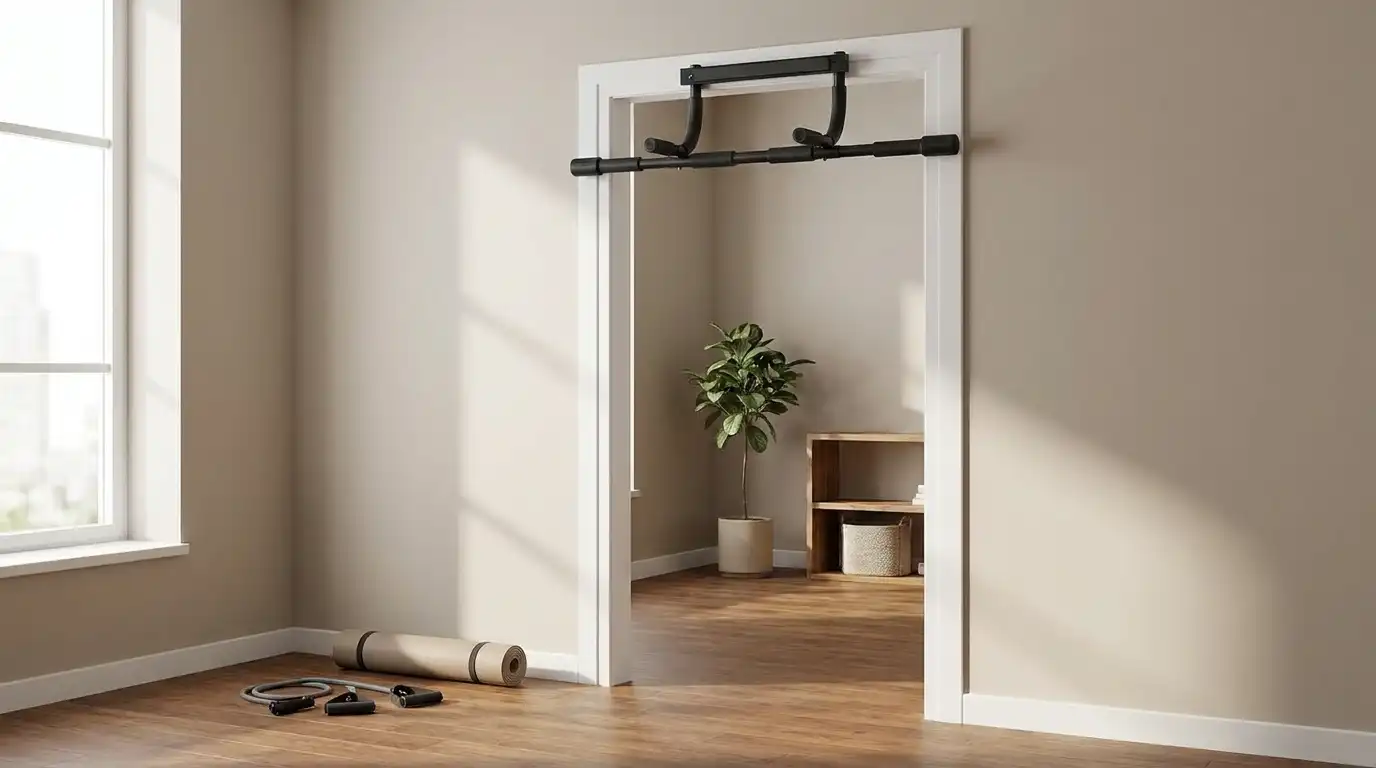

Renters often face one frustrating limitation when setting up a home gym: they cannot drill holes into walls, ceilings, or door frames without risking damage to the property. Fortunately, a no drilling pull up bar for renters offers a practical way to train upper-body strength without permanent installation. With the right equipment, we can create a functional pull-up station, protect the rental property, and maintain an effective strength-training routine in a small living space.
Table of Contents
Why Choose a No Drilling Pull Up Bar for Renters?
Building a home gym in a rented apartment requires a different approach than setting up equipment in a privately owned house. Many traditional pull-up bars rely on wall-mounted brackets, ceiling anchors, or screws that leave permanent holes. These installation methods may be unsuitable for tenants who must return their property in its original condition.
A no drilling pull up bar eliminates much of this installation difficulty. Depending on the design, it can use doorway pressure, a freestanding frame, or an adjustable tension mechanism to remain in position.
The biggest advantage is flexibility. We can install certain models without permanent modifications, remove them when necessary, and move portable equipment between rooms or properties.
Other benefits include:
- Rental-friendly installation: Avoid unnecessary drilling and permanent fixtures.
- Space efficiency: Many doorway models require very little storage space.
- Convenient workouts: Train at home without depending on gym opening hours.
- Flexible placement: Choose equipment that suits the available doorway or floor space.
- Budget-conscious training: Build upper-body strength without paying for a full gym membership.
However, not every drill-free pull-up bar is suitable for every doorway. Understanding the different designs is essential before purchasing one.
Types of No Drilling Pull Up Bars for Rental Apartments
There are several ways to create a pull-up station without permanently attaching equipment to a property.
1. Doorway Tension Pull-Up Bars
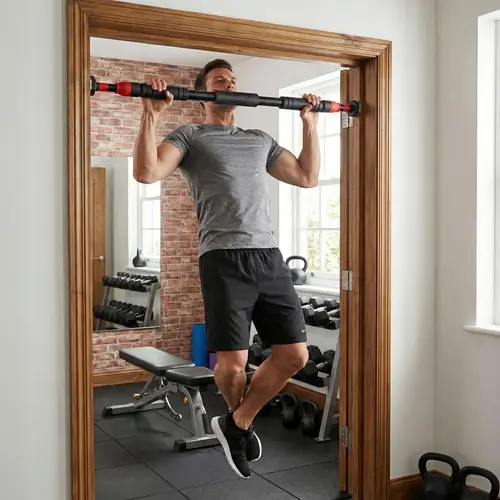
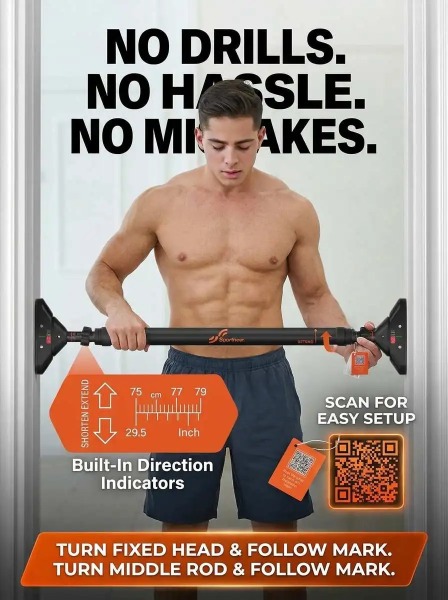
A doorway tension pull-up bar uses an adjustable mechanism to create pressure between two opposing surfaces. The bar is positioned inside a compatible doorway, then tightened according to the manufacturer’s installation instructions.
This design is attractive to renters because it generally requires no screws or permanent brackets.
Advantages:
- Compact and relatively inexpensive.
- Easy to remove when not in use.
- Suitable for many standard doorways, subject to compatibility.
- Requires minimal storage space.
Potential disadvantages:
- Stability depends heavily on the doorway’s construction and dimensions.
- Incorrect installation can cause the bar to slip.
- Some models are not designed for dynamic movements.
- Pressure can damage paint, trim, or weak door frames.
We should never assume that a tension bar is safe simply because it fits between two surfaces. The manufacturer’s instructions, weight rating, installation requirements, and condition of the doorway must all be checked.
2. Leverage-Style Doorway Pull-Up Bars
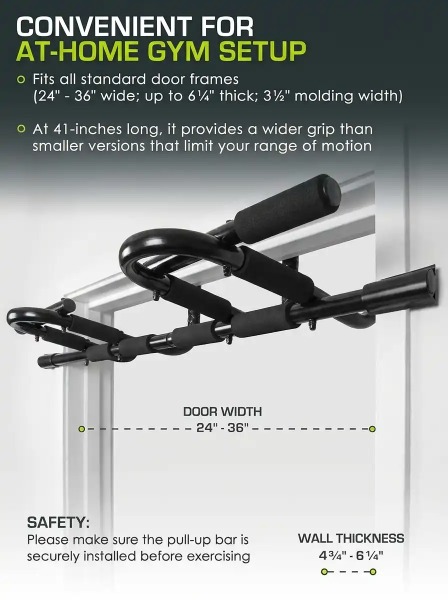
Leverage-style doorway pull-up bars use the geometry of a door frame to support the equipment. Instead of relying exclusively on pressure between two walls, these models typically use an upper section that rests against one side of the frame and lower support points that stabilize the structure.
They are often designed for installation and removal without drilling.
Their main advantage is convenience. Once we understand the installation method, the bar can usually be taken down and stored when the doorway is needed.
Before choosing one, we should verify:
- Door-frame depth and width.
- Whether the frame has suitable supporting trim.
- Maximum supported user weight.
- Compatibility with the specific doorway construction.
- Whether the manufacturer permits installation on the intended surface.
A leverage-style bar should not be installed on a decorative frame that cannot safely support the required forces.
3. Freestanding Pull-Up Stations
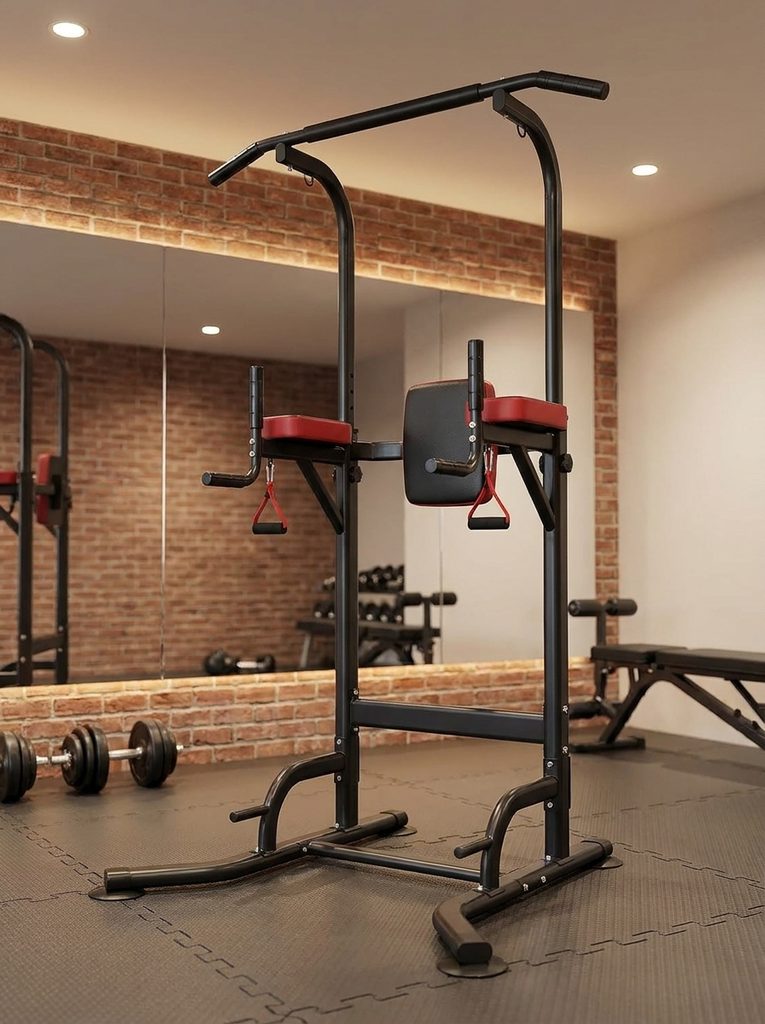
A freestanding pull-up station is one of the most versatile options for renters who want to avoid placing equipment inside a doorway.
These structures stand on the floor and usually feature a vertical frame, horizontal pull-up bar, and stabilizing base. Some models also include dip handles, knee-raise supports, and adjustable height settings.
Why we like this option:
- No wall drilling is necessary.
- The doorway remains completely accessible.
- Different exercises can be performed on one structure.
- The equipment can be relocated when necessary.
- It can support a more comprehensive bodyweight workout.
The trade-off is size. A freestanding station occupies more floor space than a doorway bar, which may be inconvenient in a studio apartment.
We should also consider the floor surface, frame stability, maximum weight capacity, assembly requirements, and available ceiling clearance.
4. Portable Outdoor Pull-Up Bars
Renters with access to a private patio, balcony, or suitable outdoor area may consider portable outdoor pull-up equipment.
Some models are lightweight and designed to be assembled without permanent installation. Others feature larger frames intended for outdoor strength training.
This approach keeps exercise equipment outside the main living area, but weather resistance becomes important.
Before placing equipment outdoors, we should check:
- Whether the manufacturer permits outdoor use.
- Resistance to moisture and corrosion.
- Surface stability.
- Wind exposure and tipping risk.
- Available overhead clearance.
A portable outdoor station is not automatically suitable for a balcony. The balcony’s structural capacity and the equipment’s footprint must also be considered.
How to Choose the Best No Drilling Pull Up Bar for Renters
Choosing the right pull-up bar involves more than comparing prices or selecting the most compact model.
We need to consider the doorway, available space, training experience, and the type of exercises we intend to perform.
Check Doorway Dimensions Before Buying
Doorway compatibility is one of the most important purchasing considerations.
Manufacturers typically specify a minimum and maximum doorway width, along with requirements for frame depth and trim construction.
Measure the opening carefully before ordering.
Pay particular attention to:
- Internal doorway width.
- Door-frame depth.
- Frame material.
- Shape and thickness of the trim.
- Clearance above the doorway.
- Condition of the surrounding structure.
A bar that appears compatible in product photographs may not work with an unusually narrow, wide, shallow, or decorative doorway.
Understand Weight Capacity
Every pull-up bar should have a clearly stated maximum user weight.
However, weight capacity should not be interpreted as a guarantee that the equipment is suitable for every movement.
A controlled pull-up places different demands on equipment than swinging, kipping, or explosive movements.
We should select equipment that comfortably accommodates the user’s body weight and follow the manufacturer’s restrictions on movement and use.
Avoid exceeding the stated weight limit or assuming that a higher advertised capacity makes an incompatible installation safe.
Consider the Installation Mechanism
A rental-friendly product should be easy to install and remove without compromising stability.
However, drill-free does not automatically mean damage-free.
Tension mechanisms can leave pressure marks, while leverage-style equipment can scratch or dent door trim. Freestanding stations can also damage flooring if their bases are not properly protected.
Look for:
- Protective contact pads.
- Clear installation instructions.
- Secure locking mechanisms.
- Compatible doorway requirements.
- Appropriate floor-contact protection.
If the manufacturer requires a particular installation surface, do not substitute another surface simply because the bar appears to fit.
Measure Available Ceiling Clearance
Pull-ups require enough vertical space for comfortable movement.
We should measure the distance between the floor, the pull-up bar, and the ceiling.
Tall users may need additional clearance, especially when performing movements that involve raising the knees or bringing the chin above the bar.
For freestanding stations, also consider the height of the equipment and whether it can fit through the apartment’s doorways during assembly.
Choose a Suitable Grip Design
Grip design affects comfort and exercise variety.
Some pull-up bars offer a simple straight horizontal handle, while others include multiple grip positions.
Common options include:
- Overhand grip: Targets the back and upper-body pulling muscles.
- Underhand grip: Often called a chin-up grip and emphasizes the biceps alongside the back.
- Neutral grip: Uses palms facing each other and may feel more comfortable for some users.
- Wide grip: Allows a wider hand position, although it is not necessary for developing a strong back.
For beginners, a comfortable straight bar with a suitable grip diameter may be more useful than a complicated multi-grip design.
Are No Drilling Pull Up Bars Safe for Renters?
Safety should be the first consideration when choosing equipment that supports our entire body weight.
The most important distinction is between a bar that is simply easy to install and one that is appropriate for the structure supporting it.
A properly selected freestanding station can avoid the uncertainty of relying on a rental property’s door frame. However, it still needs to be assembled correctly and positioned on a stable surface.
Doorway models require additional attention.
Never perform a full-weight pull-up until the equipment has been installed exactly as instructed and its compatibility has been confirmed.
We should also avoid the following mistakes:
- Installing a bar on a cracked or damaged frame.
- Using a tension bar on unsuitable surfaces.
- Ignoring the manufacturer’s weight restrictions.
- Performing swinging movements on equipment designed for controlled repetitions.
- Allowing children to hang or play on the equipment.
- Assuming that protective padding makes every doorway suitable.
- Continuing to use a bar that moves, rotates, or becomes loose.
If the doorway’s structural suitability is uncertain, choose a different training method rather than experimenting with an unsafe installation.
How to Protect Rental Property When Installing a Pull-Up Bar
Even when a pull-up bar does not require drilling, it can still leave marks.
Rental agreements may contain specific requirements concerning alterations, damage, and fixtures. Therefore, we should take precautions before introducing exercise equipment into the apartment.
Use Protective Padding
Protective pads can help reduce direct contact between equipment and painted surfaces.
Some doorway models include rubber or foam padding, while freestanding stations may benefit from compatible floor-protection mats.
We should use only protective materials permitted by the manufacturer. Adding thick padding where it is not recommended can interfere with proper installation and reduce stability.
Inspect the Installation Area Regularly
Before every workout, check the doorway or equipment base.
Look for movement, loosened adjustment mechanisms, damaged pads, cracks, scratches, or changes in the surrounding structure.
If the bar shifts during installation or use, stop immediately.
Avoid Permanent Modifications
Do not drill additional holes, attach homemade brackets, or modify the equipment to make it fit.
These alterations can weaken the equipment or damage the property.
When a product cannot be installed according to its instructions, it is better to select another model.
Best Exercises to Perform With a No Drilling Pull Up Bar
A suitable pull-up bar can support several upper-body exercises, depending on its design and the manufacturer’s permitted uses.
1. Standard Pull-Ups
Pull-ups are one of the most effective bodyweight exercises for developing upper-body pulling strength.
The movement primarily involves the latissimus dorsi, with assistance from the biceps, upper back, forearms, and core.
To perform a controlled repetition:
- Grip the bar with your palms facing away.
- Begin from a stable hanging position.
- Engage your shoulders and abdominal muscles.
- Pull your body upward without swinging.
- Lower yourself slowly and maintain control.
Beginners can start with assisted variations or alternative pulling exercises until they develop sufficient strength.
2. Chin-Ups
Chin-ups use an underhand grip, with the palms facing toward the body.
This variation emphasizes the biceps while continuing to challenge the back and other pulling muscles.
We can incorporate chin-ups into a balanced upper-body routine once we can perform them with controlled technique.
3. Dead Hangs
Dead hangs involve holding the bar with the arms extended while keeping the body controlled.
They can help beginners become comfortable supporting their body weight and develop grip endurance.
Start with short, comfortable holds rather than attempting to remain suspended for extended periods.
Only perform dead hangs on equipment explicitly rated for this type of use.
4. Knee Raises
Hanging knee raises engage the abdominal muscles and hip flexors.
The exercise involves lifting the knees toward the chest while keeping the upper body stable.
Avoid swinging or using momentum. This exercise should only be performed on a bar designed to support the additional movement demands.
5. Negative Pull-Ups
Negative pull-ups are particularly useful for people who cannot yet complete a full repetition.
The exercise focuses on the lowering phase of the movement.
We begin in the top position using a safe step or platform, then lower ourselves gradually.
This allows beginners to practice the movement pattern while developing the strength needed for complete pull-ups.
No Drilling Pull Up Bar Alternatives for Small Apartments
Sometimes a doorway pull-up bar is not suitable for the available space or property construction.
Fortunately, we can still train the upper body without installing permanent equipment.
Resistance Bands
Resistance bands are among the most practical alternatives for renters.
They take up very little storage space and can support exercises such as rows, curls, chest presses, and shoulder movements.
Some bands can also assist pull-up progression when used with a compatible pull-up station.
We should avoid anchoring bands to doors, furniture, or other structures unless the manufacturer specifically permits that use.
Adjustable Dumbbells
Adjustable dumbbells provide a versatile solution for small home gyms.
They support rows, shoulder presses, curls, lateral raises, and numerous other exercises.
Their main advantage is versatility: one compact set can replace several pairs of traditional dumbbells.
Suspension Trainers
Suspension trainers use adjustable straps and body weight to create resistance.
They can support rows, chest exercises, squats, and core movements.
However, they require a manufacturer-approved, structurally suitable anchor point. They should not be attached to unsuitable doors or furniture simply to avoid drilling.
Resistance-Based Pulling Exercises
If we cannot safely install a pull-up bar, resistance-band rows and dumbbell rows can help develop the same broad pulling-muscle groups.
These exercises provide a practical starting point while keeping the rental property free from permanent modifications.
How to Build a Small Apartment Pull-Up Workout Routine
We do not need a large room or expensive equipment to establish a consistent strength-training routine.
A compact setup can support an effective workout using controlled movements and progressive training.
Here is an example of a beginner-friendly upper-body session.
| Exercise | Sets | Repetitions |
|---|---|---|
| Assisted pull-ups | 3 | 5–8 |
| Resistance-band rows | 3 | 10–12 |
| Negative pull-ups | 2 | 3–5 |
| Dumbbell curls | 2 | 10–12 |
| Dead hangs | 2 | 10–20 seconds |
Rest for approximately 60–120 seconds between sets, adjusting the recovery period according to your fitness level.
Beginners should prioritize technique over repetition counts. If full pull-ups are too difficult, assisted variations and resistance-based exercises can provide a gradual progression.
We should also allow sufficient recovery between demanding upper-body sessions.
Common Mistakes When Buying a Rental-Friendly Pull-Up Bar
Even a well-designed product can become a poor purchase when we overlook important details.
Choosing Based on Price Alone
Low-cost equipment may appear attractive, but unclear weight ratings, weak adjustment mechanisms, and poor installation instructions can make it unsuitable.
We should prioritize documented specifications, construction quality, and compatibility.
Ignoring Door-Frame Construction
Not every doorway can support a pull-up bar.
Some frames are decorative, weak, damaged, or shaped in ways that prevent secure installation.
A compatible doorway is essential.
Assuming Every No-Drill Model Is Damage-Free
Pressure marks, scratches, dents, and paint damage are still possible.
Renters should understand how the equipment contacts the property before purchasing it.
Buying Equipment That Takes Up Too Much Space
A freestanding power tower may provide more exercise options, but it can dominate a small room.
We should measure the available floor area and consider how easily the equipment can be stored or relocated.
Ignoring Exercise Restrictions
Some bars are designed for controlled pull-ups, while others support a wider range of movements.
We should never assume that a product is suitable for swinging, kipping, or other dynamic exercises unless the manufacturer explicitly confirms it.
Final Thoughts: Choosing the Right No Drilling Pull Up Bar for Renters
A no drilling pull up bar for renters can make home strength training more accessible without requiring permanent changes to an apartment.
Doorway tension bars and leverage-style models offer compact solutions for compatible door frames. Freestanding pull-up stations provide greater versatility without relying on the property’s walls, while resistance bands and adjustable dumbbells offer practical alternatives when a pull-up installation is unsuitable.
The best choice depends on the available space, doorway construction, training goals, and equipment specifications.
Most importantly, we should never sacrifice stability to achieve a completely drill-free installation. A properly selected and correctly installed pull-up station can support a convenient home workout routine while helping us preserve the condition of a rented property.