
In 2026, building a home gym isn’t about buying everything. It’s about buying the right things.
I’ve spent the last three years testing equipment in my own garage, basement, and spare bedroom setups. I’ve bolted down Smith machines at midnight, tripped over kettlebells at 6 AM, and learned the hard way that a $50 mirror from a big-box store shatters when a 45-pound plate bounces the wrong way. I’ve also helped hundreds of readers build gyms that actually get used instead of collecting dust.
The problem? Information overload. YouTube reviewers push $4,000 machines. Reddit threads argue about cable ratios until your eyes glaze over. And every Amazon listing claims to be “commercial grade” while weighing 90 pounds and wobbling like a folding chair.
This guide fixes that. By the end, you’ll know exactly what equipment matches your goals, your space, and your budget. No fluff. No upsells you don’t need.
Table of Contents
How to Use This Guide
Who This Guide Is For
Beginners who’ve never touched a weight plate. Advanced lifters who want to quit their commercial gym. Parents building a corner in the garage. Apartment dwellers with 150 square feet and thin walls. If you want to train at home without wasting money, you’re in the right place.
How We Tested & Reviewed
Our team spent 200+ hours physically testing machines, reading owner manuals, and cross-referencing Reddit threads, Amazon reviews, and warranty documents. We look at build quality (gauge steel, welds, powder coat), real-world footprint (not the misleading “compact” claims), cable smoothness, and long-term durability. When we haven’t tested a unit personally, we flag it and explain why we still recommend it based on verified user data.
Budget Categories Explained
- $500–$1,000: The essentials. A wall pulley, a few kettlebells, a mirror, and storage.
- $1,000–$3,000: The sweet spot. A functional trainer or Smith machine, cardio piece, and organization.
- $3,000–$6,000+: The full build. Multiple stations, premium flooring, and a mirror wall that makes your gym look like a boutique studio.
The 10 Essential Home Gym Equipment Categories
Functional Trainers & Cable Machines
A functional trainer is the centerpiece of most home gyms I recommend. Two adjustable cable columns give you hundreds of exercise variations—chest flyes, tricep pushdowns, lat pulldowns, cable rows—in a footprint smaller than a loveseat.
The catch? Cheap ones feel like fishing line on a stick. Good ones cost $1,000+ and need 6 feet of depth.
Read our full functional trainer reviews →
Smith Machines
A Smith machine gives you barbell-style training without a spotter. The bar rides on fixed vertical guides with safety hooks every few inches. You can bench press alone, squat heavy, and never worry about getting pinned.
Purists hate them because the fixed path isn’t “natural.” Fair. But for home gyms, the safety trade-off wins. Most home Smith setups also include a pull-up bar, cable crossover, and weight storage.
Read our full Smith machine reviews →
All-in-One Multi-Gyms
These are the classic home gym machines—Marcy, Bowflex, Gold’s Gym. One frame, multiple stations, usually a weight stack or resistance rods. They’re plug-and-play. You don’t need plates, clips, or a degree in kinesiology.
The downside? They occupy a lot of floor space for the number of exercises they offer, and the weight stacks top out around 150–200 pounds. Fine for beginners and general fitness. Not enough for serious strength training.
Read our full all-in-one machine reviews →
Leg Press Machines
Leg day at home usually means squats, lunges, and Bulgarian split squats. But a dedicated leg press machine lets you load heavy without loading your spine. Great for people with back issues, knee rehab, or anyone who just wants to push serious weight in a controlled path.
Compact vertical leg presses start around $300. Full hack squat / leg press combos run $1,200+.
Read our full leg press reviews →
Air Bikes & Fan Bikes
The air bike is the most brutal piece of cardio equipment ever invented. The harder you pedal, the harder it pushes back. No motor, no max resistance, no mercy. Perfect for HIIT, CrossFit-style conditioning, and quick fat-loss workouts that finish in 15 minutes.
They also require zero electricity and almost no maintenance. Just a chain, a fan, and your willingness to suffer.
Read our full air bike reviews →
Power Towers (Pull-Up & Dip Stations)
A power tower is a steel frame with a pull-up bar, dip station, and usually push-up handles. That’s it. No weights, no cables, no moving parts. For $150–$300, you get a complete calisthenics station that works your back, chest, shoulders, and arms.
If you’re tight on space or budget, start here. Add a weighted vest later and you’ve got a setup that rivals most hotel gyms.
Read our full power tower reviews →
Kettlebells & Kettlebell Racks
Kettlebells are the most versatile free weights you can own. Swings, goblet squats, Turkish get-ups, snatches, carries. One kettlebell gives you a full-body workout. Five kettlebells give you a lifetime of progression.
Adjustable kettlebells save space. Cast iron sets look better and feel better. Either way, you’ll want a rack. Kettlebells on the floor are a broken toe waiting to happen.
Read our full kettlebell set & rack reviews →
Wall-Mounted Cable Pulley Systems
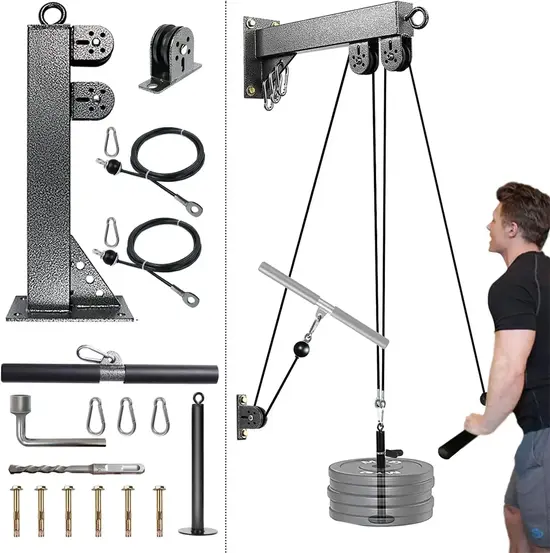
Can’t fit a full functional trainer? A wall-mounted pulley system bolts to your studs and gives you 70% of the functionality at 20% of the footprint and cost. Lat pulldowns, tricep extensions, cable rows—all from a $100–$300 kit that hangs on your wall.
The trade-off? Lower weight capacity, more setup time, and you need to supply your own weight plates. But for apartments and small garages, this is the best value in home fitness.
Gym Mirrors & Wall Installations
You need to see your form. Period. A gym mirror isn’t vanity—it’s injury prevention. When you can see your squat depth, your deadlift back angle, and your bench bar path, you fix mistakes before they become chronic pain.
Acrylic mirror tiles are cheap and shatterproof. Glass looks better but costs more and breaks. Full-wall installations transform a garage into a studio.
Read our full home gym mirror reviews →
Storage & Organization Systems
A messy gym is a gym you won’t use. Weight plate trees, dumbbell racks, wall-mounted pegboards, and bumper plate carts keep your floor clear and your head clear. The best home gyms look organized because organization reduces friction. Less friction means more workouts.
Read our full storage & organization reviews →
Home Gym Setup by Budget
Budget Setup ($500–$1,000)
You don’t need a fortune to build something functional.
The core kit:
- Wall-mounted cable pulley system ($100–$200)
- Adjustable kettlebell ($100–$150)
- Acrylic gym mirror ($50–$100)
- Weight plate tree or basic storage ($50–$80)
- Floor mats ($50–$100)
Total: ~$500–$600. Add a pull-up bar that mounts in a doorway ($30–$50) and you’ve got lat pulldowns, rows, swings, squats, and pull-ups. That’s more variety than most hotel gyms.
Who this is for: Beginners, apartment dwellers, anyone testing the waters before committing serious money.
Mid-Range Setup ($1,000–$3,000)
This is where home gyms get good.
The core kit:
- Functional trainer or Smith machine ($800–$1,800)
- Air bike ($500–$800)
- Power tower ($150–$300)
- Full-length mirror ($100–$200)
- Plate tree + accessory storage ($100–$200)
- Flooring ($100–$300)
Total: ~$1,800–$2,800. You now have a cable station, barbell station, cardio machine, calisthenics station, and a space that looks intentional. This is the setup I recommend to 80% of readers.
Who this is for: Serious beginners, intermediate lifters, garage gym builders.
Premium Setup ($3,000–$6,000+)
Money isn’t the constraint. Space and time are.
The core kit:
- Smith machine with integrated functional trainer ($1,200–$2,500)
- Leg press / hack squat machine ($800–$1,500)
- All-in-one multi-gym or secondary cable station ($600–$1,200)
- Full mirror wall ($300–$800)
- Professional flooring ($300–$600)
- Storage systems ($200–$400)
- Air bike or rower ($500–$1,000)
Total: ~$4,000–$6,500. This is a commercial-grade setup in your basement or garage. Multiple people can train simultaneously. You have redundancy (two ways to work every muscle group). And the mirror wall makes the space feel like a real gym, not a storage closet with a bench.
Who this is for: Advanced lifters, families, anyone who trains 5+ days per week and never wants to wait for equipment again.
Home Gym Setup by Space
Studio Apartment (100–200 sq ft)
You need equipment that folds, mounts on walls, or stores in a closet.
Priority list:
- Adjustable kettlebell
- Wall-mounted pulley system
- Doorway pull-up bar
- Foldable yoga mat
- Small mirror (over-the-door or wall-mounted)
Skip the machines. You don’t have the floor space or the ceiling height. Focus on kettlebells, bodyweight, and the wall pulley.
Spare Bedroom (150–250 sq ft)
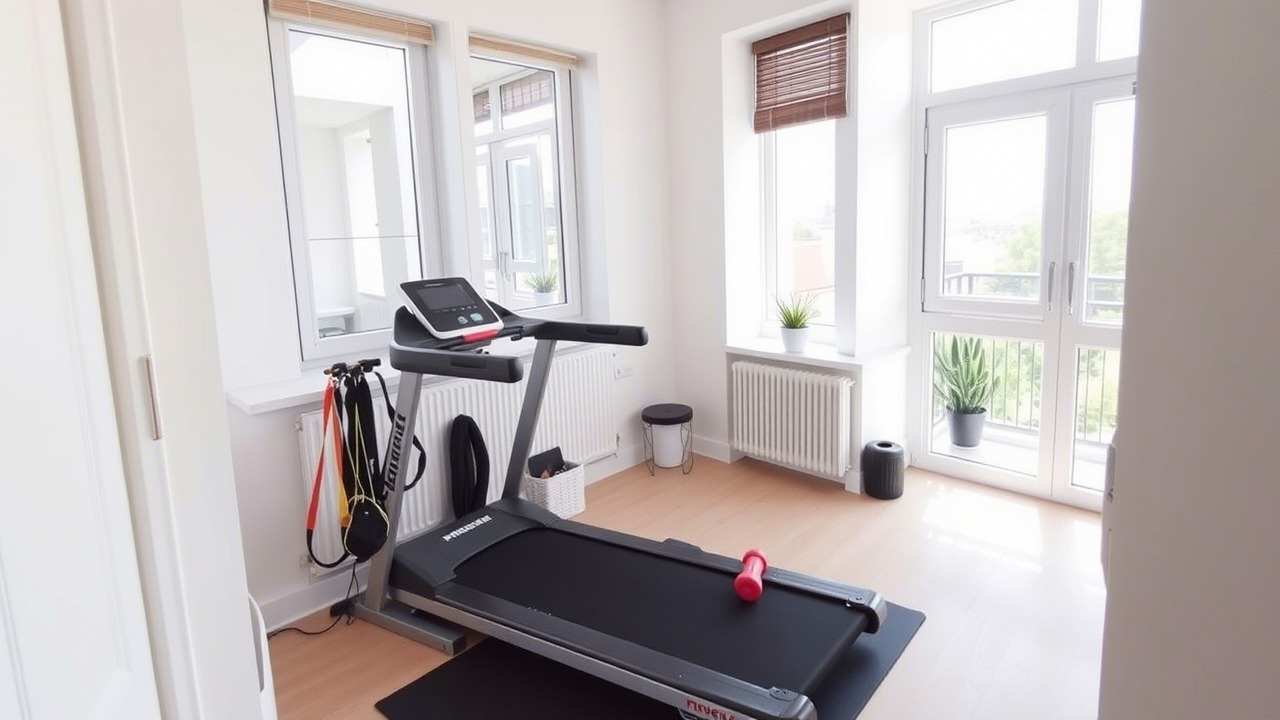
A spare bedroom gives you enough room for one major machine plus accessories.
Best layout: Place your functional trainer or all-in-one machine against the longest wall. Mirror on the opposite wall. Storage in the closet. Air bike or power tower in the corner. Keep a 3-foot walkway clear on all sides.
Pro tip: Put rubber flooring down. Your landlord (and your downstairs neighbors) will thank you.
Garage Gym (300–600 sq ft)
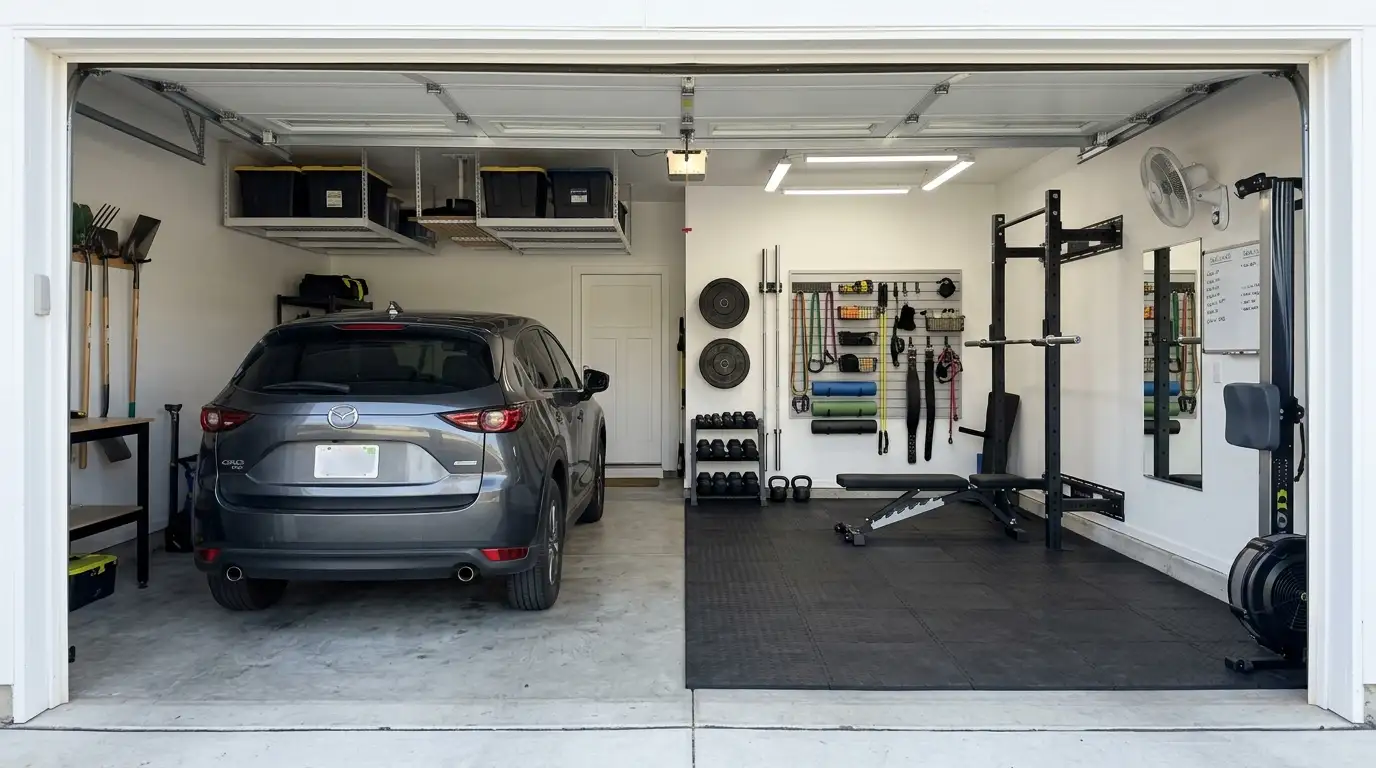
This is the dream. High ceilings, concrete floors, and permission to bolt things down.
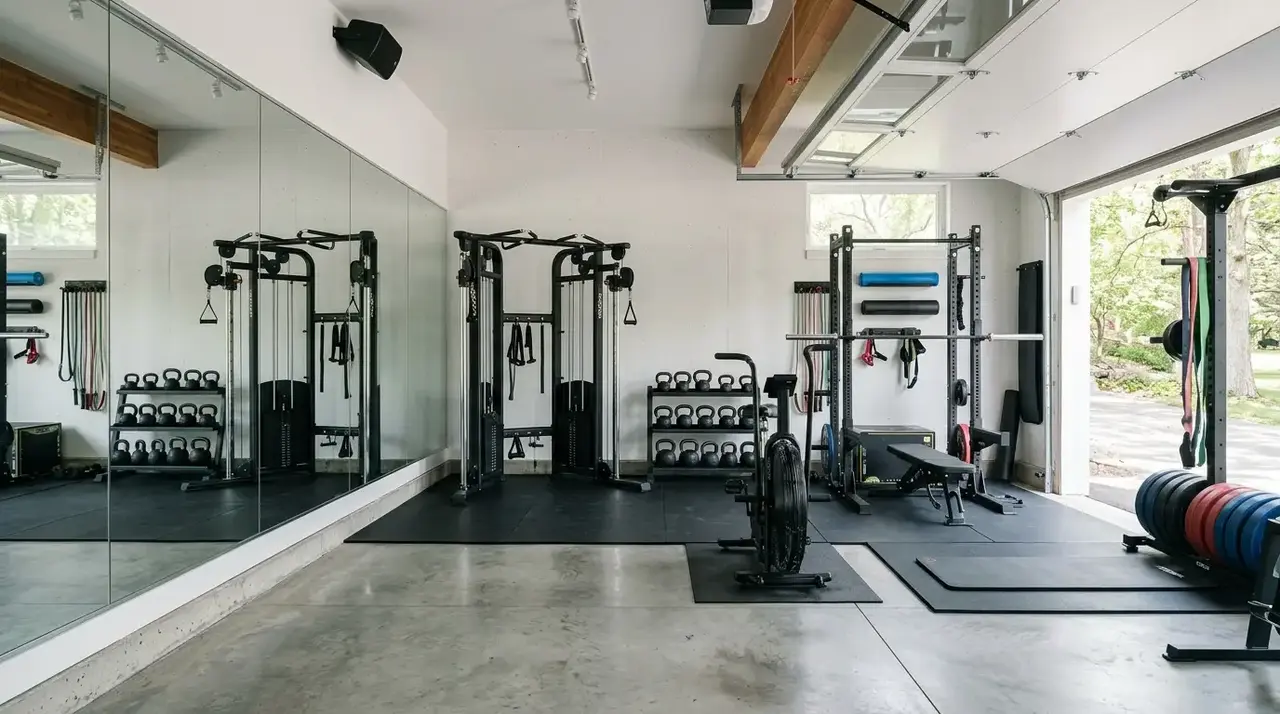
Best layout: Divide the space into zones. Cardio near the door (where airflow is best). Strength equipment in the center or against walls. Storage along the back wall. Mirror on the wall facing your main lifting area.
Pro tip: Insulate if you live somewhere with real winters. A garage gym that’s 35°F in January is a garage gym you won’t use.
Basement Gym (200–400 sq ft)
Basements have great temperature control but often suffer from low ceilings and bad lighting.
Watch the height: Measure from floor to joists before buying a power tower or Smith machine. You need at least 7.5 feet for most pull-up bars and 8+ feet for a full Smith setup.
Fix the lighting: Add LED shop lights or strip lighting. A bright basement gym feels like a real gym. A dim one feels like a dungeon.
Home Gym Layout & Design Tips
The “Work Triangle” Concept
Borrowed from kitchen design, the work triangle places your three most-used stations within easy reach of each other. In a home gym, that’s usually:
- Cardio zone: Air bike, rower, or jump rope area
- Strength zone: Rack, Smith machine, or functional trainer
- Recovery / accessory zone: Stretching mat, foam roller, kettlebell corner
You should be able to move between all three without squeezing past equipment or tripping over plates.
Flooring Considerations
Concrete destroys joints. Carpet absorbs sweat and smells. You need proper gym flooring.
Options:
- Horse stall mats: $40–$60 each, 4×6 feet, ¾-inch thick. The gold standard for garage gyms.
- Rubber gym tiles: $2–$4 per square foot. Easier to install, cleaner look.
- Puzzle mats: $1–$2 per square foot. Fine for light use, but they shift under heavy equipment.
Place mats under every station. Extend them 2 feet beyond the footprint of your machine so dropped weights land on rubber, not concrete.
Lighting & Mirror Placement
Bad lighting makes a gym feel like a cave. Good lighting makes it feel like a studio.
Lighting: Aim for 3,000–5,000 lumens in your main work area. LED shop lights are cheap and bright. Add a dimmable option if you do yoga or stretching.
Mirrors: Place your main mirror where you can see yourself during squats, deadlifts, and presses. If you have multiple stations, consider a mirror wall or two smaller mirrors angled to cover both areas.
Ventilation & Climate Control
Sweat + stagnant air = mildew and rust.
Garage gyms: Open the door during workouts. Add a box fan. Consider a mini-split AC if you’re in a hot climate.
Basement gyms: Run a dehumidifier. Mold grows fast in damp basements, and it’ll wreck your equipment and your lungs.
Spare bedrooms: Crack a window. A small air purifier handles dust and chalk.
Final Thoughts & Next Steps
Building a home gym is one of the best investments you can make in your health. But the equipment is only half the battle. The other half is showing up.
Start small. Buy one or two pieces you know you’ll use. Build the habit first, then expand. A $500 gym you use daily beats a $5,000 gym that collects dust.
Ready to dive deeper? Explore our detailed reviews below or check out our Small Space Home Gym Guide.
Key Takeaways
- A functional home gym costs $500–$3,000 for most people. You don’t need commercial-grade gear to get commercial-grade results.
- Start with versatile equipment: kettlebells, wall pulleys, and pull-up bars give you the most exercises per dollar.
- Measure your space before you buy. Ceiling height, floor type, and ventilation matter as much as the machine specs.
- Organization isn’t optional. A clean gym gets used more than a cluttered one.
- Mirrors prevent injury by letting you check form in real time.
- Buy for your current fitness level, not your fantasy fitness level. A beginner doesn’t need a $2,500 Smith machine.
- The “work triangle”—cardio, strength, recovery zones—keeps your layout efficient.
- Proper flooring protects your joints, your equipment, and your relationship with your downstairs neighbors.
- Ventilation prevents rust and mildew. Open a window, run a fan, or install a mini-split.
- Consistency beats equipment quality every time. Start now, upgrade later.
Suggested Reads: Strongman Equipment for Home Gym: Best Setup Guide
Frequently Asked Questions
What is the best home gym equipment for beginners?
Start with an adjustable kettlebell, a doorway pull-up bar, and a set of resistance bands. That’s under $200 and gives you full-body workouts. Once you’re consistent for 60 days, add a wall-mounted pulley system or a power tower.
How much does a complete home gym cost?
Anywhere from $500 to $6,000+. A solid mid-range setup runs $1,500–$3,000. The biggest variables are whether you buy a functional trainer or Smith machine and whether you install a mirror wall.
What equipment gives the most exercises per dollar?
functional trainer or wall-mounted pulley system. Hundreds of cable exercises in one footprint. Second place goes to adjustable kettlebells.
Do I need a power rack or is a Smith machine enough?
A Smith machine is enough for 90% of home gym users. Power racks are better for free-weight purists and competitive lifters. If you train alone and safety matters more than perfect bar path, go with the Smith.
How much space do I need for a functional trainer?
Most need a 5×6 foot footprint plus 2–3 feet of clearance on all sides for cable travel. That’s roughly an 8×10 foot area minimum. Wall-mounted pulleys need half that.
Are all-in-one home gyms worth it?
For beginners and general fitness, yes. For serious strength training, no. The weight stacks cap out too low. They’re great for someone who wants to press a button and work out without thinking about programming.
What’s the first piece of equipment I should buy?
An adjustable kettlebell. One weight, infinite exercises, stores in a closet. If you use it consistently for a month, you’ll know exactly what to buy next.
How do I organize a small home gym?
Vertical storage. Wall-mounted racks, plate trees, and pegboards keep the floor clear. Store accessories (bands, gloves, chalk) in bins on shelves. If it doesn’t fit on a wall or in a bin, you probably don’t need it.