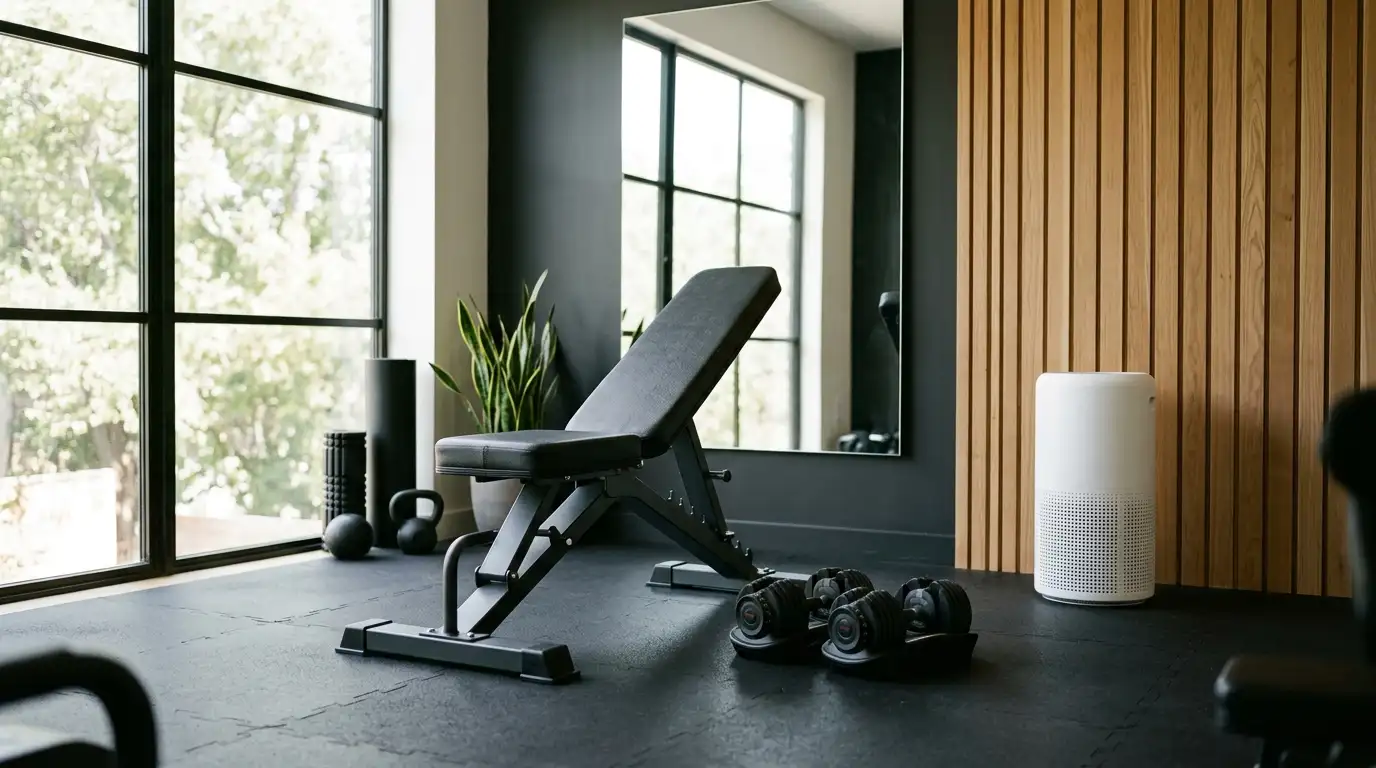

The best air purifier for a home gym combines high clean air delivery rate (CADR), effective particle filtration, adequate activated carbon for odors, and a size that matches the workout space. The Levoit Core 600S-P is a strong candidate for many home gyms, while the Coway Airmega 400 suits larger spaces and the Blueair Blue Pure 211i Max offers high published airflow. Chalk-heavy gyms also need source control, ventilation, and regular pre-filter maintenance.
Quick Comparison: Best Air Purifiers for Fitness Enthusiasts
| Air purifier | Published CADR | Noise range | Best for |
|---|---|---|---|
| Levoit Core 600S-P | 391 CFM | 26–55 dB | Larger home gyms and smart controls |
| Coway Airmega 400 | Smoke 328, dust 328, pollen 400 CFM | 22–52 dB(A) | Large workout rooms and washable pre-filter maintenance |
| Blueair Blue Pure 211i Max | Smoke 435, dust 452, pollen 450 CFM | 23–53 dB | High-airflow workout spaces |
| Winix 5500-2 | Verify current published CADR | Verify current published range | Smaller gyms where pre-filter maintenance matters |
Specifications are from manufacturer listings where available. CADR is a particle-cleaning performance measure, and manufacturer room-size figures can use different air-change assumptions. Compare like-for-like ratings before buying.
Table of Contents
The Link Between Air Quality and Athletic Performance (#air-quality-performance)
Air quality affects the comfort of your workout environment, especially when you’re breathing harder during intense cardio, circuits, or heavy sets. An air purifier can reduce certain airborne particles, but its benefits depend on the pollutants present, the device’s capacity, and how the room is ventilated.
Airborne Dust, Allergens, and Breathing Comfort
Home gyms collect dust from flooring, equipment, storage areas, outdoor air, and everyday household activity. Depending on the space, airborne pollutants may include pollen, pet dander, fine particulate matter, and particles associated with mold.
People with allergies or asthma may experience respiratory irritation from some of these pollutants. Filtering suitable airborne particles can help reduce exposure, although individual symptom improvements vary.
During exercise, ventilation increases as your body demands more oxygen. Dust and allergens may aggravate sensitive airways, making training less comfortable. A room air purifier can reduce some airborne particles, but it cannot replace medical treatment or correct inadequate ventilation.
The U.S. Environmental Protection Agency recommends selecting an air cleaner with a clean air delivery rate appropriate for the room and treating filtration as one part of an indoor air-quality strategy.
Lifting Chalk and the Garage Gym Problem
Lifting chalk helps improve grip by absorbing moisture from your hands. The same chalk can become airborne when you clap your hands, brush powder off a barbell, or drop chalk-covered equipment.
In a small garage gym, those particles can remain suspended before settling on racks, plates, benches, and nearby surfaces. Repeated use can create a persistent layer of fine dust.
A purifier with suitable particle filtration and sufficient airflow can capture some airborne chalk. However, the most effective approach starts with reducing the amount released into the room.
Consider liquid chalk where appropriate, keep loose chalk in a closed container, avoid unnecessary clapping or brushing, and wipe down equipment regularly. If your gym has substantial visible dust, a purifier alone is unlikely to solve the entire problem.
Rubber Flooring, Sweat Odors, and Stale Air
Rubber mats, adhesives, cleaning products, and other gym materials may release odors or volatile organic compounds (VOCs). Sweat and damp towels can also make a poorly ventilated workout room smell stale.
An activated carbon filter can adsorb certain gases and odor compounds. Its effectiveness depends on the type and amount of carbon, the pollutant, airflow, and how quickly the filter becomes saturated.
A thin carbon-coated filter may offer limited odor capacity compared with a filter containing a substantial quantity of carbon.
Ventilation and source control remain essential. Remove damp towels after workouts, allow sweaty equipment to dry, clean flooring according to its manufacturer’s instructions, and investigate persistent chemical smells rather than relying on an air purifier to mask them.
For more deatails about home gym flooring read Best Home Gym Flooring Mats for Every Fitness Space (2026)
Why Lifters Should Care About Clean Air and Recovery (#clean-air-recovery)
A clean, comfortable bedroom or workout space can support better rest and training consistency. Reducing airborne irritants may help some people who experience allergy-related congestion, but there is no sound basis for claiming that an air purifier directly increases muscle growth or growth hormone.
Sleep Quality and Athletic Recovery
Sleep supports recovery from demanding training. Deep sleep, also called slow-wave sleep, is associated with important physiological processes, including patterns of growth hormone secretion.
REM sleep is a separate sleep stage. The two should not be confused when discussing recovery physiology.
For someone whose nighttime congestion is triggered by dust, pollen, or pet dander, reducing those airborne particles may improve sleep comfort. A quieter purifier can also be easier to tolerate overnight, provided it is appropriately sized and operated at a useful setting.
However, better sleep is influenced by many factors, including sleep duration, schedule, temperature, stress, and training load. An air purifier cannot guarantee deeper sleep, a higher growth hormone response, faster muscle repair, or greater muscle growth.
Chalk Exposure During Heavy Lifts
Chalk dust deserves particular attention during workouts involving frequent grip changes or repeated heavy sets.
A purifier can gradually reduce airborne particles circulating through the room. It may be less effective when large amounts of chalk are released close to the lifter faster than the machine can clean the air.
Keep loose chalk contained, clean surfaces regularly, and consider whether the amount of powder you’re using is necessary. People who develop coughing, wheezing, or persistent respiratory irritation should reduce exposure and seek appropriate medical advice.
Why Bedroom Gyms Need a Different Approach
A workout space that doubles as a bedroom requires a balance between airflow and noise. Running a purifier at maximum speed may deliver more clean air, but the fan can interfere with sleep.
Look for a unit with a low-speed or night mode, a published noise range, and enough CADR to handle the room without depending on maximum speed all night.
If the same room is used for both lifting and sleeping, clean up chalk and sweat after exercise and allow time for the room to air out before bed.
How to Choose an Air Purifier for a Home Gym (#choose-gym-air-purifier)
The right air purifier for a home gym should match the room’s size, particle load, odor concerns, and noise requirements. Start with CADR and filtration, then consider filter maintenance, replacement costs, and where the unit will sit during training.
1. Choose Effective Particle Filtration
A HEPA filter is designed to capture airborne particles efficiently. For a home gym, it can help reduce dust, pollen, pet dander, and airborne chalk particles that pass through the filtration system.
True HEPA is a useful specification to look for, but the complete purifier matters too. Airflow, filter sealing, fan performance, and maintenance affect how much air the device actually cleans.
A clogged filter or obstructed intake can reduce performance. Check the manufacturer’s instructions for filter replacement and cleaning.
2. Look for Activated Carbon if Odors Matter
Particle filters and gas filters perform different jobs. A HEPA filter targets particles, while activated carbon adsorbs certain gases and odor compounds.
If rubber flooring, cleaning products, or persistent stale smells are your main concern, examine the carbon filter’s construction and replacement cost. Carbon quantity matters, and no standard CADR rating tells you how well a device removes every gas or odor.
Strong or persistent chemical odors should be investigated at their source. Ventilation and removal of the offending material may be necessary.
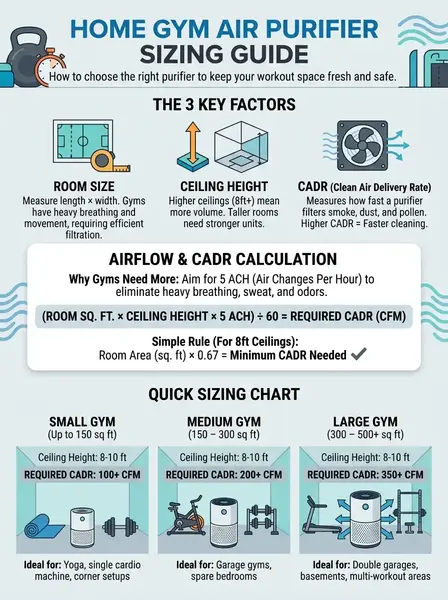
3. Use CADR to Size the Purifier
CADR stands for Clean Air Delivery Rate. It measures the volume of filtered air a purifier delivers, with separate ratings commonly provided for smoke, dust, and pollen.
A higher CADR generally means the purifier can clean a larger space or deliver more filtered air in the same space.
The EPA provides the following approximate sizing guide for rooms with standard 8-foot ceilings:
| Room area | Suggested minimum CADR |
|---|---|
| 100 sq. ft. | 65 CFM |
| 200 sq. ft. | 130 CFM |
| 300 sq. ft. | 195 CFM |
| 400 sq. ft. | 260 CFM |
| 500 sq. ft. | 325 CFM |
| 600 sq. ft. | 390 CFM |
These figures are estimates for particle removal, not a guarantee of performance under heavy chalk exposure. Higher ceilings increase the room’s air volume, and open-plan spaces may require a larger purifier or multiple units.
For a gym with frequent chalk use, selecting more capacity than the basic room-size minimum can give you greater flexibility to operate the unit at a quieter setting.
4. Understand CFM and Air Changes per Hour
CFM means cubic feet per minute. It describes airflow volume, while CADR describes the delivery of cleaned air. A fan’s advertised airflow should not be treated as equivalent to its CADR.
Air changes per hour (ACH) estimates how many room-volumes of air a device can process in an hour. The calculation depends on room volume and the purifier’s effective clean-air delivery.
For example, a 300-square-foot gym with an 8-foot ceiling contains approximately 2,400 cubic feet of air. A purifier delivering 200 CFM of clean air would provide a theoretical rate of:
200 × 60 ÷ 2,400 = 5 air changes per hour.
Actual pollutant concentrations depend on how particles enter the room, how they’re distributed, and how the purifier operates. Treat this calculation as a sizing aid, not a guarantee that every particle is removed five times each hour.
5. Check Noise, Maintenance, and Running Costs
A purifier that is too noisy may end up switched off during workouts or sleep. Compare published noise ranges and check whether the machine maintains useful airflow on low or medium settings.
Also investigate:
- Pre-filter maintenance: Can you vacuum or wash it, and how often?
- Replacement filters: Are compatible replacements readily available?
- Filter life: Is the published estimate based on typical household use?
- Power use: How much electricity will continuous operation require?
- Controls: Does it have a timer, night mode, or automatic fan adjustment?
A washable pre-filter can make routine maintenance easier, but it does not mean the main HEPA or carbon filter is washable. Follow the manufacturer’s instructions for each component.
6. Avoid Ozone-Generating Air Cleaners
Avoid air cleaners that intentionally generate ozone for use in occupied workout spaces. Ozone irritates the respiratory system, and the EPA warns that ozone generators are not a safe substitute for effective air cleaning.
Check claims about ionizers, plasma systems, and other active air-cleaning technologies carefully. Prefer a clearly specified filtration system and review credible information about ozone emissions.
Best Air Purifiers for Fitness Enthusiasts and Heavy Lifters (#best-gym-air-purifiers)
The following products are candidates selected using their published specifications and practical fit for home gyms. These are editorial recommendations based on product information, not results from hands-on comparative testing.
1. Levoit Core 600S-P: Best Overall Candidate for Home Gyms
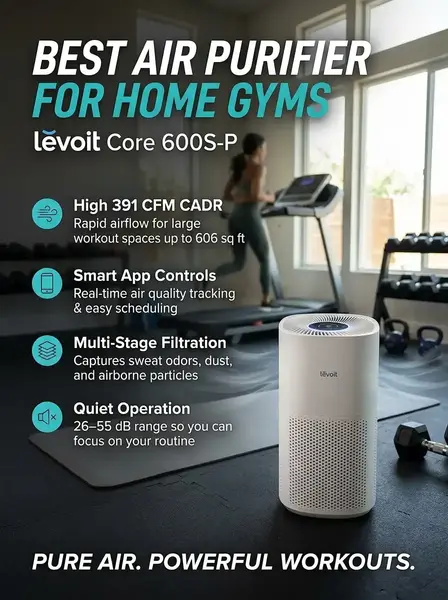
The Levoit Core 600S-P is a strong starting point for people who want substantial airflow, smart controls, and a relatively compact floor-standing unit.
The manufacturer’s published specifications list a CADR of 391 CFM, a noise range of 26–55 dB, and a recommended room size of 606 square feet at 4.8 air changes per hour. Its listed power consumption is 49 watts.
Why consider it
- High published CADR for larger home workout rooms.
- App controls and real-time air-quality information.
- Sleep mode and adjustable fan settings.
- A filter system designed for multiple stages of particle filtration.
Limitations
- Maximum fan speed can be noticeably louder than low-speed operation.
- Filter replacement costs should be included in the ownership budget.
- Verify the exact filter configuration for the model and market you’re purchasing.
Best for: A medium-to-large home gym where particle removal and smart controls matter.
Skip it if: You need a compact unit for a tiny workout corner or your primary concern is a very strong chemical odor requiring substantial gas-filter capacity.
2. Coway Airmega 400: Best Candidate for Large Gym Spaces
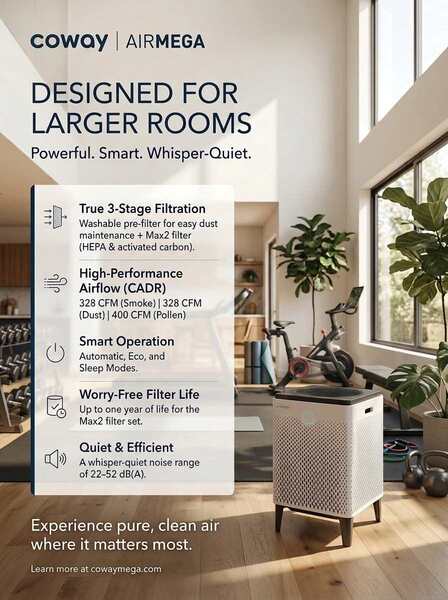
The Coway Airmega 400 is designed for larger rooms and includes a washable pre-filter alongside a Max2 filter combining HEPA filtration and activated carbon.
Coway lists CADR figures of 328 CFM for smoke, 328 CFM for dust, and 400 CFM for pollen. Its published noise range is 22–52 dB(A), and the manufacturer lists a filter-life estimate of up to one year for the Max2 filter set under its stated conditions.
Why consider it
- Washable pre-filter makes routine dust maintenance easier.
- Particle filtration and activated carbon in the main filter set.
- Automatic, eco, and sleep modes.
- Separate CADR figures make particle-performance comparisons easier.
Limitations
- Its larger footprint requires space away from equipment and walkways.
- The washable pre-filter still needs regular cleaning.
- Strong rubber or chemical odors may exceed the carbon filter’s capacity.
Best for: Larger home gyms where dust collection and routine pre-filter maintenance are priorities.
Skip it if: Your gym is small, your budget is tight, or you need a purifier that fits on a desk or shelf.
3. Blueair Blue Pure 211i Max: Best Candidate for High Airflow
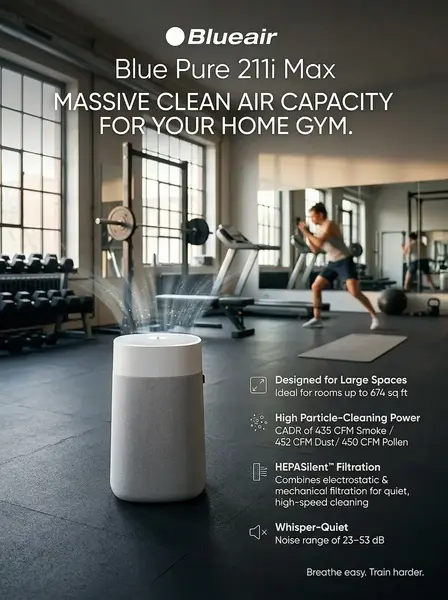
The Blueair Blue Pure 211i Max is worth comparing if your gym is relatively large and you want substantial particle-cleaning capacity.
Blueair’s current product listing gives CADR ratings of 435 CFM for smoke, 452 CFM for dust, and 450 CFM for pollen. The listed noise range is 23–53 dB, and the manufacturer recommends a room of approximately 674 square feet at its stated air-change rate.
Its HEPASilent filtration system combines mechanical and electrostatic filtration. It should therefore be described according to the manufacturer’s actual technology rather than automatically labeled a conventional True HEPA-only system.
Why consider it
- High published CADR ratings across smoke, dust, and pollen.
- Night mode and multiple fan-speed settings.
- A particle-plus-carbon filter design.
- Manufacturer specifications provide a clear basis for room-size comparisons.
Limitations
- Its larger size may be excessive for a small bedroom gym.
- Carbon-filter capacity should be checked if odor removal is the main objective.
- The filtration technology differs from a conventional HEPA-only design, which may matter to shoppers who specifically require True HEPA.
Best for: Larger workout rooms where high airflow is a priority.
Skip it if: You specifically require a conventional True HEPA filter or your main problem is heavy chemical off-gassing rather than airborne particles.
4. Winix 5500-2: Candidate for Smaller Workout Rooms
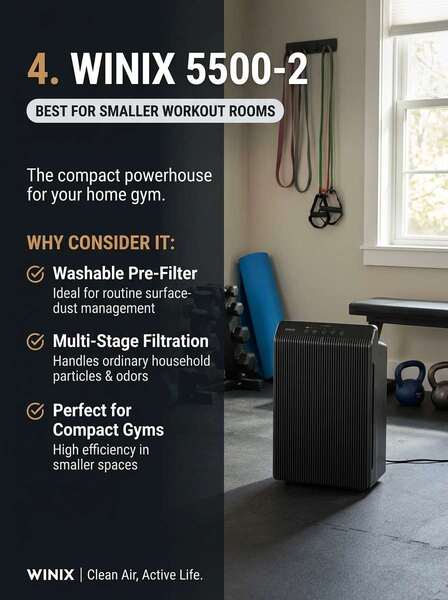
The Winix 5500-2 is worth investigating for a smaller home gym where a washable pre-filter and multi-stage filtration are appealing.
Before assigning it a final ranking, verify the current manufacturer’s specifications for CADR, room coverage, noise, replacement-filter availability, and the exact filtration configuration. Product listings and filter bundles can differ by retailer and region.
Why consider it
- A washable pre-filter can help with routine surface-dust management.
- Multiple filtration stages may suit ordinary household particles.
- It is a candidate to compare against larger, higher-CADR units for smaller rooms.
Limitations
- The published CADR should be checked before using it in a large or chalk-heavy gym.
- The amount of activated carbon matters for odor control.
- Confirm the current manual’s maintenance instructions and replacement-filter details.
Best for: A small workout room where its verified capacity meets the actual room requirements.
Skip it if: You have a large garage gym, generate substantial airborne chalk, or cannot confirm that the unit meets your CADR needs.
Which Air Purifier Should You Choose?
| Your main concern | Recommended starting point | What to prioritize |
|---|---|---|
| General home-gym dust | Levoit Core 600S-P | CADR, particle filtration, convenient controls |
| Large workout room and routine dust maintenance | Coway Airmega 400 | High airflow and washable pre-filter |
| High airflow in a larger room | Blueair Blue Pure 211i Max | CADR and acceptable filtration technology |
| Small bedroom gym | Compare compact alternatives, including the Winix 5500-2 if appropriately sized | Low-speed noise, CADR, footprint |
| Strong rubber or chemical odors | Choose based on verified carbon capacity and address the source | Ventilation and gas-specific filtration |
| Heavy chalk use | A high-CADR purifier with manageable pre-filter maintenance | Source control, cleaning, airflow |
A larger purifier is not automatically the best choice for every gym. The best fit depends on the room, the pollutants you need to control, the speed you can tolerate, and the maintenance you will actually perform.
Setup and Maintenance for Chalk-Heavy Gym Spaces (#gym-purifier-maintenance)
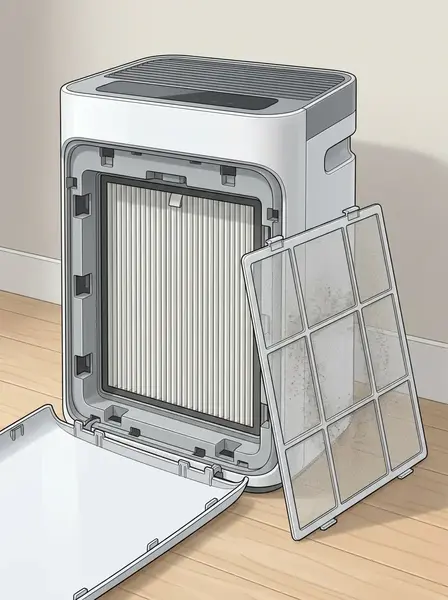
A good air purifier performs best when you place it where air can circulate freely, control dust at its source, and maintain the filters according to the manual.
Where Should You Place an Air Purifier in a Home Gym?
Start by positioning the purifier outside the lifting area, away from plates, dumbbells, resistance bands, and common walking routes. Leave the manufacturer’s recommended clearance around its air intake and outlet.
Your suggested placement of approximately 3–5 feet from a heavy lifting zone is a reasonable starting point, but it is not a universal technical rule. The ideal location depends on the unit’s intake design, room layout, and where airborne particles are generated.
Avoid placing the purifier directly beside a spot where chalk is repeatedly thrown into the air. A concentrated dust cloud can quickly load the pre-filter and spread particles across the room before the machine captures them.
Keep the intake unobstructed. If the unit has a top outlet, avoid placing it beneath shelves or other surfaces that block airflow.
Clean the Pre-Filter Regularly
A pre-filter catches larger particles before they reach the main filter. In a chalk-heavy gym, inspect it more frequently than you would in a lightly used bedroom.
Follow the manufacturer’s instructions for cleaning. Some pre-filters can be vacuumed or washed; others should only be cleaned using specified methods. Allow washable components to dry completely before reinstalling them.
Never wash a HEPA or carbon filter unless the manufacturer explicitly says it is washable. Moisture can damage certain filter materials and affect performance.
Reduce Chalk Before It Becomes Airborne
Use these habits to reduce the burden on your purifier:
- Store loose chalk in a sealed container.
- Apply only the amount you need for your grip.
- Consider liquid chalk where suitable for your training and equipment.
- Avoid clapping chalk-covered hands together.
- Wipe down racks, benches, and nearby surfaces regularly.
- Vacuum settled dust using a suitable vacuum rather than redistributing it with a dry brush.
Improve Ventilation and Control Moisture
Air purification works best alongside source control and ventilation. If outdoor air is clean enough, ventilating the room can help remove pollutants and odors that a particle filter cannot capture.
If your garage gym smells musty, inspect for moisture and mold. A portable purifier may capture some airborne mold particles, but it cannot repair a leak or resolve the underlying moisture problem.
For persistent rubber or chemical odors, check whether the flooring or other equipment needs additional airing out, whether the smell comes from a cleaning product, or whether the material itself may be releasing pollutants.
A Simple Gym Air-Cleaning Routine
| When | Action |
|---|---|
| Before training | Check that the intake is clear and the purifier is operating normally |
| During training | Use a speed that provides useful airflow without creating an unacceptable noise level |
| After training | Remove damp towels, wipe equipment, and clean up visible chalk |
| Weekly or as needed | Inspect and clean the pre-filter according to the manual |
| At the manufacturer’s interval | Replace the main filter and check the unit’s condition |
Key Takeaways (#gym-air-purifier-takeaways)
- Choose by CADR: Match the purifier’s clean-air delivery rate to the gym’s floor area, ceiling height, and particle load.
- Use suitable particle filtration: HEPA-equipped units can help reduce airborne dust and allergens, including some airborne chalk.
- Consider activated carbon: Carbon filtration can help with certain odors and gases, but its effectiveness depends on capacity and the pollutants involved.
- Control chalk at its source: Closed containers, careful application, and routine cleaning reduce the amount of dust entering the air.
- Balance airflow and noise: Bedroom gyms benefit from quiet settings, provided the purifier still supplies adequate clean air.
- Maintain the filters: Clean washable pre-filters as directed and replace main filters when required.
- Keep expectations realistic: Filtration can improve indoor air quality, but it does not guarantee better athletic performance, increased growth hormone, or faster muscle growth.
- Avoid ozone generators: Choose filtration and ventilation strategies that are appropriate for occupied spaces.
The best air purifier for a home gym is the one that suits your space, filters the pollutants you actually have, and can be maintained consistently. Start with room size and CADR, assess your need for carbon filtration, and combine the purifier with ventilation and good gym-cleaning habits.
Frequently Asked Questions
1. Can an air purifier remove lifting chalk dust?
Yes, a suitably sized air purifier with effective particle filtration can capture some airborne chalk. Results depend on CADR, filter design, room size, and how much dust is released. Source control remains important because a purifier may struggle to capture large chalk clouds immediately after they form.
2. Is a HEPA filter good for a garage gym?
A HEPA-equipped purifier can help reduce airborne particles in a garage gym, including dust and some allergens. Choose a unit with enough CADR for the room, allow for higher ceilings, and maintain the pre-filter frequently if you use lifting chalk. Ventilation and dust cleanup are still necessary.
3. Does an air purifier help with sweat and rubber-mat odors?
It may help if the purifier contains activated carbon capable of adsorbing the compounds responsible for the odors. Effectiveness depends on the carbon quantity, pollutant, and filter condition. Removing damp towels, drying equipment, ventilating the room, and addressing the source of chemical odors are also important.
4. Can an air purifier improve athletic performance?
An air purifier can improve indoor particle levels when appropriately selected and operated. People sensitive to airborne irritants may experience a more comfortable training environment. There is insufficient evidence to claim that a home air purifier directly increases strength, endurance, muscle growth, or athletic performance.
5. Should I run my air purifier while lifting weights?
Running it during workouts can help remove airborne particles as the air circulates. Use a fan speed that provides enough clean air for your space. If chalk is heavily airborne, reduce the amount released and clean the room rather than relying exclusively on the purifier.
6. Is a quiet air purifier better for a bedroom gym?
A quiet purifier can be more practical in a bedroom gym because it is easier to run during sleep. Compare the published noise range and CADR, and make sure the low-speed setting still provides adequate cleaning for your room. Quiet operation alone does not establish sufficient filtration capacity.
7. How often should I clean my gym air purifier’s pre-filter?
Inspect it frequently if your gym produces chalk dust, and clean it whenever required by the manufacturer’s instructions. The interval depends on how heavily the purifier is used and how much dust enters the room. Check the main filter separately and replace it at the recommended interval.
8. Are ozone air purifiers safe for home gyms?
Avoid air cleaners that intentionally generate ozone in occupied workout spaces. Ozone can irritate the airways, and the EPA states that ozone generators are not an effective general solution for indoor air pollution at concentrations that meet public-health standards.