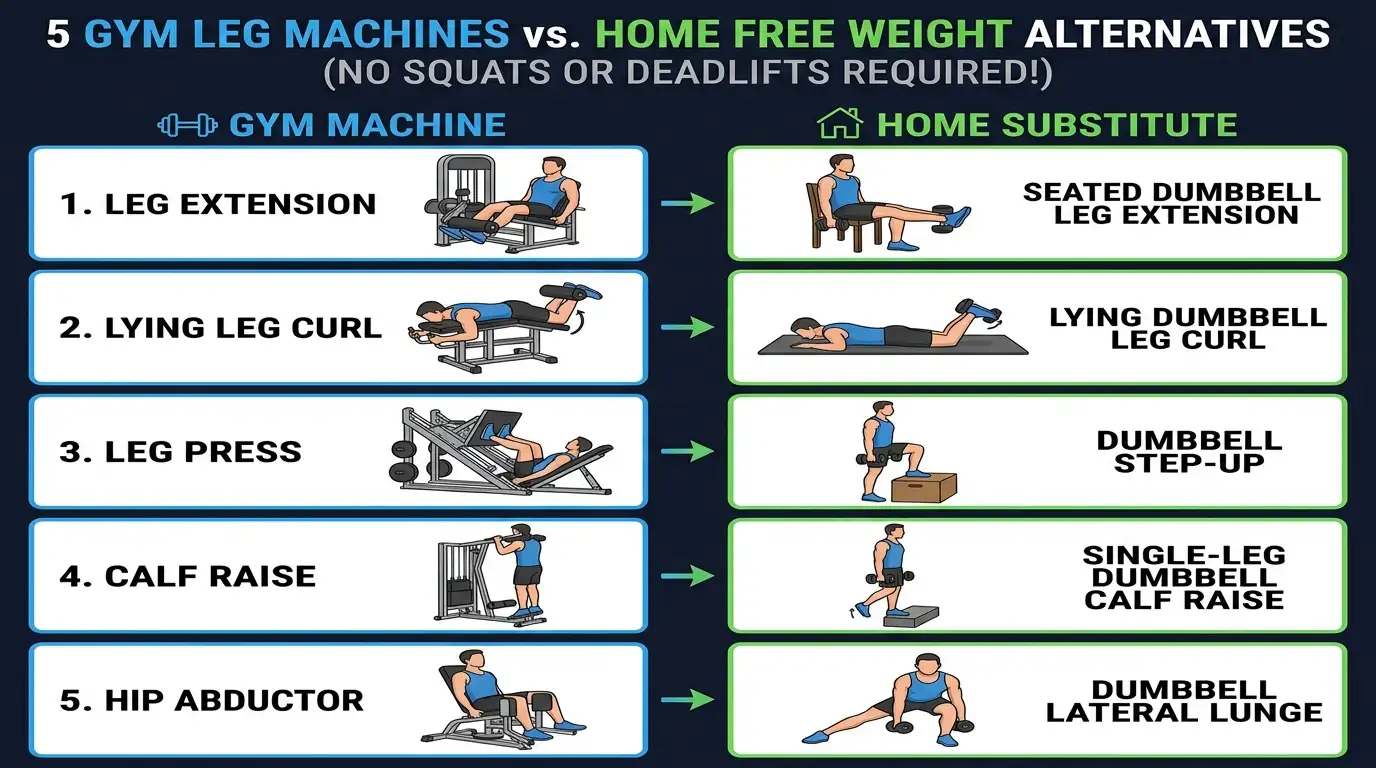

Building stronger legs at home doesn’t require a commercial gym, expensive machines, or a workout built around heavy squats and deadlifts. With the right free-weight exercises, positioning, and equipment adjustments, we can target the quadriceps, hamstrings, glutes, and calves with movements that closely replicate the function of popular leg machines.
Traditional leg workouts often rely heavily on compound exercises. Squats, lunges, and deadlifts are effective, but they aren’t ideal for everyone. Some lifters prefer to avoid movements that place substantial demands on the lower back, while others want to isolate individual muscles, train around limited mobility, or build a more balanced home workout routine.
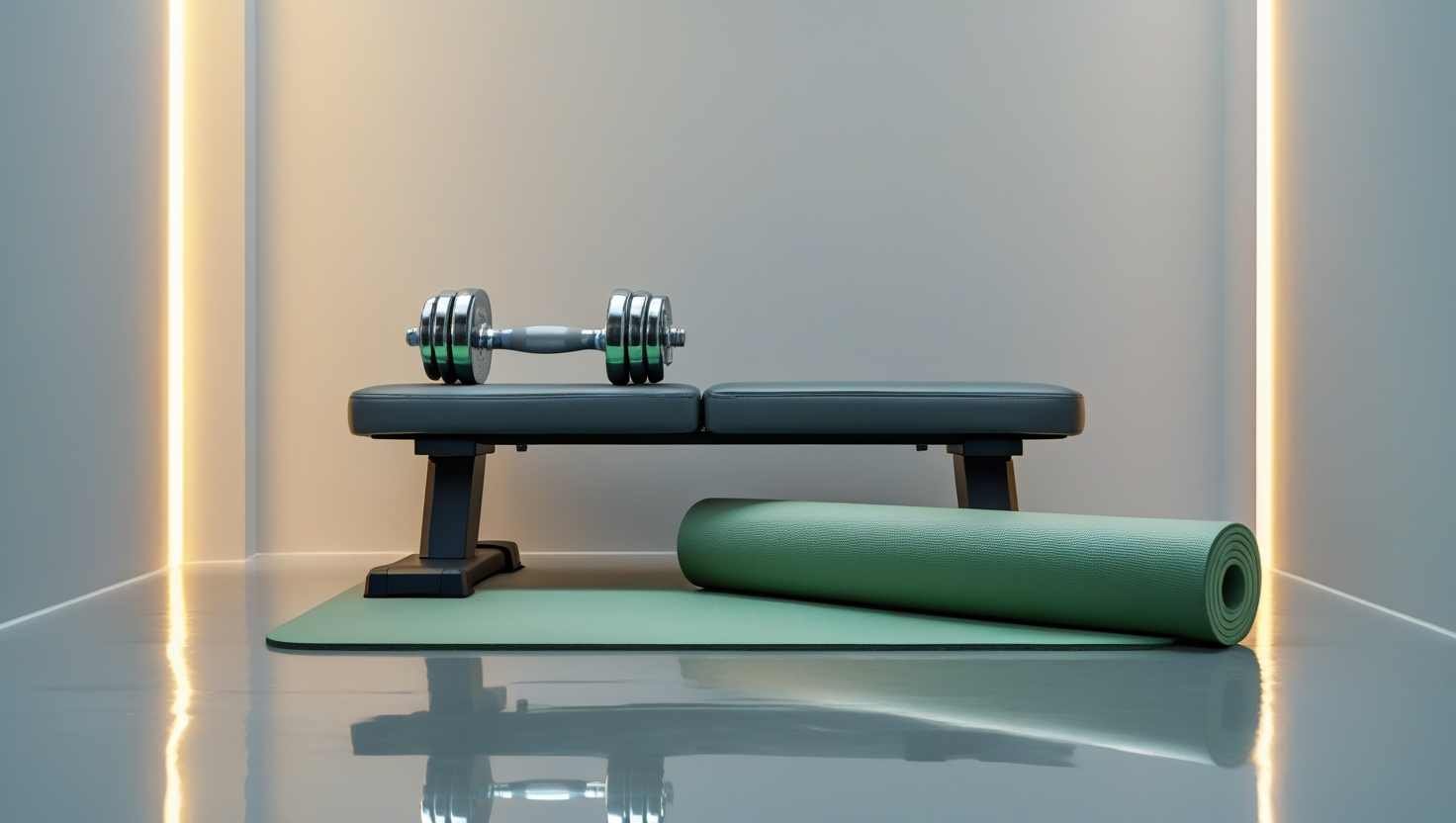
Fortunately, a pair of dumbbells, a sturdy bench, a few weight plates, and optional ankle attachments can provide surprisingly versatile alternatives to machine-based training.
In this guide, we explore five gym leg machine alternatives using free weights, focusing on muscle targeting, setup, movement mechanics, and practical ways to train at home without relying on traditional squats or deadlifts.
Table of Contents
Why Replicate Gym Leg Machines With Free Weights?
Leg machines provide a controlled movement path and allow us to focus on specific muscle groups without having to stabilize as much external weight. The leg extension isolates the quadriceps, the leg curl targets the hamstrings, and the leg press allows us to train the lower body through a controlled pressing motion.
However, these machines take up considerable space and can be expensive. For home lifters, recreating their functions with dumbbells and simple accessories can be a more practical solution.
Free weights also give us flexibility. We can adjust our range of motion, change our body position, work one leg at a time, and select resistance according to our current strength and comfort level.
The goal isn’t to reproduce the exact mechanics of a commercial machine. Instead, we want to replicate its primary training function by choosing exercises that emphasize the same muscles and provide a similar resistance challenge.
This approach is particularly useful when:
- We want to train our legs without a full home gym.
- We prefer isolation exercises over heavy compound lifts.
- We need alternatives to conventional squats and deadlifts.
- We want to reduce unnecessary loading through the lower back.
- We need to train specific muscles rather than perform another full-body movement.
A properly designed free-weight routine can provide meaningful lower-body stimulus without requiring bulky equipment.
1. Dumbbell Lying Leg Curl: Replace the Hamstring Curl Machine
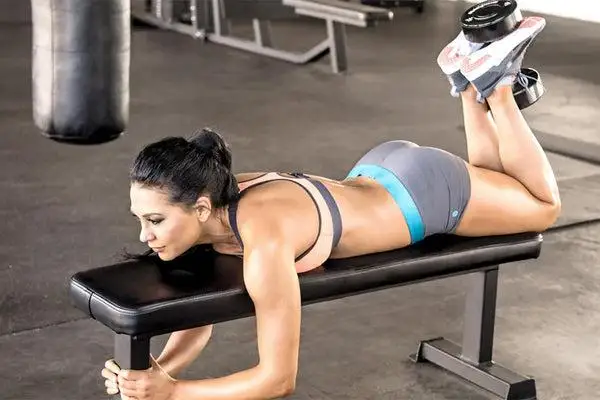
The lying leg curl machine is designed to isolate the hamstrings by bending the knees against resistance. We can recreate this function at home using a dumbbell, a flat bench, or an ankle-weight attachment.
How to Perform a Dumbbell Lying Leg Curl
- Lie face down on a flat bench, keeping your hips supported and your legs extended.
- Secure a light dumbbell between your feet, holding it firmly with the insides of your shoes or ankles.
- Bend your knees slowly, bringing your heels toward your glutes.
- Pause briefly when the hamstrings are fully contracted.
- Lower the dumbbell under control until your legs are nearly straight.
- Repeat without swinging the legs or lifting your hips off the bench.
We should begin with a light dumbbell to ensure we can secure it safely. The weight should remain stable throughout the movement, and we should stop immediately if we cannot hold it securely between our feet.
Muscles Targeted
- Hamstrings: The primary muscles responsible for knee flexion.
- Gastrocnemius: Assists in knee flexion, particularly when the ankle position allows it.
- Glutes: Help stabilize the hips against the bench.
Best Equipment Alternatives
If holding a dumbbell between the feet feels uncomfortable or unsafe, we can use ankle weights, resistance bands, or a dedicated ankle strap attachment. These accessories are especially useful when training with lighter loads or performing higher repetitions.
The movement closely replicates the function of a lying leg curl machine because resistance is applied while we bend the knee, allowing us to focus on hamstring contraction without performing a deadlift.
Recommended sets and repetitions: 3 sets of 10–15 repetitions.
2. Seated Dumbbell or Ankle-Weighted Leg Extension: Replace the Leg Extension Machine
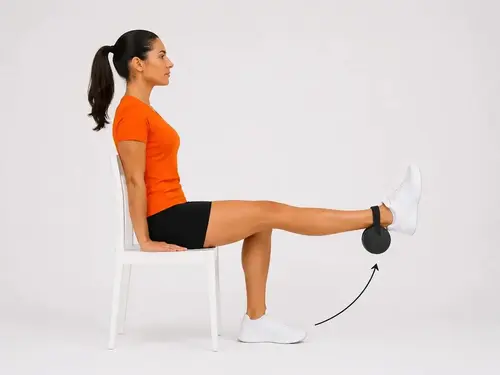
The leg extension machine isolates the quadriceps by allowing us to straighten the knee against resistance. For home workouts, a chair, bench, ankle weights, or a resistance band can reproduce the essential movement pattern.
This exercise is particularly useful when we want to train the front of the thighs without relying on squats, step-ups, or heavy lower-body compound exercises.
How to Perform a Seated Leg Extension at Home
- Sit upright on a stable chair or bench with our back supported if possible.
- Keep both feet on the floor and position the knees comfortably.
- Attach an ankle weight or resistance band around the lower leg.
- Slowly straighten one knee until the leg approaches a comfortable extended position.
- Squeeze the quadriceps at the top without forcefully locking the knee.
- Lower the leg slowly and repeat before switching sides.
The movement should remain controlled. We should avoid swinging the lower leg or using momentum to lift the resistance.
Can We Use a Dumbbell for Leg Extensions?
A dumbbell isn’t always practical for seated leg extensions because securing it between the feet can be unstable. Instead, ankle weights or resistance bands are generally better choices for this movement.
If we want to use free weights exclusively, a lighter dumbbell can be secured only when the setup is stable and safe. However, ankle-weight resistance is a more practical solution for replicating the leg extension function.
Muscles Targeted
- Quadriceps: Rectus femoris, vastus lateralis, vastus medialis, and vastus intermedius.
- Vastus medialis: Contributes to knee extension and is often emphasized during controlled terminal extension.
- Rectus femoris: Works across both the hip and knee joints.
Unlike leg press machines, this exercise allows us to concentrate on knee extension without requiring substantial external loading through the torso.
Recommended sets and repetitions: 3 sets of 12–20 repetitions per leg.
3. Wall-Supported Dumbbell Sissy Squat: Replace the Leg Press and Hack Squat
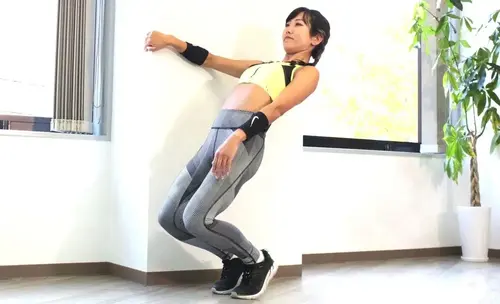
The leg press and hack squat machines are popular because they allow us to emphasize the quadriceps through considerable knee flexion while keeping the upper body supported.
Although we cannot perfectly reproduce either machine with dumbbells, wall-supported sissy squats offer a useful alternative for targeting the quadriceps without performing traditional squats or deadlifts.
The wall provides balance, while the movement allows the knees to travel forward and the torso to remain relatively upright. This position places a greater emphasis on the quadriceps compared with many hip-dominant lower-body movements.
How to Perform Wall-Supported Sissy Squats
- Stand beside a sturdy wall or use a secure support for balance.
- Position the feet approximately hip-width apart.
- Hold the wall lightly rather than pulling yourself forward.
- Keep the torso relatively upright while bending the knees.
- Allow the knees to travel forward gradually as the heels remain grounded if your mobility permits.
- Lower only as far as we can maintain balance and comfortable knee movement.
- Push through the feet and extend the knees to return to the starting position.
For beginners, bodyweight is usually sufficient. Once the movement becomes comfortable, we can increase repetitions, adjust the range of motion, or use a light dumbbell held close to the chest if balance and control remain solid.
How a Slant Board Improves the Movement
A slant board can help elevate the heels and make deeper knee flexion more accessible for people who have difficulty maintaining a comfortable ankle position.
It can also be useful for controlled quadriceps training and calf mobility work. We can explore additional variations in our guide to slant boards for squats and calf stretches.
However, we shouldn’t assume that a sissy squat is automatically easier on the knees or spine. The movement places significant demands on the knees, and the appropriate range depends on our strength, mobility, and tolerance.
Muscles Targeted
- Quadriceps: The primary muscle group driving knee extension.
- Vastus medialis and lateralis: Contribute to knee extension and control.
- Core muscles: Help stabilize the body during the movement.
This is a bodyweight-based alternative rather than a direct leg press replacement. We can make it more challenging through controlled tempo and repetitions instead of automatically adding heavy dumbbells.
Recommended sets and repetitions: 2–3 sets of 8–15 repetitions.
4. Dumbbell Hip Thrust: Replace the Glute Machine
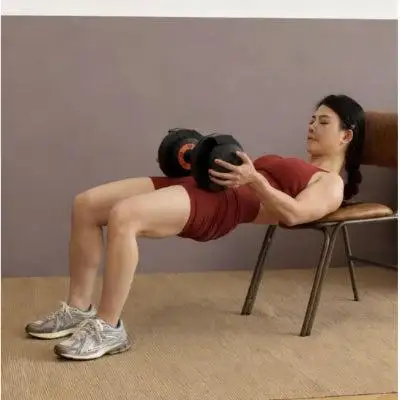
Many commercial gyms have dedicated glute machines designed to train hip extension without requiring a conventional deadlift. At home, we can reproduce this function with a dumbbell hip thrust or weighted glute bridge.
This exercise places the primary emphasis on the glute muscles while limiting the need to hold heavy weights in our hands throughout the movement.
How to Perform a Dumbbell Hip Thrust
- Sit on the floor with the upper back supported against a stable bench or sofa edge.
- Place a dumbbell horizontally across the hips, using a folded towel or pad for comfort.
- Bend the knees and position the feet firmly on the floor.
- Brace the core and keep the chin slightly tucked.
- Drive through the feet and raise the hips until the torso and thighs form a roughly straight line.
- Squeeze the glutes at the top without excessively arching the lower back.
- Lower the hips slowly until we reach the starting position.
If bench positioning is uncomfortable or unstable, we can perform a weighted glute bridge on the floor instead. The floor version reduces the range of motion but still provides an effective way to train hip extension.
Why Hip Thrusts Work Well for Home Training
Hip thrusts are particularly useful because resistance can be placed directly over the hips instead of being held in a position that demands considerable grip strength.
We can begin with bodyweight, add a single dumbbell, or use a heavier weight as our strength improves. The exercise can also be performed with a resistance band around the thighs to introduce additional hip-abduction resistance.
For a more specialized setup, we can explore compact hip thrust benches, which can make positioning more comfortable in a dedicated home gym.
Muscles Targeted
- Gluteus maximus: Primary muscle responsible for hip extension.
- Hamstrings: Assist with hip extension.
- Adductors: Help stabilize the lower body.
- Core: Maintains trunk stability during the movement.
Recommended sets and repetitions: 3 sets of 10–15 repetitions.
5. Single-Leg Elevated Calf Raise: Replace the Standing Calf Raise Machine
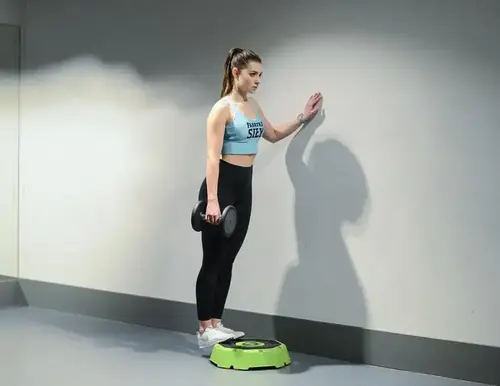
The standing calf raise machine allows us to train the calf muscles through a controlled range of motion while adding resistance. At home, a step, a sturdy platform, and a dumbbell are enough to create a similar training stimulus.
Single-leg calf raises are especially useful because they allow us to challenge each calf independently without needing a heavy machine stack.
How to Perform a Single-Leg Calf Raise
- Stand on a stable step or raised platform with the ball of one foot supported.
- Hold a wall, railing, or stable support for balance.
- Keep the knee straight but not forcefully locked.
- Lower the heel slowly below the platform level if the available range is comfortable.
- Press through the ball of the foot and raise the heel as high as possible.
- Pause briefly at the top and lower under control.
- Complete the repetitions before switching legs.
If we want additional resistance, we can hold a dumbbell on the opposite or same side as the working leg, depending on which position allows better balance and control.
The most important element is maintaining a full, controlled range of motion rather than bouncing through repetitions.
Muscles Targeted
- Gastrocnemius: Emphasized when performing calf raises with the knee relatively straight.
- Soleus: Also contributes to plantar flexion and is active throughout the movement.
- Foot and ankle stabilizers: Help maintain balance and control.
Single-leg variations increase the challenge without requiring extremely heavy loads. This makes them practical for home gyms where dumbbells may have limited weight increments.
Recommended sets and repetitions: 3–4 sets of 12–20 repetitions per leg.
How to Build a Machine-Free Leg Workout at Home
We don’t need to perform every exercise in the same workout to train the entire lower body. The five alternatives can be organized into a balanced routine that prioritizes muscle isolation, manageable resistance, and controlled movement.
| Exercise | Target Muscle | Sets | Reps |
|---|---|---|---|
| Dumbbell lying leg curl | Hamstrings | 3 | 10–15 |
| Seated leg extension | Quadriceps | 3 | 12–20 |
| Wall-supported sissy squat | Quadriceps | 2–3 | 8–15 |
| Dumbbell hip thrust | Glutes | 3 | 10–15 |
| Single-leg calf raise | Calves | 3 | 12–20 |
We can rest approximately 60–120 seconds between sets, depending on the exercise, resistance, and how quickly we recover.
For beginners, starting with two sets per exercise may be more appropriate. Once we can complete every repetition with good technique and without discomfort, we can gradually increase the repetitions or resistance.
The routine can be performed once or twice weekly, depending on our overall training schedule, recovery, and experience.
What Equipment Do We Need to Replicate Leg Machines at Home?
One advantage of machine-free lower-body training is that we don’t need to invest in a large collection of equipment.
| Equipment | Purpose | Priority |
|---|---|---|
| Adjustable dumbbells | Hip thrusts and weighted calf raises | High |
| Flat exercise bench | Lying leg curls and hip thrust positioning | High |
| Ankle weights | Seated leg extensions | High |
| Resistance bands | Knee extensions and additional leg resistance | Optional |
| Slant board | Heel elevation and mobility adjustments | Optional |
| Stable step or platform | Elevated calf raises | High |
Adjustable dumbbells are particularly useful because they let us modify resistance without buying multiple pairs of weights. An exercise bench also increases our training options, allowing us to perform supported movements instead of relying exclusively on floor exercises.
For beginners, the most useful approach is to purchase equipment gradually. We can start with a pair of dumbbells, a stable bench, and ankle weights before adding specialized accessories.
Can We Build Strong Legs Without Squats or Deadlifts?
Yes. Squats and deadlifts are valuable exercises, but they aren’t the only ways to develop lower-body strength and muscle.
By combining knee extension, knee flexion, hip extension, and plantar flexion, we can train the major leg muscles using different movement patterns. These exercises provide a practical way to focus on the quadriceps, hamstrings, glutes, and calves without building our entire workout around traditional compound lifts.
However, no collection of free-weight alternatives perfectly reproduces every function of a commercial leg machine. The leg press, hack squat, leg extension, and leg curl have different resistance curves, movement paths, and stabilization requirements.
Our objective is to select exercises that provide the training stimulus we need with equipment we can use safely and consistently.
How to Progress With Free-Weight Leg Machine Alternatives
To keep making progress, we need a simple progression strategy rather than constantly changing exercises.
- Increase repetitions first: If we can complete 10 repetitions comfortably, work toward 12–15 before increasing resistance.
- Add weight gradually: Use small increments when the exercise becomes too easy.
- Slow down the lowering phase: Controlled eccentric repetitions increase the challenge without requiring heavier dumbbells.
- Improve range of motion: Gradually increase movement depth only when it remains comfortable and controlled.
- Train each side independently: Single-leg exercises can help us identify strength differences and develop balanced control.
- Track our workouts: Record repetitions, resistance, and how each exercise feels to make progress easier to measure.
Consistency matters more than equipment complexity. A modest home setup can support meaningful progress when we apply progressive overload and give the muscles adequate recovery.
Final Thoughts: Machine-Free Leg Training for a Practical Home Gym
Replicating gym leg machines at home doesn’t require complicated equipment or risky exercise hacks. We can train the hamstrings with dumbbell leg curls, isolate the quadriceps with seated leg extensions, use wall-supported knee-dominant movements for quad development, build stronger glutes with hip thrusts, and develop our calves with elevated single-leg raises.
These exercises provide a practical solution for lifters who want to train their lower body without relying on traditional squats or deadlifts.
By combining a few dumbbells, a bench, ankle weights, and a stable platform, we can create a versatile home leg workout that emphasizes targeted muscle training, controlled resistance, and efficient use of space.
The best machine-free routine is one we can perform safely, progressively, and consistently with the equipment we already have.